SDR Interview Questions: Master Remote Sales Roles
Master sdr interview questions with proven frameworks for remote sales roles. Get exact questions hiring managers ask, role-play prep tips, and the 30-60-90...
October 23, 2026 • 27 min read

SDR interview questions assess prospecting skills, rejection handling, and remote work capabilities for sales development roles. The most effective include questions about cold outreach experience, CRM proficiency, time management in distributed teams, and qualification methodologies like BANT or MEDDIC for identifying qualified leads remotely.
Remote SDR positions represent one of the fastest-growing segments in distributed work, with companies hiring sales development representatives across time zones to build pipeline 24/7. Understanding the specific sdr interview questions hiring managers ask for remote roles gives you a competitive advantage in landing these high-earning positions that often lead to account executive promotions within 12-18 months.
This comprehensive guide covers the exact questions remote employers ask, what they're evaluating, and how to craft responses that demonstrate you can prospect, qualify, and convert leads without in-office supervision. You'll learn how remote SDR interviews differ from traditional sales interviews, the technical assessments you'll face, and the proven frameworks that get offers.
Whether you're transitioning from another field or moving from in-office to remote sales, these insights come from analyzing actual interview processes at companies actively hiring on remoteonly.io—where 7,000+ verified remote positions are re-validated daily against employer ATS systems.
Key Takeaways
- Remote SDR interviews emphasize self-management, async communication skills, and home office setup beyond traditional sales competencies
- Expect role-play scenarios testing cold calling, email sequencing, and objection handling specific to distributed team environments
- Technical proficiency questions cover CRM platforms (Salesforce, HubSpot), sales engagement tools (Outreach, SalesLoft), and video conferencing etiquette
- The 30-60-90 day plan question appears in 73% of SDR final interviews and tests strategic thinking for remote ramp-up
- Behavioral questions focus on rejection resilience, quota attainment, and examples of working independently without direct supervision
Understanding SDR Interview Questions for Remote Roles
Remote SDR interviews differ fundamentally from traditional sales interviews because hiring managers must evaluate your ability to perform in isolation. Companies hiring remote SDRs prioritize candidates who demonstrate proactive communication, structured daily routines, and comfort with technology stacks since managers can't observe your work habits directly.
The interview process typically includes 4-5 stages: initial recruiter screen (30 minutes), hiring manager interview (45-60 minutes), role-play assessment (30-45 minutes), panel interview with sales leadership (60 minutes), and final culture fit conversation. Each stage tests different competencies relevant to remote sales development.
Core Competencies Remote Employers Evaluate
Remote SDR positions require mastery across five domains that interviewers assess through targeted questions:
- Prospecting methodology: Your approach to identifying, researching, and reaching ideal customer profiles across industries and company sizes
- Communication clarity: Ability to convey value propositions concisely via phone, email, LinkedIn, and video without in-person rapport building
- Technical proficiency: Comfort navigating CRM systems, sales engagement platforms, data enrichment tools, and video conferencing software
- Self-management: Demonstrated ability to structure days, maintain activity metrics, and stay motivated without office environment energy
- Coachability: Openness to feedback delivered asynchronously through recorded call reviews, email critiques, and Slack coaching
How Remote SDR Questions Differ from Traditional Sales Interviews
Traditional in-office SDR interviews focus heavily on personality fit and energy level observable in person. Remote interviews shift emphasis to tangible proof of self-direction and results. Expect questions about your home office setup, internet reliability, preferred communication tools, and examples of previous remote work success.
Remote employers also probe deeper into your daily routine structure. They want to know how you'll maintain 50-100 daily activities (calls, emails, social touches) without the ambient pressure of a bullpen environment where colleagues' activity creates momentum.
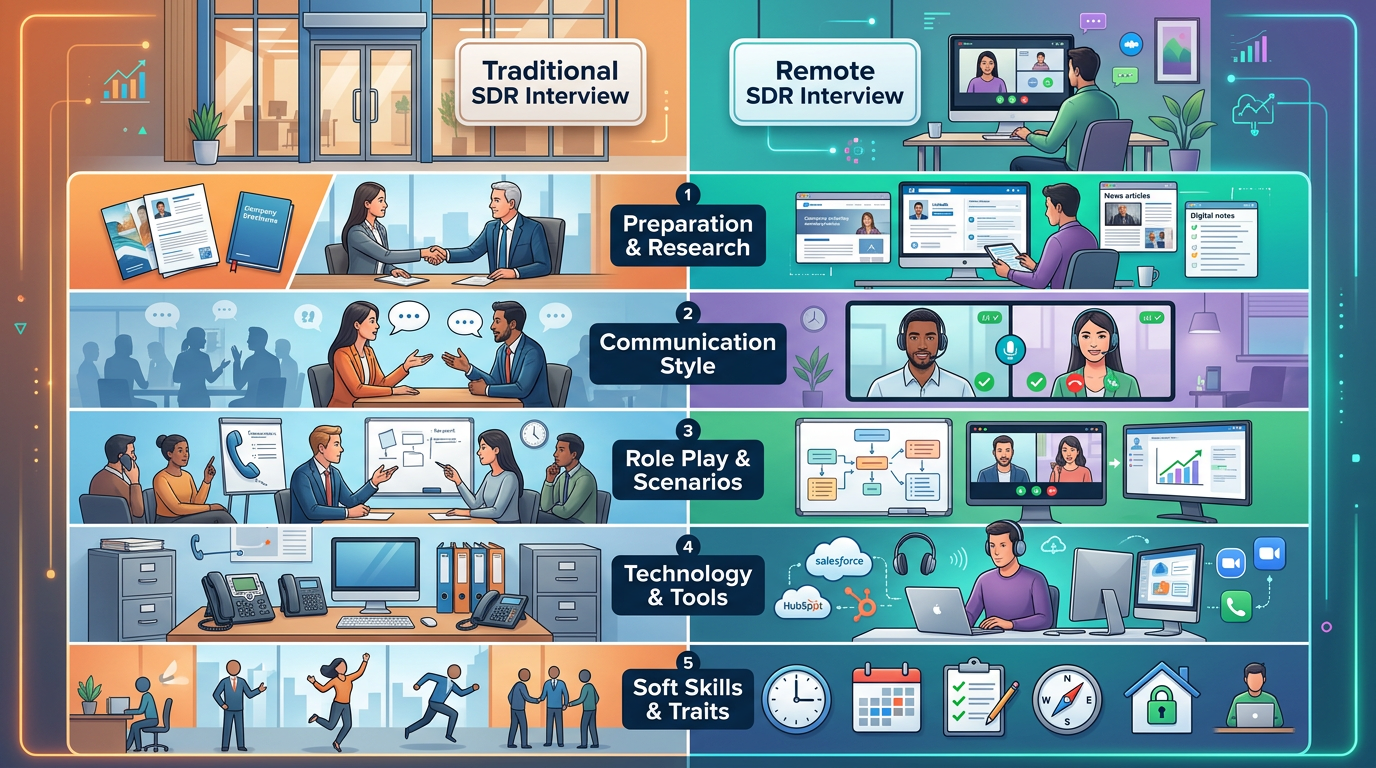
Infographic comparing traditional vs remote SDR interview focus areas, showing five key difference categories with icons for in-office energy vs structured independence
Essential SDR Interview Questions About Sales Experience
Experience-based questions form the foundation of most SDR interviews. Hiring managers use these questions to verify you understand the SDR role's daily reality: high-volume outreach, frequent rejection, and pipeline generation pressure rather than closing deals.
Background and Motivation Questions
These opening questions assess your understanding of sales development and commitment to the career path:
- "Walk me through your background and why you're interested in SDR work." Connect your previous experience to skills relevant for prospecting—customer service builds empathy, retail develops resilience, teaching requires clear communication. Mention specific attraction to pipeline building versus closing.
- "Why do you want to work in sales, specifically as an SDR?" Demonstrate understanding that SDRs focus on qualification and appointment setting, not closing. Reference career progression paths from SDR to AE to leadership.
- "What do you know about our company and our ideal customer profile?" Research their target market, recent funding, product positioning, and competitive landscape. Reference their actual job listings from platforms like remoteonly.io to show preparation.
- "Why are you interested in remote sales development specifically?" Discuss benefits like geographic flexibility and elimination of commute time while acknowledging challenges like self-motivation requirements and async communication needs.
Prospecting and Outreach Methodology
These questions evaluate your tactical approach to the core SDR function—filling the pipeline with qualified meetings:
- "Describe your prospecting process from identifying a target account to booking a meeting." Outline a structured approach: account selection criteria, stakeholder mapping, research (LinkedIn, company website, news), multi-channel sequencing (email, phone, social), and persistence cadence.
- "How do you prioritize your daily prospecting activities?" Discuss time-blocking strategies—morning for high-value calls when decision-makers are available, afternoon for research and email composition, consistent daily activity targets across channels.
- "What's your approach to cold calling versus email outreach?" Demonstrate understanding that effective SDRs use multi-channel sequences: initial research, personalized email, phone follow-up, LinkedIn connection, value-add touchpoints across 8-12 attempts over 3-4 weeks.
- "Walk me through how you would research a prospect before reaching out." Detail specific sources: LinkedIn profile and activity, company website for initiatives, recent funding announcements, job postings indicating growth areas, tech stack from tools like BuiltWith, mutual connections for warm introductions.
Handling Rejection and Objections
Rejection resilience separates successful SDRs from those who burn out. Every interviewer will probe this area:
"How do you handle rejection in sales?" Frame rejection as data collection rather than personal failure. Discuss tracking objection patterns to refine messaging, maintaining activity volume to ensure statistical success, and separating self-worth from daily outcomes. Mention specific techniques like the 10-minute reset rule after difficult calls.
"Tell me about a time you faced significant rejection. How did you respond?" Use the STAR method (Situation, Task, Action, Result) with a specific example. Best responses show you analyzed what wasn't working, sought coaching, adjusted your approach, and ultimately succeeded through persistence and adaptation.
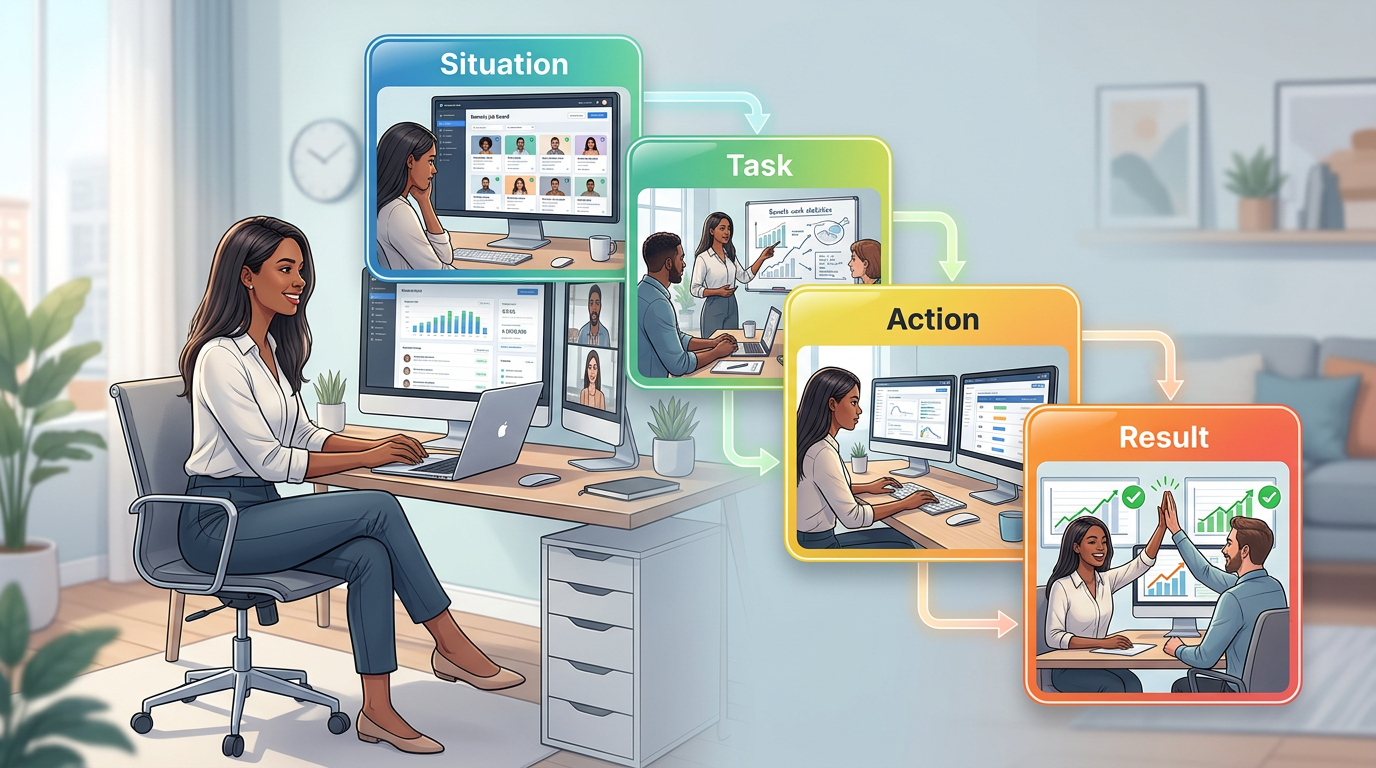
Visual representation of the STAR method framework for behavioral interview questions, showing four connected boxes with example SDR scenario
Technical and Tool-Specific SDR Interview Questions
Remote SDRs must navigate technology stacks independently without IT support nearby. Interviewers assess your comfort with sales tools, CRM hygiene practices, and troubleshooting capabilities since technical difficulties can't be solved by walking to a colleague's desk.
CRM and Sales Platform Experience
Questions in this category verify you can maintain accurate pipeline data and use tools efficiently:
- "What CRM systems have you used, and how do you maintain data quality?" Discuss experience with Salesforce, HubSpot, or other platforms. Emphasize daily logging habits, custom field completion, activity tracking, and understanding that CRM data drives forecasting and commission calculations.
- "Which sales engagement platforms are you familiar with?" Mention tools like Outreach, SalesLoft, Apollo, or similar sequence automation platforms. Describe how you've used them for cadence management, email template A/B testing, and activity reporting.
- "How do you use LinkedIn for prospecting?" Detail Sales Navigator features (lead lists, saved searches, InMail), engagement strategies (commenting on posts, connection request personalization), and integration with your overall outreach sequence.
- "Describe your experience with video prospecting or asynchronous video messages." Discuss tools like Vidyard or Loom for personalized video outreach, when video adds value versus text communication, and how you've used video to stand out in crowded inboxes.
Remote Work Technology Requirements
These questions specifically address distributed team challenges:
"Describe your home office setup and internet reliability." Detail your dedicated workspace, internet speed (minimum 25 Mbps for video calls), backup connectivity plan (mobile hotspot), noise-canceling headset, and professional video background. This question assesses whether you've invested in remote work infrastructure.
"What collaboration tools are you comfortable using for remote team communication?" List experience with Slack, Microsoft Teams, Zoom, Google Workspace, and async communication practices like clear written updates, appropriate channel usage, and video message etiquette for coaching feedback.
Behavioral SDR Interview Questions for Remote Success
Behavioral questions predict future performance based on past actions. Remote SDR behavioral questions focus on self-motivation, independent problem-solving, and results achieved without direct supervision since managers can't provide real-time coaching.
Self-Management and Motivation
These questions assess your ability to maintain productivity without office structure:
- "Describe a time you had to stay motivated during a challenging period with poor results." Use STAR format showing how you maintained activity levels despite low conversion, sought pattern insights from successful peers, adjusted messaging based on data, and ultimately recovered performance.
- "How do you structure your workday when working remotely?" Detail your morning routine, time-blocking strategy for different activity types, break schedule to avoid burnout, and end-of-day wrap-up process. Mention specific productivity techniques like Pomodoro intervals or activity batching.
- "Tell me about a time you identified and solved a problem independently." Describe situations where you noticed declining email open rates, researched best practices, tested new subject line approaches, and improved engagement metrics without waiting for management direction.
- "What metrics do you track to measure your own performance?" Discuss leading indicators (calls made, emails sent, connections requested) versus lagging indicators (meetings booked, opportunities created, pipeline value). Show you understand activity volume drives results.
Communication and Collaboration in Distributed Teams
Remote work requires exceptional written communication and proactive updates:
- "How do you ensure clear communication with team members you've never met in person?" Discuss over-communication practices, video-first for complex topics, written summaries after verbal conversations, appropriate response time expectations, and asking clarifying questions rather than making assumptions.
- "Describe a time you had a conflict with a colleague and how you resolved it remotely." Show emotional intelligence by describing how you requested a video call for nuanced discussion, assumed positive intent, focused on shared goals, and documented agreed-upon solutions.
- "How do you build relationships with account executives you'll be setting meetings for?" Detail strategies like regular sync meetings, sharing prospect research, requesting feedback on meeting quality, celebrating closed deals together, and understanding each AE's ideal customer profile preferences.
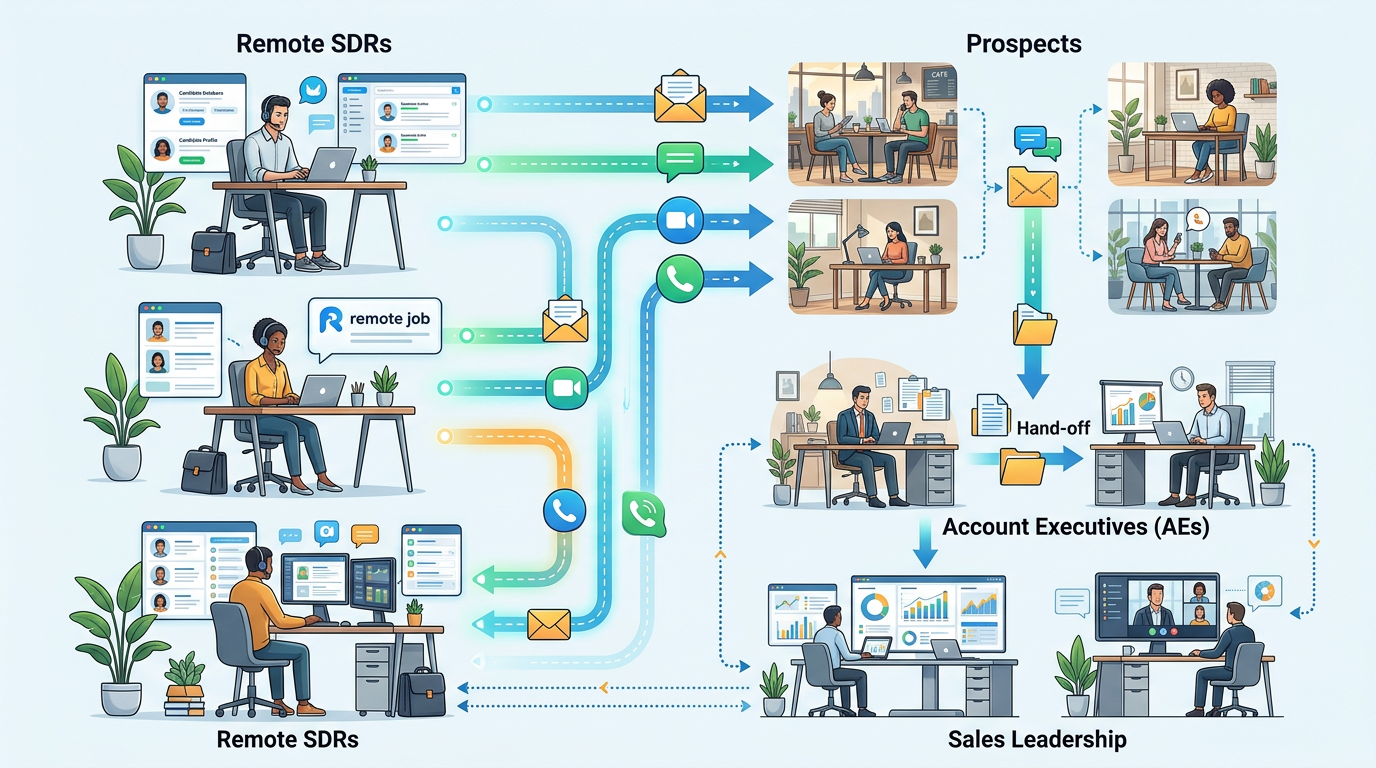
Diagram showing remote SDR communication flow between SDR, prospects, AEs, and sales leadership with different communication channels labeled
Role-Play and Assessment-Based SDR Interview Questions
Most SDR interviews include live assessments where you demonstrate skills in real-time. Role-play scenarios test your ability to think quickly, handle objections, and communicate value under pressure—critical skills for cold calling and live conversations with prospects.
Common Role-Play Scenarios
Expect these assessment formats during your interview process:
- Cold call simulation: The interviewer plays a prospect who answers your call. You must deliver an opening value proposition, handle initial resistance, ask qualifying questions, and attempt to book a meeting—all in 3-5 minutes.
- Email critique exercise: You're given a poorly written prospecting email and asked to rewrite it, explaining your changes. This tests your understanding of personalization, value proposition clarity, call-to-action strength, and brevity.
- Objection handling rapid-fire: The interviewer throws common objections at you in quick succession: "We're happy with our current solution," "Send me information," "I'm too busy," "Call me next quarter." You must respond to each professionally and persistently.
- Discovery question development: You're given a prospect scenario and asked to develop 5-7 qualifying questions you'd ask to determine if they're a good fit. This assesses your understanding of qualification frameworks like BANT (Budget, Authority, Need, Timeline) or MEDDIC (Metrics, Economic Buyer, Decision Criteria, Decision Process, Identify Pain, Champion).
How to Prepare for SDR Role-Play Assessments
Preparation dramatically improves role-play performance:
- Research the company's value proposition thoroughly. Understand their product, target customer, key differentiators, and typical pain points they solve. You'll need to articulate this clearly in 30 seconds or less.
- Practice common objection responses out loud. Write out and rehearse responses to the top 10 objections: no budget, no time, happy with current solution, send information, not interested, wrong person, call back later, already looked at your solution, too expensive, need to think about it.
- Prepare 8-10 discovery questions for their customer profile. Focus on questions that uncover pain points, budget implications, decision-making process, timeline urgency, and success metrics. Avoid yes/no questions.
- Record yourself doing mock cold calls. Listen for filler words (um, like, you know), speaking pace, energy level, and question clarity. Aim for confident, conversational tone rather than scripted or aggressive.
Strategic Thinking Questions: The 30-60-90 Day Plan
The 30-60-90 day plan question appears in most final-round SDR interviews. This question tests whether you understand the SDR ramp-up process, can set realistic goals, and think strategically about your first quarter rather than just showing up for daily activity.
What Interviewers Evaluate with This Question
When asking "What would your first 30, 60, and 90 days look like in this role?" hiring managers assess:
- Understanding of realistic ramp-up timelines (most SDRs aren't at full quota until month 3)
- Balance between learning/training and activity/results expectations
- Knowledge of what SDRs actually need to learn (product, ICP, tools, process)
- Goal-setting ability with specific, measurable milestones
- Proactive approach to relationship building with team members
Framework for Answering the 30-60-90 Question
Structure your response around learning, doing, and optimizing:
First 30 Days (Learning Foundation): Focus on absorbing product knowledge, understanding ideal customer profile deeply, mastering CRM and sales tools, shadowing successful SDRs on calls, and beginning low-volume outreach to practice messaging. Set activity goals at 50% of full quota—perhaps 20-25 daily activities and 2-3 meetings booked weekly.
Days 31-60 (Increasing Activity): Ramp to 75% of full activity quota, refine messaging based on early prospect feedback, develop your own cadences and templates, request regular coaching on recorded calls, and build relationships with account executives. Target 4-5 meetings booked weekly as you gain confidence and efficiency.
Days 61-90 (Full Performance): Reach 100% activity quota (typically 50-80 daily activities), consistently hit meeting booking targets (6-8+ weekly), identify which messaging and channels work best for your territory, contribute insights to team meetings about what's working, and begin mentoring newer SDRs if applicable.
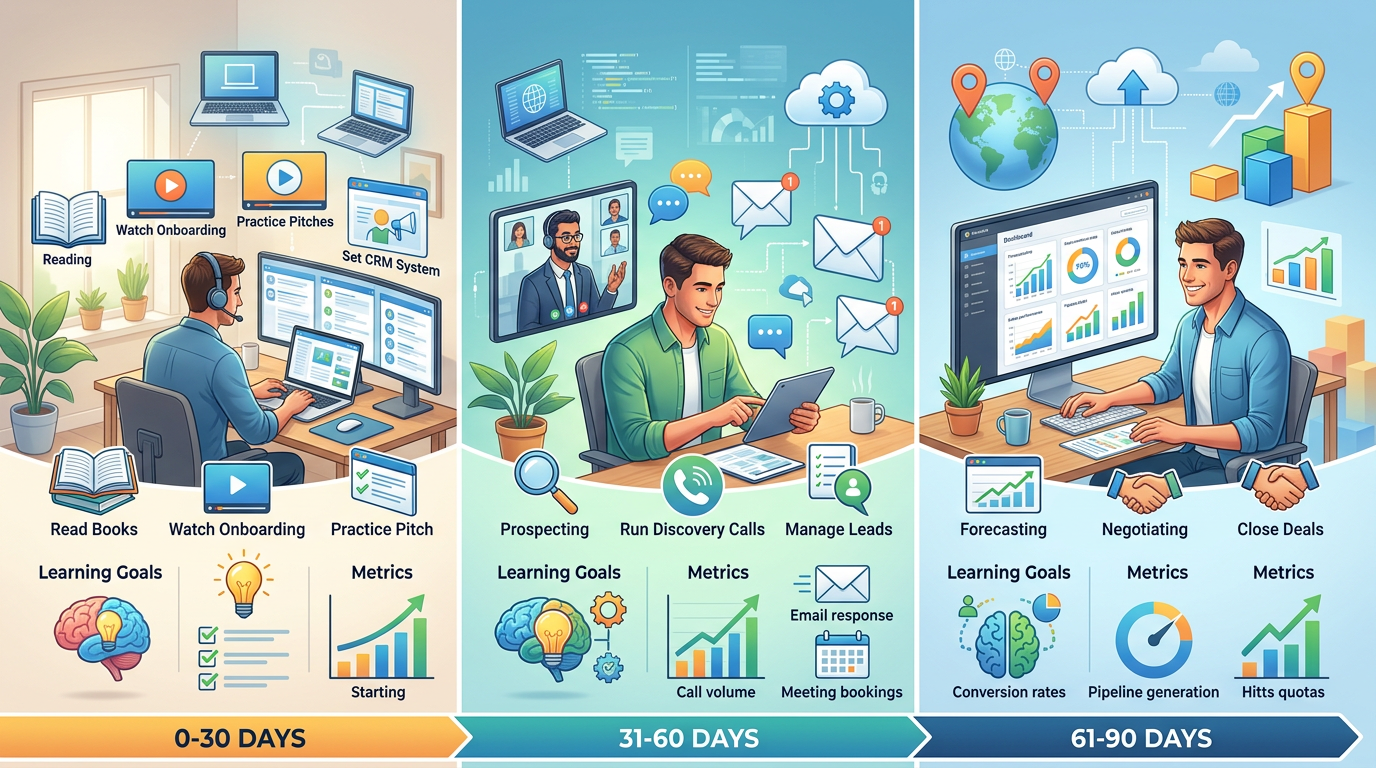
Timeline infographic showing 30-60-90 day SDR ramp plan with specific activities, learning goals, and metrics for each phase
Questions SDRs Should Ask Interviewers
Interviews are bidirectional evaluation opportunities. Asking informed questions demonstrates your seriousness about the role and helps you assess whether the remote SDR position aligns with your career goals and work style preferences.
Questions About Team Structure and Support
These questions reveal how the remote SDR team operates and what support you'll receive:
- "What does the SDR team structure look like, and how many SDRs support each account executive?" Understanding the SDR-to-AE ratio (typically 2:1 or 3:1) indicates how much pipeline pressure you'll face and how collaborative the handoff process is.
- "How do you onboard and train remote SDRs, and what does the first month look like?" Look for structured programs with clear milestones, assigned mentors, regular check-ins, and realistic ramp expectations rather than "figure it out yourself" approaches.
- "What does coaching look like for remote SDRs? How often do managers review calls and provide feedback?" Strong programs include weekly 1-on-1s, regular call reviews with specific feedback, and accessible managers for questions despite distributed locations.
- "How does the team communicate and collaborate remotely? What tools do you use?" Assess whether they have strong async communication norms, regular team meetings for connection, and appropriate tool stack for distributed work.
Questions About Metrics and Career Progression
These questions clarify expectations and growth opportunities:
- "What are the specific activity and results metrics SDRs are measured against?" Get clarity on daily activity expectations (calls, emails, social touches), weekly meeting booking quotas, monthly pipeline creation targets, and how performance reviews work.
- "What does the typical career path look like for successful SDRs here?" Look for clear promotion timelines (12-18 months is standard), examples of SDRs who've advanced to AE roles, and whether they promote from within versus external hiring.
- "What percentage of your SDRs hit quota consistently, and what separates top performers?" If fewer than 60-70% hit quota regularly, it may indicate unrealistic targets, poor lead quality, or inadequate training. Ask what top performers do differently.
- "How do you determine territory assignments and lead distribution for remote SDRs?" Understand whether you'll have defined accounts, geographic territories, or inbound lead rotation, and how equitable the distribution is.
Questions About Remote Work Culture and Expectations
These questions help you evaluate the remote work environment:
- "What are your expectations around working hours and availability for remote SDRs?" Clarify whether you need to work specific hours for live calls, have flexibility for time zone differences, and whether evening/weekend work is expected.
- "How do you build team culture and connection among remote SDRs?" Look for intentional culture-building efforts like virtual team events, Slack social channels, occasional in-person gatherings, or peer recognition programs.
- "What technology stipend or equipment do you provide for remote SDRs?" Many companies provide laptops, monitors, headsets, and monthly stipends for internet/phone. Understand what's provided versus what you'll need to supply.
Understanding the 5 C's of Interviewing for SDR Roles
The 5 C's framework—Competence, Character, Communication, Culture Fit, and Career Goals—provides a structure for both interviewers and candidates. Understanding this framework helps you prepare responses that address what hiring managers actually evaluate beyond just your answers to specific questions.
How the 5 C's Apply to Remote SDR Interviews
Competence: Your ability to perform SDR functions—prospecting, qualifying, booking meetings—demonstrated through experience examples, role-play performance, and understanding of sales methodologies. For remote roles, competence extends to technical proficiency with sales tools and self-management capabilities.
Character: Your integrity, work ethic, resilience, and coachability. Interviewers assess character through behavioral questions about handling rejection, ethical dilemmas (like misrepresenting product capabilities to book meetings), and how you've responded to critical feedback from managers.
Communication: Your ability to articulate ideas clearly, listen actively, and adapt communication style to different audiences. This is especially critical for remote SDRs who must communicate effectively via phone, email, video, and text without in-person interaction to build rapport.
Culture Fit: Alignment between your work style preferences and the company's values and operating norms. For remote teams, this includes comfort with async communication, proactive over-communication, and ability to build relationships virtually rather than needing in-person connection.
Career Goals: Whether the SDR role aligns with your professional trajectory and how long you plan to stay. Companies want SDRs who view the role as a career stepping stone (12-24 months) rather than a short-term stop (3-6 months) or permanent position (3+ years), as SDR skills are designed to develop AE capabilities.
Preparing Responses that Address All 5 C's
Structure your interview preparation to demonstrate strength across all five areas:
- Prepare 3-4 specific achievement examples showing competence in prospecting, persistence, and results
- Have a character story ready about an ethical challenge or how you handled difficult feedback
- Practice communication through mock calls and concise, structured answers to behavioral questions
- Research company culture through Glassdoor, LinkedIn employee posts, and company blog to demonstrate fit
- Articulate a clear 2-3 year career vision that includes SDR as a strategic foundation for AE promotion

Circular diagram showing the 5 C's of interviewing framework with remote SDR-specific examples for each category
Red Flags to Watch for in Remote SDR Interviews
While you're being evaluated, you should also assess whether the company offers a legitimate opportunity. Remote SDR roles can vary dramatically in quality, support, and career development potential—some are excellent launching pads while others lead to frustration and burnout.
Warning Signs of Problematic Remote SDR Roles
- Unrealistic quota expectations: If they expect 10+ meetings booked weekly from day one, or if fewer than 50% of SDRs hit quota regularly, targets may be unattainable regardless of skill level.
- Vague or nonexistent training program: Lack of structured onboarding, no assigned mentor, or expectations that you'll "figure it out" indicate insufficient investment in SDR success.
- High SDR turnover: If the entire team has been there less than 6 months, or they're hiring 5+ SDRs simultaneously for a small company, turnover is likely high due to poor management or unrealistic expectations.
- No clear path to promotion: If they can't cite examples of SDRs who've been promoted to AE, or if the timeline is vague ("eventually" or "when you're ready"), advancement opportunities may not exist.
- Compensation structure concerns: Base salary significantly below market ($40k-50k for US remote SDR roles), uncapped commission that's difficult to understand, or OTE (on-target earnings) that seems unrealistic compared to quota difficulty.
- Poor product-market fit indicators: If they struggle to articulate their ideal customer profile, have frequent product pivots, or can't explain clear differentiation from competitors, you'll struggle to book qualified meetings.
Questions to Uncover Potential Issues
Ask these probing questions to identify red flags:
- "What's the average tenure of SDRs on the team?" (Look for 12-18 months, not 3-6 months)
- "Can you share examples of SDRs who've been promoted to AE, and what their timeline looked like?" (Should have specific names and timelines)
- "What percentage of SDRs achieved quota last quarter?" (Should be 60-80%; lower indicates problems)
- "How do you ensure lead quality and territory equity for remote SDRs?" (Should have clear processes, not vague answers)
Final Preparation Tips for Remote SDR Interviews
Thorough preparation separates candidates who get offers from those who don't. Remote SDR interviews require demonstrating both sales skills and remote work capabilities, so your preparation should address both dimensions.
One Week Before Your Interview
- Deep-dive the company's business model: Understand their product, pricing, target customer segments, competitive positioning, recent news, and growth trajectory. Review their website, recent blog posts, LinkedIn company page, and Glassdoor reviews.
- Research your interviewers on LinkedIn: Understand their backgrounds, how long they've been with the company, their career paths, and any shared connections or experiences you can reference to build rapport.
- Prepare your STAR stories: Write out 5-6 specific achievement and challenge stories using the Situation-Task-Action-Result framework, covering rejection handling, independent problem-solving, collaboration, and quantifiable results.
- Practice role-play scenarios out loud: Record yourself doing mock cold calls, objection handling, and discovery questions. Listen critically for areas to improve in pacing, confidence, and clarity.
- Test your technology setup: Verify your internet speed, test video and audio quality on the interview platform (Zoom, Teams, Google Meet), ensure your background is professional, and have a backup plan if technology fails.
Day of Interview Best Practices
- Log in 5 minutes early to demonstrate punctuality and resolve any technical issues before start time
- Have your prepared questions, resume, and company research notes visible but not obstructing eye contact with camera
- Dress professionally from waist up at minimum (full professional attire helps mindset even if not visible)
- Position camera at eye level, ensure good lighting (facing window or ring light), and eliminate background noise
- Keep water nearby, silence all notifications, and close unnecessary browser tabs to avoid distractions
- Take brief notes during the conversation, especially when they describe role expectations or next steps
- Send a personalized thank-you email within 24 hours referencing specific conversation points and reiterating your interest
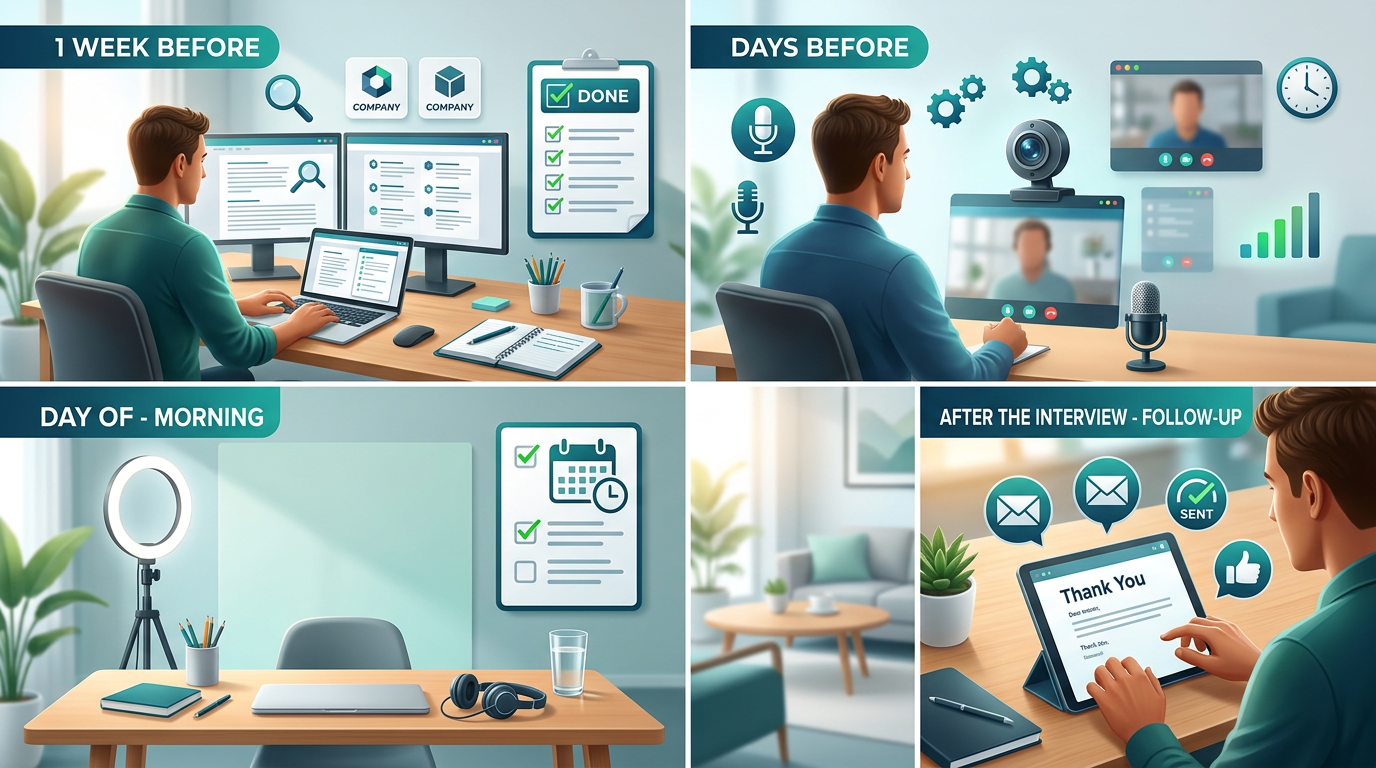
Checklist infographic showing remote interview preparation steps from one week before through day-of and follow-up actions
Frequently Asked Questions
How to prepare for a SDR interview?
Prepare by researching the company's product and ideal customer profile thoroughly, practicing cold call role-plays out loud, writing STAR-format stories about rejection handling and sales achievements, and developing 8-10 discovery questions for their target market. Test your home office technology setup and prepare thoughtful questions about team structure, quota expectations, and career progression paths.
What are some good questions to ask in an SDR interview?
Ask about SDR-to-AE ratios and team structure, onboarding and training programs for remote SDRs, specific activity and meeting booking quotas, what percentage of SDRs hit quota consistently, typical career progression timeline to account executive roles, and how the team builds culture remotely. These questions demonstrate strategic thinking while helping you evaluate the opportunity's quality.
What is the 30-60-90 rule in an interview?
The 30-60-90 rule asks candidates to outline their first three months in the role. For SDRs, structure your answer around learning foundation (days 1-30 at 50% activity quota), increasing activity (days 31-60 at 75% quota), and full performance (days 61-90 at 100% quota). Include specific metrics, learning goals, and relationship-building plans for each phase.
What are the 5 C's of interviewing?
The 5 C's are Competence (ability to perform SDR functions), Character (integrity and resilience), Communication (clarity across channels), Culture Fit (alignment with company values and remote work style), and Career Goals (whether the role fits your professional trajectory). Prepare responses and examples that demonstrate strength across all five areas to present as a complete candidate.
What metrics do remote SDRs typically need to achieve?
Remote SDRs typically target 50-80 daily activities (calls, emails, social touches), 6-10 qualified meetings booked weekly, and monthly pipeline creation of $50k-150k depending on average deal size. Leading indicators like activity volume and email response rates matter as much as lagging indicators like meetings booked, since consistent activity drives results over time.
How long does the remote SDR interview process typically take?
Remote SDR interview processes typically span 2-4 weeks with 4-5 stages: recruiter screen, hiring manager interview, role-play assessment, panel interview with sales leadership, and final culture fit conversation. Some companies condense this into 1-2 weeks for urgent hiring needs, while enterprise companies may extend to 6 weeks with additional stakeholder interviews.
What technology tools should I mention knowing for remote SDR roles?
Mention proficiency with CRM platforms like Salesforce or HubSpot, sales engagement tools like Outreach or SalesLoft, LinkedIn Sales Navigator for prospecting, video messaging tools like Vidyard or Loom, and collaboration platforms like Slack and Zoom. Even basic familiarity with these tools demonstrates remote work readiness and reduces training time required.
Conclusion
Mastering sdr interview questions requires understanding both traditional sales competencies and remote-specific capabilities that distributed teams demand. The questions covered in this guide—from prospecting methodology and rejection handling to the 30-60-90 day plan and the 5 C's framework—represent what hiring managers actually evaluate when selecting remote SDRs who can succeed independently.
Preparation separates candidates who receive offers from those who don't. Research the company thoroughly, practice role-play scenarios out loud, prepare STAR-format achievement stories, develop thoughtful questions about team structure and career progression, and test your technology setup before interviews. Remember that you're also evaluating whether the remote SDR role offers legitimate growth opportunities, realistic quotas, and strong support systems.
Remote SDR positions offer exceptional career launching pads for sales professionals, with clear paths to account executive roles within 12-18 months and geographic flexibility that traditional office roles can't match. With 7,000+ verified remote positions re-validated daily on remoteonly.io, opportunities exist across industries and company stages for prepared candidates who can demonstrate both sales skills and remote work excellence through their interview performance.