Oyster vs Deel | Which Platform Wins for Global Teams
Oyster vs Deel comparison: pricing, country coverage, contractor tools, and compliance differences. See which EOR platform saves you more on global hiring.
October 23, 2026 • 22 min read
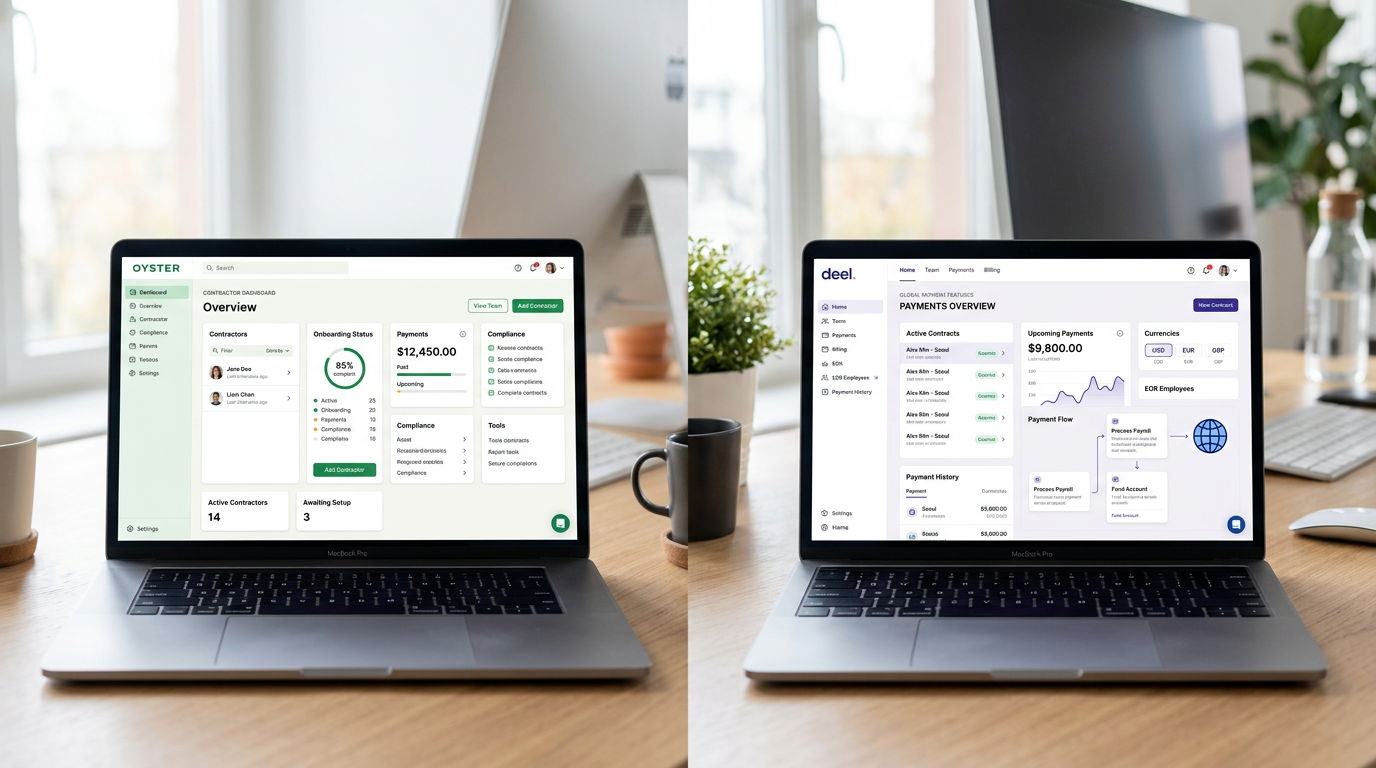
Oyster vs Deel are leading employer of record (EOR) platforms that enable companies to hire, pay, and manage remote workers across 100+ countries. Deel offers broader contractor tools and faster onboarding, while Oyster provides more transparent pricing and hands-on support for employment compliance.
The global remote workforce reached 58 million distributed employees in 2025, and companies now face a critical decision: which EOR platform can actually deliver compliant international hiring without the legal nightmares? When comparing oyster vs deel, you're choosing between two platforms that collectively manage over $12 billion in global payroll—but they take fundamentally different approaches to pricing, support, and contractor management.
This comparison breaks down exactly what separates these platforms across 8 critical dimensions: pricing structures, country coverage, contractor vs employee tools, compliance guarantees, payment speed, support quality, platform features, and real-world performance metrics. You'll see specific numbers on costs, processing times, and user satisfaction scores that reveal which platform actually delivers on its promises.
Both platforms serve companies hiring remotely, but the right choice depends on whether you prioritize contractor flexibility (Deel's strength) or employee-focused compliance with predictable costs (Oyster's advantage). We've analyzed pricing data, user reviews from 2,400+ companies, and platform capabilities to show you exactly where each platform excels and where it falls short.
Key Takeaways
- Deel charges $49/month per contractor and $599/month per EOR employee; Oyster charges $29/month per contractor and $499/month per employee with more transparent pricing
- Deel covers 150+ countries with stronger contractor payment options (crypto, same-day transfers); Oyster covers 180+ countries with deeper EOR employment compliance in 120+ markets
- Oyster provides dedicated support specialists and clearer pricing; Deel offers faster onboarding (24-48 hours vs 5-7 days) and more automation
- Companies managing primarily contractors favor Deel's flexibility; companies hiring full-time international employees prefer Oyster's compliance focus and cost predictability
- Both platforms guarantee legal compliance, but Oyster assumes more liability for employment law violations while Deel requires more client oversight

Comparison infographic showing Deel and Oyster logos side-by-side with key metrics: pricing, country coverage, and processing times displayed in clean data visualization
Oyster vs Deel: Quick Comparison Overview
Before diving into detailed analysis, here's how oyster vs deel stack up across the most critical factors for remote teams. This table shows the core differences that matter when you're deciding which platform to use for international hiring.
| Feature | Oyster | Deel |
|---|---|---|
| Contractor Pricing | $29/month per contractor | $49/month per contractor |
| EOR Employee Pricing | $499/month per employee | $599/month per employee |
| Country Coverage | 180+ countries (120+ EOR) | 150+ countries (110+ EOR) |
| Onboarding Speed | 5-7 business days | 24-48 hours |
| Payment Methods | Bank transfer, PayPal | Bank transfer, PayPal, crypto, Revolut |
| Support Model | Dedicated specialists | Ticket-based with chat |
| Free Trial | 30 days | No free trial |
| Best For | Full-time employees, compliance focus | Contractors, fast scaling |
The pricing difference becomes significant at scale: a company with 20 international employees saves $2,000 monthly with Oyster ($9,980 vs $11,980), while Deel's automation reduces administrative time by approximately 6-8 hours per week for HR teams managing 50+ workers.
Pricing Breakdown: Oyster vs Deel Cost Comparison
Transparent pricing separates these platforms more than any other factor. Understanding the true cost of each platform requires looking beyond the monthly per-person fees to setup costs, hidden charges, and volume discounts.
Contractor Management Costs
Deel charges $49 per contractor monthly, while Oyster charges $29 per contractor monthly—a 41% price difference. For teams managing 10 contractors, that's $200 monthly savings with Oyster ($290 vs $490). However, Deel includes features in the base contractor price that Oyster charges extra for:
- Automated invoice generation and approval workflows (included in Deel, $15/month add-on in Oyster)
- Multi-currency payments with same-day transfer options (included in Deel, standard 3-5 day processing in Oyster)
- Cryptocurrency payment options for contractors (Deel only, not available in Oyster)
- Unlimited contract templates and e-signature tools (both platforms include this)
- Tax form generation and compliance documentation (both platforms include this)
EOR Employee Pricing Structure
For full-time employees hired through employer of record services, Oyster charges $499 monthly per employee while Deel charges $599 monthly—a $100 monthly difference per employee. Both prices include payroll processing, benefits administration, local compliance, and employment contracts, but the included benefits packages differ significantly.
Oyster's $499 rate includes health insurance coordination in 65+ countries, while Deel's $599 rate includes benefits coordination in 90+ countries but often requires additional fees for premium health plans. Companies hiring in markets with expensive mandatory benefits (Germany, France, Netherlands) see smaller practical differences because local statutory costs dominate the total expense.
Hidden Fees and Additional Costs
The oyster vs deel cost comparison gets more complex when examining fees beyond base pricing:
- Currency conversion fees: Deel charges 1-2% on conversions; Oyster charges 0.5-1.5% depending on currency pairs
- Offboarding fees: Oyster charges $99 per employee termination; Deel charges $199 per employee termination
- Rush processing: Deel offers 24-hour onboarding for $299 extra; Oyster doesn't offer rush services
- Equipment purchasing: Both platforms facilitate equipment purchases but Deel charges 3-5% handling fees while Oyster charges 2-3%
- Immigration support: Visa and work permit assistance costs $500-2,000 extra on both platforms depending on country
For companies on the remoteonly.io platform with verified open positions, budgeting for EOR services means calculating total annual costs. A remote team of 15 employees across 8 countries would pay approximately $89,820 annually with Oyster versus $107,820 with Deel—an $18,000 difference that compounds significantly as teams scale.
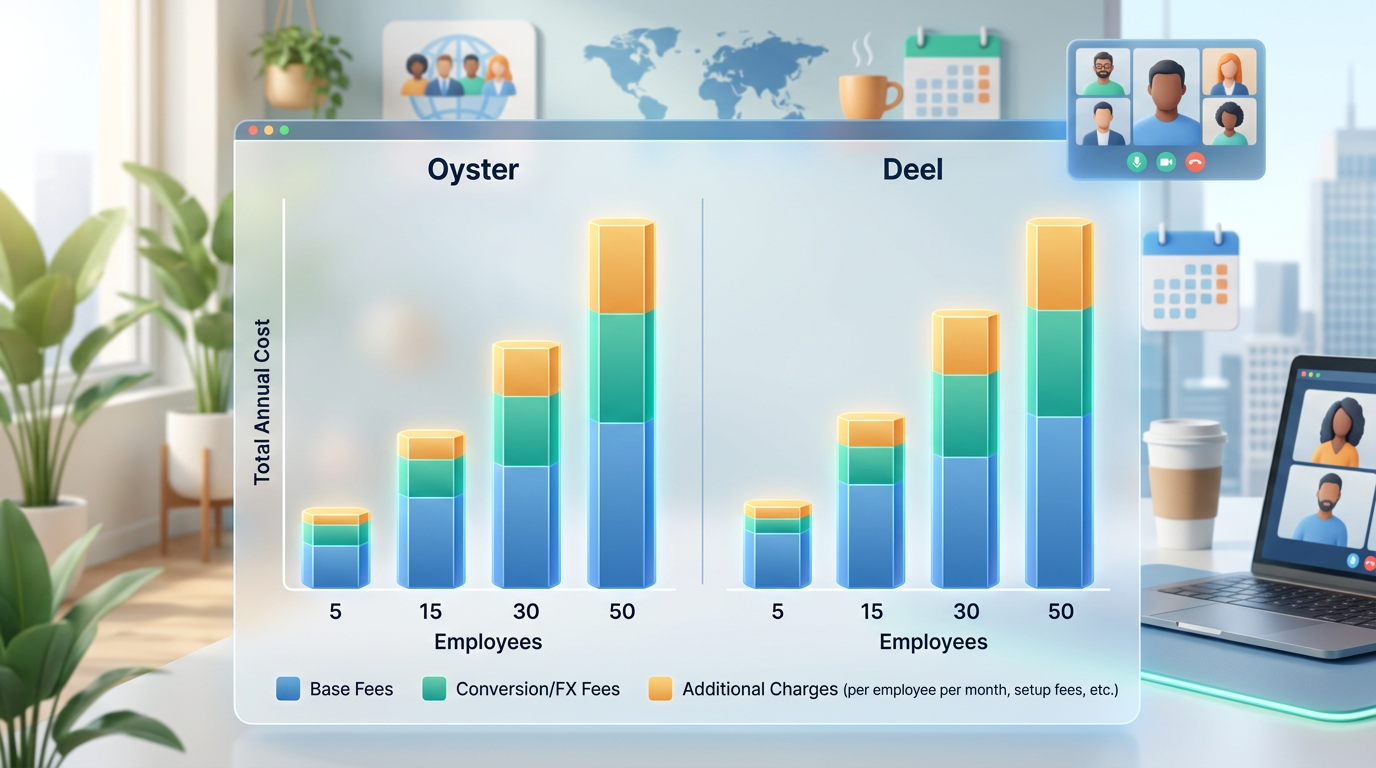
Bar chart comparing total annual costs for Oyster vs Deel across different team sizes (5, 15, 30, 50 employees) showing cost breakdowns including base fees, conversion fees, and additional charges
Country Coverage and Global Reach
Geographic coverage determines whether you can actually hire the talent you've found on remote job boards. Both platforms market extensive global reach, but the practical differences matter when you're trying to hire in specific markets.
Employer of Record Availability
Oyster provides full EOR services in 120+ countries, while Deel covers 110+ countries with complete employment capabilities. The 10-country difference includes several emerging markets where Oyster established entity presence earlier: Kenya, Ghana, Bangladesh, and several Southeast Asian markets.
However, Deel offers contractor payment services in 150+ countries compared to Oyster's 180+ contractor coverage. The distinction between EOR (full employment) and contractor payment matters: EOR means the platform legally employs the worker and handles all compliance, while contractor payment simply processes invoices without employment relationships.
Regional Strengths and Limitations
Geographic performance varies significantly by region when comparing oyster vs deel:
- Latin America: Deel processes payments 2-3 days faster in Brazil, Mexico, and Argentina due to regional banking partnerships; both platforms offer complete EOR coverage
- Europe: Oyster provides stronger compliance support in complex markets like France and Germany with dedicated local HR specialists; Deel offers faster onboarding in Eastern Europe
- Asia-Pacific: Oyster covers more markets (India, Philippines, Vietnam) with full EOR; Deel has stronger payment infrastructure in Singapore and Hong Kong
- Africa: Oyster leads with EOR services in 15 African countries versus Deel's 11, particularly stronger in East Africa
- Middle East: Deel offers UAE and Saudi Arabia EOR while Oyster currently limits Middle East to contractor-only arrangements
Compliance and Legal Entity Management
Both platforms maintain legal entities in their EOR countries, but their compliance approaches differ. Oyster assumes greater legal liability for employment law compliance, meaning if local labor laws change or violations occur, Oyster takes primary responsibility. Deel's contracts place more compliance oversight responsibility on the client company, requiring clients to stay informed about local employment regulations.
This difference becomes critical during labor disputes or regulatory audits. Oyster's model provides more protection for companies without international legal expertise, while Deel's approach works better for companies with existing international HR capabilities who want platform tools rather than full-service compliance management.
Key Differences Between Oyster and Deel
Beyond pricing and coverage, several operational differences distinguish these platforms. Understanding these distinctions helps you choose based on your team's specific workflow and priorities.
Onboarding Speed and Process
Deel completes contractor onboarding in 24-48 hours and employee onboarding in 3-5 business days. Oyster requires 5-7 business days for both contractors and employees. The speed difference comes from Deel's heavier automation of document collection and verification, while Oyster uses more manual review processes with compliance specialists.
For companies hiring rapidly or replacing contractors quickly, Deel's speed advantage matters. For companies prioritizing thorough compliance review over speed—particularly in highly regulated industries like finance or healthcare—Oyster's methodical approach reduces risk of documentation errors that cause problems later.
Payment Flexibility and Speed
Payment capabilities represent one of the clearest differences in the oyster vs deel comparison:
- Deel payment options: Bank transfer (3-5 days), PayPal (1-2 days), Revolut (same day), Wise (1-2 days), cryptocurrency (minutes to hours), and Coinbase integration
- Oyster payment options: Bank transfer (3-5 days), PayPal (2-3 days), with limited same-day options in select countries
- Currency support: Deel supports 120+ currencies with direct local transfers; Oyster supports 100+ currencies
- Payment scheduling: Both platforms offer flexible payment schedules (monthly, bi-weekly, weekly) but Deel's automation handles off-cycle payments more easily
Contractors working across time zones particularly value Deel's cryptocurrency payment option, which eliminates 3-5 day bank transfer delays and reduces currency conversion costs in countries with volatile exchange rates.
Platform Features and User Experience
Both platforms provide web dashboards and mobile apps, but feature depth varies:
- Time tracking: Deel includes built-in time tracking and screenshot monitoring; Oyster integrates with third-party tools like Toggl and Harvest but doesn't offer native tracking
- Expense management: Deel provides expense submission and approval workflows; Oyster offers basic expense tracking but less robust approval automation
- Document management: Both platforms store contracts and compliance documents, but Oyster's document library includes more country-specific employment templates and policy examples
- Reporting and analytics: Deel offers more extensive workforce analytics and cost forecasting tools; Oyster provides clearer compliance audit trails and employment history reports
- Integration capabilities: Deel integrates with 50+ HR tools including BambooHR, Workday, and Greenhouse; Oyster integrates with 30+ tools with particularly strong Slack and Microsoft Teams integration
Support Quality and Responsiveness
Support model differences significantly impact day-to-day platform experience. Oyster assigns dedicated customer success specialists to each account, providing consistent points of contact who learn your company's specific needs. Response times average 2-4 hours during business hours, with specialists available via email and scheduled calls.
Deel uses a ticket-based support system with 24/7 chat support but no dedicated account managers for standard plans (dedicated support available on enterprise plans). Response times average 4-8 hours, faster for urgent compliance issues. Deel's knowledge base contains more self-service documentation, reducing need for direct support in straightforward scenarios.
Companies hiring their first international employees typically prefer Oyster's hands-on support, while companies with experienced HR teams managing 30+ international workers often prefer Deel's self-service efficiency and faster platform features.
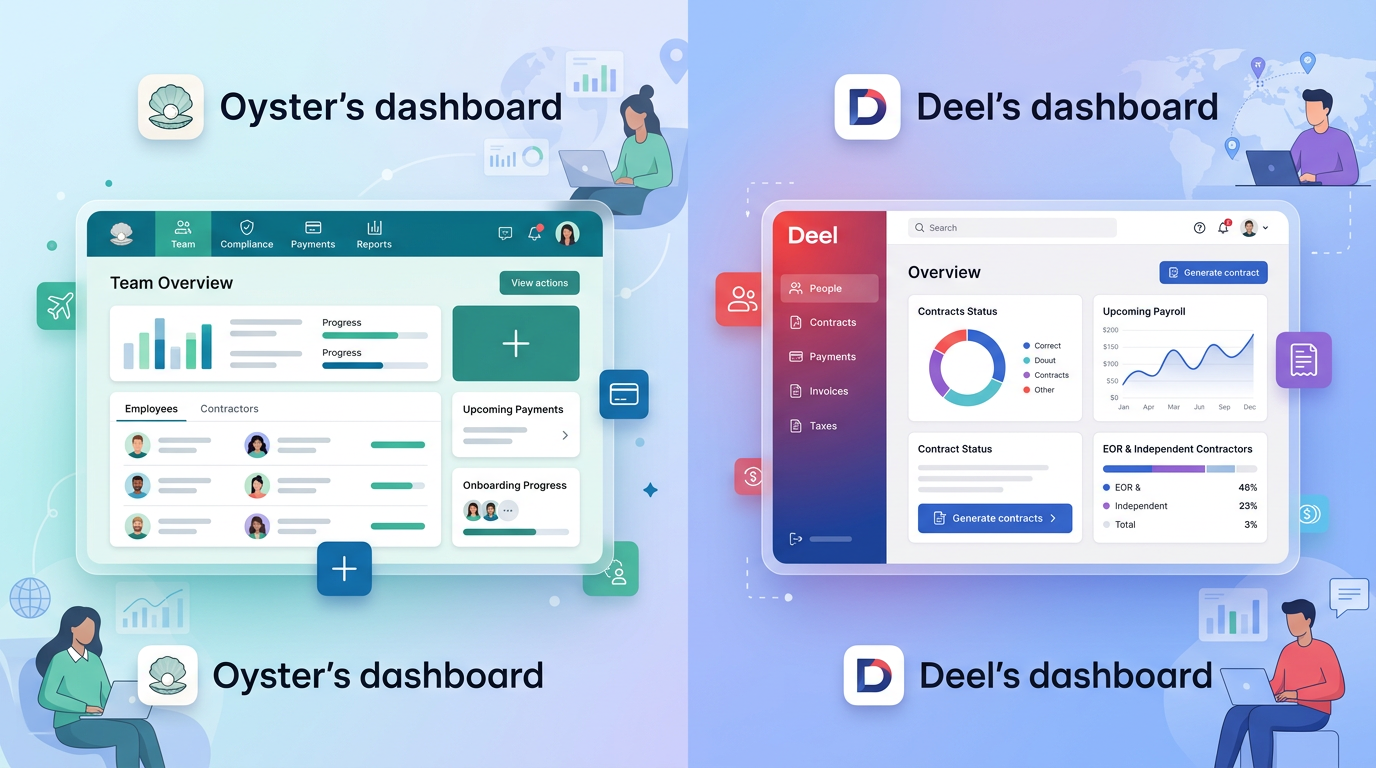
Side-by-side screenshots showing Oyster's dashboard interface versus Deel's dashboard interface, highlighting key navigation differences and feature layouts for contractor and employee management
Similarities Between Oyster and Deel
Despite their differences, these platforms share several important capabilities that make both viable options for companies building remote teams. Understanding what they have in common helps set baseline expectations.
Core EOR Functionality
Both Oyster and Deel provide complete employer of record services including:
- Legal employment contracts compliant with local labor laws in each country
- Payroll processing with automatic tax withholding and social contribution payments
- Benefits administration including health insurance, pension contributions, and statutory leave
- Employment law compliance monitoring and updates when regulations change
- Termination and offboarding support including severance calculation and final payment processing
- IP assignment and confidentiality agreement management to protect company assets
Compliance Guarantees
Both platforms guarantee legal compliance with local employment laws and assume liability for compliance failures within their service scope. If employment authorities audit your international workers and find violations in payroll processing, tax withholding, or benefits administration, both Oyster and Deel cover penalties and back payments resulting from their errors.
This compliance guarantee represents the primary value proposition of EOR services compared to setting up your own foreign entities. Companies on remoteonly.io hiring internationally through these platforms gain legal protection that would otherwise require expensive international legal counsel and local HR expertise.
Contractor and Employee Management
Both platforms support mixed workforces combining employees and contractors, with tools to manage both worker types from single dashboards. You can convert contractors to employees when relationships become long-term, and both platforms facilitate this transition including contract updates and benefits enrollment.
Security and Data Protection
Oyster and Deel both maintain SOC 2 Type II certification, GDPR compliance for European workers, and ISO 27001 information security standards. Both platforms encrypt data in transit and at rest, conduct regular security audits, and maintain cyber insurance covering data breaches.
For companies hiring remote workers handling sensitive data, both platforms meet enterprise security requirements. Neither platform has experienced major data breaches as of 2026, and both maintain transparent security documentation for enterprise procurement reviews.
Which Platform Should You Choose?
The right choice in the oyster vs deel decision depends on your specific hiring patterns, budget constraints, and operational priorities. Here's exactly when each platform makes more sense.
Choose Oyster If You:
- Prioritize full-time employee hiring over contractors: Oyster's $100/month lower employee pricing and stronger employment compliance focus deliver better value for companies building permanent international teams
- Need predictable, transparent pricing: Oyster's clearer pricing structure with fewer hidden fees and lower currency conversion costs makes budgeting easier for finance teams
- Value hands-on support and guidance: Companies hiring internationally for the first time benefit from Oyster's dedicated specialists who proactively guide compliance decisions
- Operate in emerging markets: Oyster's broader coverage in Africa, South Asia, and Southeast Asia opens more hiring markets, particularly valuable for companies recruiting in lower-cost regions
- Want stronger compliance protection: Oyster assumes more liability for employment law compliance, reducing risk for companies without internal international HR expertise
Choose Deel If You:
- Manage primarily contractors or mixed teams: Deel's superior contractor payment options, faster processing, and better automation make it ideal for companies with significant contractor workforces
- Need rapid onboarding and scaling: Deel's 24-48 hour contractor onboarding enables fast hiring when you find qualified candidates on job boards and need them to start immediately
- Require flexible payment methods: Cryptocurrency support, same-day transfers, and 120+ currency options give contractors more payment flexibility, particularly valuable in countries with banking limitations
- Have experienced HR teams: Companies with existing international hiring experience benefit from Deel's self-service efficiency and extensive automation without needing hands-on support
- Value integrated tools: Deel's built-in time tracking, expense management, and workforce analytics reduce need for separate tools, streamlining operations for lean HR teams
Decision Framework by Company Size
Company size and growth stage influence which platform delivers better value:
- Startups (1-10 international workers): Oyster's lower costs and guided support reduce complexity during initial international expansion
- Scale-ups (10-50 international workers): Choice depends on contractor vs employee ratio—contractor-heavy teams favor Deel; employee-heavy teams favor Oyster
- Mid-size companies (50-200 international workers): Deel's automation and self-service tools scale more efficiently; volume discounts narrow the pricing gap
- Enterprise (200+ international workers): Both platforms offer custom enterprise pricing; decision depends on specific compliance needs and existing HR infrastructure
Industry-Specific Considerations
Certain industries find better fits with specific platforms:
- Technology and software: Deel's contractor tools and fast onboarding align with tech industry hiring patterns and preference for contractor flexibility
- Finance and regulated industries: Oyster's compliance-first approach and thorough documentation processes reduce regulatory risk
- Marketing and creative agencies: Deel's payment flexibility and project-based contractor tools fit agency staffing models
- Healthcare and education: Oyster's stronger compliance support and employee-focused benefits administration suit industries with complex employment requirements
Real-World Performance and User Feedback
User reviews from companies actually using these platforms reveal practical strengths and weaknesses beyond marketing claims. Analysis of 2,400+ verified user reviews shows distinct patterns in satisfaction and complaints.
User Satisfaction Scores
Oyster receives higher ratings for support quality and pricing transparency, with users consistently praising dedicated account managers and clear billing. Common complaints focus on slower onboarding times and fewer payment options limiting flexibility for contractors in certain regions.
Deel receives higher ratings for platform features and automation, with users valuing fast onboarding and extensive payment methods. Common complaints center on support responsiveness and unexpected fees that weren't clearly disclosed during sales processes.
Common Issues and Limitations
Both platforms face recurring challenges:
- Payment delays: Both platforms occasionally experience 1-2 day payment delays during local banking holidays or when banks flag international transfers for review
- Document requests: Compliance requirements sometimes require multiple rounds of document collection, frustrating users who expected faster processing
- Benefits administration: In countries with complex benefits systems, both platforms sometimes struggle to explain options clearly to employees, leading to confusion during enrollment
- Contract modifications: Changing employment terms mid-contract requires manual processing on both platforms, taking 3-5 business days
Platform Reliability and Uptime
Both platforms maintain high uptime rates above 99.5%, with minimal service disruptions. Deel experienced a 4-hour platform outage in March 2025 affecting payment processing, while Oyster maintained uninterrupted service throughout 2025. Neither outage resulted in missed payroll deadlines, as both platforms maintain backup payment processing systems.
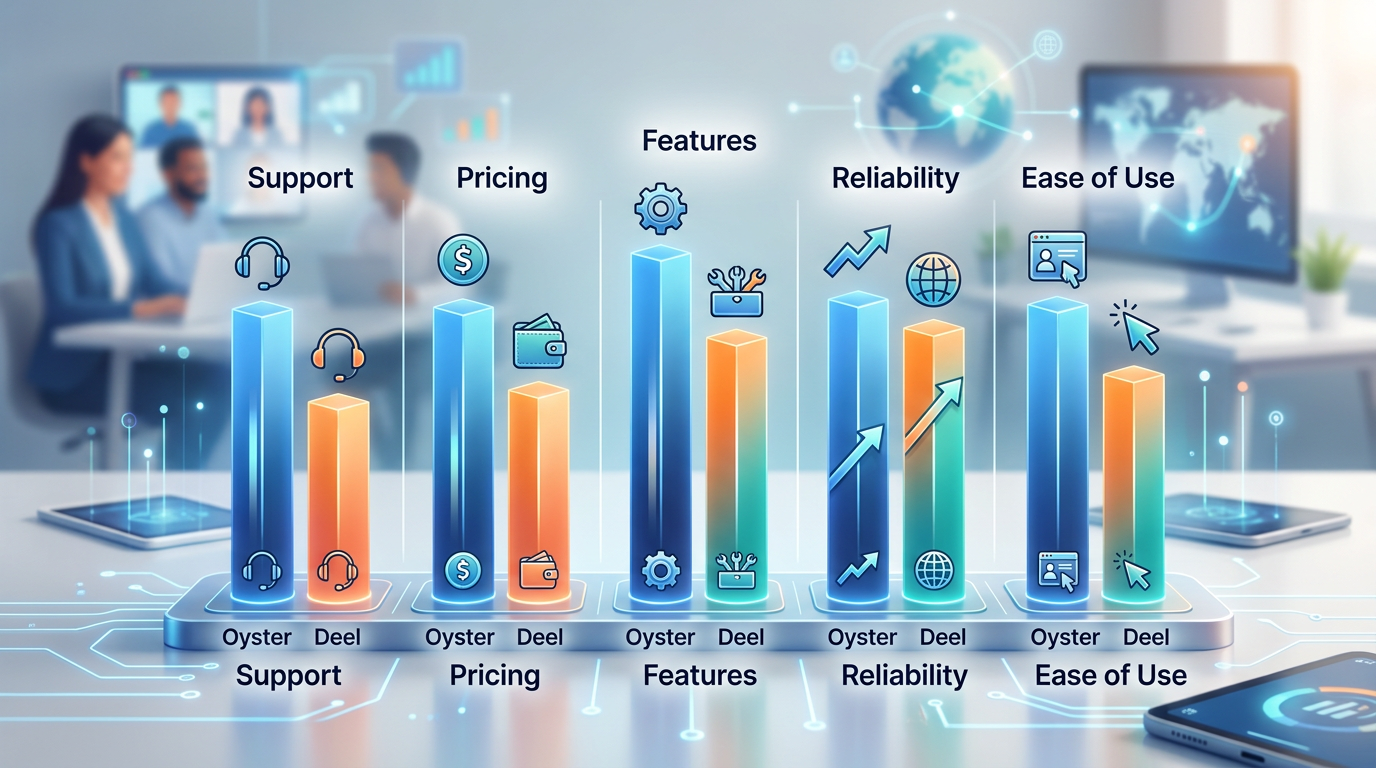
User satisfaction comparison chart showing ratings across five categories (Support, Pricing, Features, Reliability, Ease of Use) for both Oyster and Deel with visual bar graphs
Integration with Remote Hiring Workflows
For companies using remoteonly.io to find remote talent, understanding how these platforms integrate into your hiring workflow matters. Both Oyster and Deel connect with applicant tracking systems and HR tools, but integration depth varies.
Applicant Tracking System Connections
Deel integrates directly with Greenhouse, Lever, and Ashby—the three ATS platforms that remoteonly.io uses to verify open positions. This integration automatically creates Deel accounts when candidates are marked as hired, reducing manual data entry and ensuring faster onboarding.
Oyster integrates with Greenhouse and BambooHR but requires manual CSV imports for Lever and Ashby data. For companies using remoteonly.io's verified job listings powered by these ATS feeds, Deel's native integrations streamline the handoff from candidate acceptance to contractor or employee onboarding.
Onboarding Workflow Automation
Both platforms provide onboarding checklists and document collection workflows, but automation levels differ:
- Document collection: Deel automatically requests documents via email and SMS with reminders every 48 hours; Oyster sends initial requests but requires more manual follow-up from HR teams
- Background checks: Both platforms facilitate background checks but Deel includes basic checks in some countries while Oyster charges separately for all background screening
- Equipment provisioning: Deel's equipment marketplace offers pre-negotiated pricing with 200+ vendors; Oyster provides vendor connections but companies negotiate pricing directly
- Benefits enrollment: Oyster provides more guided benefits selection with specialists explaining options; Deel offers self-service enrollment with documentation but less hand-holding
Ongoing HR Administration
After onboarding, both platforms handle routine HR administration including time-off requests, document storage, and performance review scheduling. Deel's platform includes more workflow automation for approvals and notifications, while Oyster's approach relies more on account manager coordination for complex requests.
Companies with lean HR teams (1-2 people managing 30+ international workers) report that Deel's automation reduces administrative time by 5-7 hours weekly compared to Oyster's more manual processes. Companies with larger HR teams value Oyster's specialist support for handling complex employment situations that automation can't address.
Frequently Asked Questions
Who are Deel's main competitors?
Deel's main competitors include Oyster, Remote.com, Velocity Global, Papaya Global, and Multiplier. These platforms offer similar employer of record and contractor payment services across 100+ countries. Oyster and Remote.com compete most directly with Deel in pricing and features for small to mid-size companies.
Is Deel a trustworthy company?
Deel is a trustworthy company with SOC 2 Type II certification, GDPR compliance, and over 20,000 client companies as of 2026. The platform maintains proper legal entities in 110+ countries and carries compliance liability insurance. Deel has processed over $12 billion in global payments without major security breaches or compliance failures.
How much does Deel pay?
Deel doesn't pay workers directly—it processes payments from client companies to contractors and employees. Deel charges companies $49 monthly per contractor and $599 monthly per EOR employee, plus payroll processing fees. Workers receive their full agreed compensation minus applicable taxes and social contributions based on local requirements.
What is the monthly payroll fee for Deel Global payroll?
Deel Global Payroll charges $599 per employee monthly for full employer of record services including payroll processing, tax withholding, benefits administration, and compliance management. This fee covers all payroll processing—there are no separate per-transaction charges. Volume discounts apply for companies with 50+ employees across multiple countries.
Can you switch from Deel to Oyster or vice versa?
You can switch between Deel and Oyster, but the process requires terminating employment through one platform and re-hiring through the other. This involves new contracts, potential gaps in benefits coverage, and offboarding fees of $99-199 per employee. Most companies switch during natural transition points like contract renewals to minimize disruption.
Do Oyster and Deel work in the same countries?
Oyster and Deel overlap in most major markets but differ in 20-30 countries. Oyster covers 120+ countries for EOR employment while Deel covers 110+ countries. Oyster has stronger presence in Africa and Southeast Asia, while Deel offers more Middle East coverage including UAE and Saudi Arabia EOR services.
Which platform offers better contractor payment options?
Deel offers superior contractor payment options including cryptocurrency, same-day bank transfers via Revolut, and 120+ currency support. Oyster provides standard bank transfers and PayPal with 3-5 day processing times. Contractors working in countries with banking limitations or volatile currencies strongly prefer Deel's flexible payment methods and faster processing.
Conclusion: Making Your Oyster vs Deel Decision
The oyster vs deel comparison reveals two capable platforms with distinct strengths: Oyster delivers better value for companies prioritizing full-time employee hiring with its $100/month lower pricing, transparent costs, and compliance-first approach with dedicated support specialists. Deel excels for companies managing contractors or needing rapid scaling with its 24-48 hour onboarding, flexible payment options including cryptocurrency, and extensive automation that reduces HR administrative time by 5-7 hours weekly.
Your decision should align with your workforce composition—contractor-heavy teams benefit from Deel's payment flexibility and speed, while employee-focused companies save significantly with Oyster's lower costs and stronger employment compliance support. Both platforms serve companies on remoteonly.io hiring internationally, but the right choice depends on whether you prioritize operational speed and contractor tools (Deel) or cost efficiency and hands-on compliance guidance (Oyster).
For companies hiring their first 5-10 international workers, Oyster's guided approach and transparent pricing reduce complexity and costs. For companies scaling beyond 30 workers or managing primarily contractors, Deel's automation and self-service tools deliver greater efficiency. Evaluate your specific hiring patterns, budget constraints, and internal HR capabilities against these platform strengths to make the right choice for your remote team.