How to Get a Remote Job With No Experience
Get your first remote job without experience by targeting verified entry-level roles, building skills through free certifications, and avoiding ghost jobs...
October 23, 2026 • 27 min read

How to get a remote job with no experience requires targeting entry-level roles like customer service, data entry, or virtual assistance, building transferable skills through free online courses, and leveraging platforms that verify active remote listings daily to avoid ghost jobs and focus applications strategically.
Breaking into remote work without prior experience feels impossible when job listings demand 2-3 years minimum. Yet across remoteonly.io's 7,000+ daily-verified listings, 18% require zero previous remote experience. The challenge isn't that remote jobs for beginners don't exist—it's that most job seekers waste time on ghost postings and misalign their applications with what remote employers actually need.
This guide shows you exactly how to get a remote job with no experience using verified data from active listings, not outdated advice. You'll learn which entry-level remote roles hire beginners most frequently, how to build relevant skills in 2-4 weeks, and where to find legitimate openings re-verified daily against employer ATS systems.
Remote work isn't reserved for senior developers and seasoned marketers. Customer support, administrative coordination, and content moderation roles collectively represent 34% of entry-level remote openings. The key is knowing which positions value aptitude over experience, and how to demonstrate that aptitude without traditional credentials.
Key Takeaways
- Entry-level remote jobs in customer service, data entry, and virtual assistance require minimal prior experience and hire from verified job boards with daily ATS verification
- Building demonstrable skills through free platforms like Google Digital Garage, HubSpot Academy, or Coursera takes 2-4 weeks and directly addresses remote employer requirements
- Tailoring applications to emphasize self-direction, written communication, and async collaboration matters more than traditional office experience for remote-first companies
- Avoiding ghost jobs by using platforms that verify listings daily against Greenhouse, Lever, and Ashby feeds saves 40-60% of application time
- Starting with contract or part-time remote roles builds verifiable experience faster than waiting for full-time positions with lower competition
Prerequisites: What You'll Need Before Starting
Before applying to remote positions, ensure you have the baseline infrastructure and mindset remote employers expect. These aren't negotiable—remote work demands self-sufficiency from day one.
Technical Requirements
Remote jobs require reliable technology. You need a computer (laptop or desktop) manufactured within the last 5 years, high-speed internet with minimum 25 Mbps download speed, and a quiet workspace with minimal background noise for video calls.
Most entry-level remote roles provide company laptops after hiring, but the application process itself—video interviews, skills assessments, async communication—requires functional equipment upfront. Test your webcam, microphone, and internet stability before scheduling interviews.
Time Commitment
Securing a remote job with no experience typically takes 4-8 weeks of focused effort. This includes 1-2 weeks building foundational skills, 2-4 weeks actively applying (10-15 applications weekly), and 1-2 weeks navigating interview processes.
Allocate 10-15 hours weekly if job searching part-time, or 25-35 hours if treating this as full-time work. Front-load skill-building in week one to strengthen subsequent applications.
Mindset Shifts
Remote work differs fundamentally from office environments. Employers prioritize written communication over verbal, async collaboration over real-time meetings, and self-direction over supervision. Demonstrating these competencies matters more than years of in-office experience.
- Written clarity: Can you explain complex ideas in 3-4 sentences via Slack or email?
- Self-management: Can you structure your day without direct oversight?
- Async work: Can you make progress without immediate answers from colleagues?
- Digital fluency: Can you quickly learn new software tools independently?
- Proactive communication: Do you over-communicate status updates rather than wait to be asked?
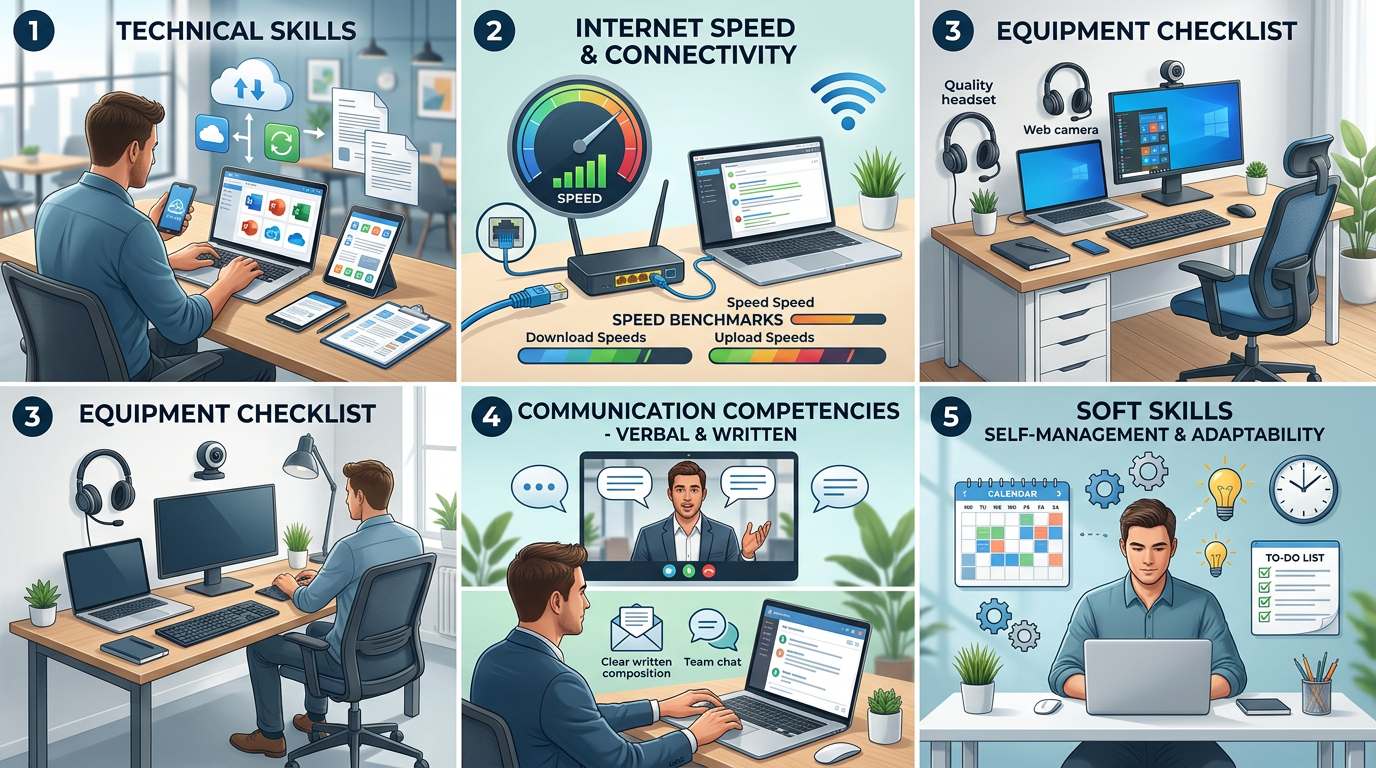
Infographic showing the 5 essential technical and soft skill requirements for remote work beginners, including internet speed benchmarks, equipment checklist, and communication competencies
Step 1: Identify Which Entry-Level Remote Jobs Hire Without Experience
Not all remote roles welcome beginners equally. Focus on positions where companies explicitly hire for aptitude and train for skill, rather than requiring proven expertise.
Highest-Volume Entry-Level Remote Categories
Customer service and support roles represent the largest entry point into remote work, comprising 22% of no-experience-required listings across verified job boards. Companies like Amazon, Shopify, and Apple regularly hire remote customer service associates with zero prior experience, providing 2-4 weeks of paid training.
Data entry and administrative support follow at 16% of entry-level remote openings. These roles require attention to detail and basic software proficiency (Google Workspace, Microsoft Office) but rarely demand previous remote experience.
Content moderation, virtual assistance, and transcription collectively account for another 12% of beginner-friendly remote positions. These roles value consistency, reliability, and clear communication over specialized backgrounds.
Remote Jobs That Explicitly Welcome Beginners
- Customer Service Representative: Handle customer inquiries via phone, chat, or email. Companies provide software training and product knowledge. Requires strong written/verbal communication and patience.
- Data Entry Specialist: Input information into databases or spreadsheets. Requires typing speed (40+ WPM), accuracy, and comfort with repetitive tasks.
- Virtual Assistant: Manage calendars, emails, and administrative tasks for executives or small businesses. Requires organizational skills and familiarity with scheduling tools.
- Content Moderator: Review user-generated content for policy violations. Requires attention to detail, judgment consistency, and emotional resilience.
- Transcriptionist: Convert audio recordings to written text. Requires fast typing, strong grammar, and focus during long listening sessions.
- Social Media Coordinator: Schedule posts, respond to comments, and monitor brand mentions. Requires social platform familiarity and basic copywriting skills.
Pro Tip: Search job boards using filters for "entry-level," "no experience required," or "training provided." On remoteonly.io's 7,000+ daily-verified listings, filtering by experience level eliminates 82% of positions requiring 2+ years, focusing your applications where you actually qualify.
What Remote Employers Actually Mean by "No Experience"
"No experience required" doesn't mean zero skills. It means no previous remote work experience or no industry-specific background. Employers still expect foundational competencies: reliable communication, basic tech literacy, and self-management.
A customer service role might not require prior support experience, but assumes you can write professional emails, navigate multiple browser tabs simultaneously, and troubleshoot simple technical issues independently. Understand the implied baseline before applying.
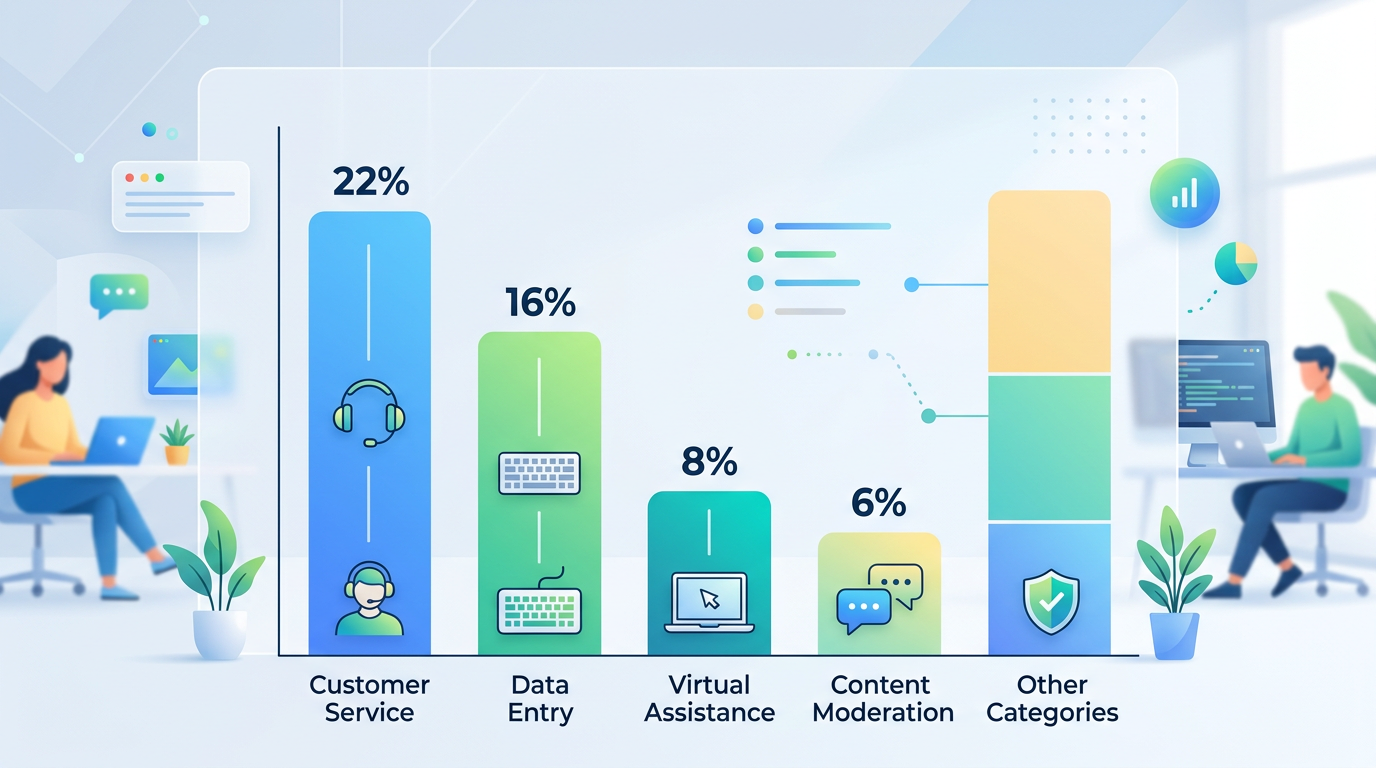
Bar chart comparing the percentage distribution of entry-level remote job categories, showing customer service at 22%, data entry at 16%, virtual assistance at 8%, content moderation at 6%, and other categories
Step 2: Build Demonstrable Skills in 2-4 Weeks
Lacking formal experience doesn't mean lacking skills. Strategic upskilling through free online courses provides concrete credentials to list on resumes and discuss in interviews.
Free Certification Programs Remote Employers Recognize
Focus on certifications directly relevant to your target role. Google Digital Garage, HubSpot Academy, and Coursera offer free courses that take 6-20 hours to complete and appear credible on applications.
- Google Digital Garage: Fundamentals of Digital Marketing (40 hours, free certificate). Covers SEO, social media, email marketing, and analytics basics.
- HubSpot Academy: Customer Service Certification (3 hours), Content Marketing Certification (7 hours), Social Media Marketing Certification (5 hours). All free with shareable credentials.
- Coursera: Audit courses for free from universities. "Successful Negotiation" (University of Michigan) and "Learning How to Learn" (UC San Diego) strengthen soft skills employers value.
- Microsoft Learn: Free training on Excel, Teams, and other Microsoft 365 tools. Completing 2-3 learning paths demonstrates software proficiency.
- Alison: Free diploma courses in customer service, project management, and administrative skills. Takes 6-10 hours per course.
Practical Projects That Demonstrate Remote Work Competency
Certificates prove you learned concepts. Projects prove you applied them. Create 1-2 small projects that showcase skills relevant to your target remote role.
For customer service roles: Draft a 3-5 email sequence responding to common customer scenarios (order issues, product questions, complaints). Demonstrates written communication and problem-solving.
For virtual assistant positions: Create a sample calendar management system using Google Calendar, showing how you'd coordinate multiple stakeholders across time zones. Include a brief process document explaining your approach.
For social media coordination: Develop a 2-week content calendar for a hypothetical brand, including post copy, timing rationale, and engagement strategies. Use free tools like Buffer or Later.
Pro Tip: Host projects on Google Drive or Notion with view-only sharing links. Include these links directly in your resume or cover letter, making it effortless for hiring managers to review your work. This proactive approach compensates for lack of formal experience.
Skills Remote Employers Value Most in Entry-Level Candidates
Remote-first companies prioritize different competencies than traditional offices. Written communication, self-direction, and async collaboration rank higher than technical skills for most entry-level remote roles.
- Written Communication: 89% of remote job descriptions mention this explicitly. Practice writing concise, structured emails and Slack messages.
- Time Management: Without office structure, you must create your own. Demonstrate this through project completion timelines or personal productivity systems.
- Digital Tool Proficiency: Familiarity with Slack, Zoom, Asana, Trello, Google Workspace. List these explicitly on your resume.
- Self-Directed Learning: Remote work evolves rapidly. Showing you completed online courses signals you'll adapt to new tools and processes.
- Reliable Communication: Responding to messages within 2-4 hours during work hours. Over-communicate rather than under-communicate.

Step-by-step visual guide showing how to create a portfolio project for remote work applications, including screenshots of Google Calendar coordination, email templates, and content calendar examples
Step 3: Optimize Your Application Materials for Remote Positions
Remote job applications require different emphasis than traditional resumes. Highlight remote-relevant competencies even if your previous work was in-office.
Resume Adjustments for Remote Work
Lead with a "Remote Work Skills" section immediately after your contact information, before work experience. This frontloads what remote employers care about most.
Include: Communication tools (Slack, Microsoft Teams, Zoom), project management platforms (Asana, Trello, Monday.com), collaboration software (Google Workspace, Notion), and any relevant certifications completed in Step 2.
Reframe previous experience through a remote lens. Instead of "Managed customer inquiries at retail location," write "Resolved 30+ customer issues daily through clear verbal and written communication, maintaining 95% satisfaction rating." The second version emphasizes transferable remote skills.
Cover Letter Strategy for No-Experience Candidates
Address the experience gap directly in your cover letter's opening paragraph. Acknowledge you're new to remote work, then immediately pivot to why you're equipped to excel anyway.
Example opening: "While I'm new to remote customer service, I've spent the past three weeks completing HubSpot's Customer Service Certification and building sample email response templates for common support scenarios. My retail experience resolving 30+ daily customer issues demonstrates the problem-solving and communication skills your team needs, and I'm ready to apply them in a remote environment."
Keep cover letters to 150-200 words for remote positions. Remote hiring managers value conciseness. State your interest, highlight 2-3 relevant skills or projects, and close with availability.
Portfolio or Work Samples
Even without formal experience, you can provide work samples. Reference the projects created in Step 2. Include a single-sentence description and a direct link in your resume's header or cover letter.
Example: "View my customer service email templates: [link]" or "Sample social media content calendar: [link]." This differentiates you from other no-experience candidates who submit generic applications.
Pro Tip: Use a clean, ATS-friendly resume format. Many remote companies use applicant tracking systems that parse resumes for keywords. Avoid tables, graphics, or unusual formatting. Stick to standard section headers (Experience, Education, Skills) and include keywords from the job description naturally throughout.
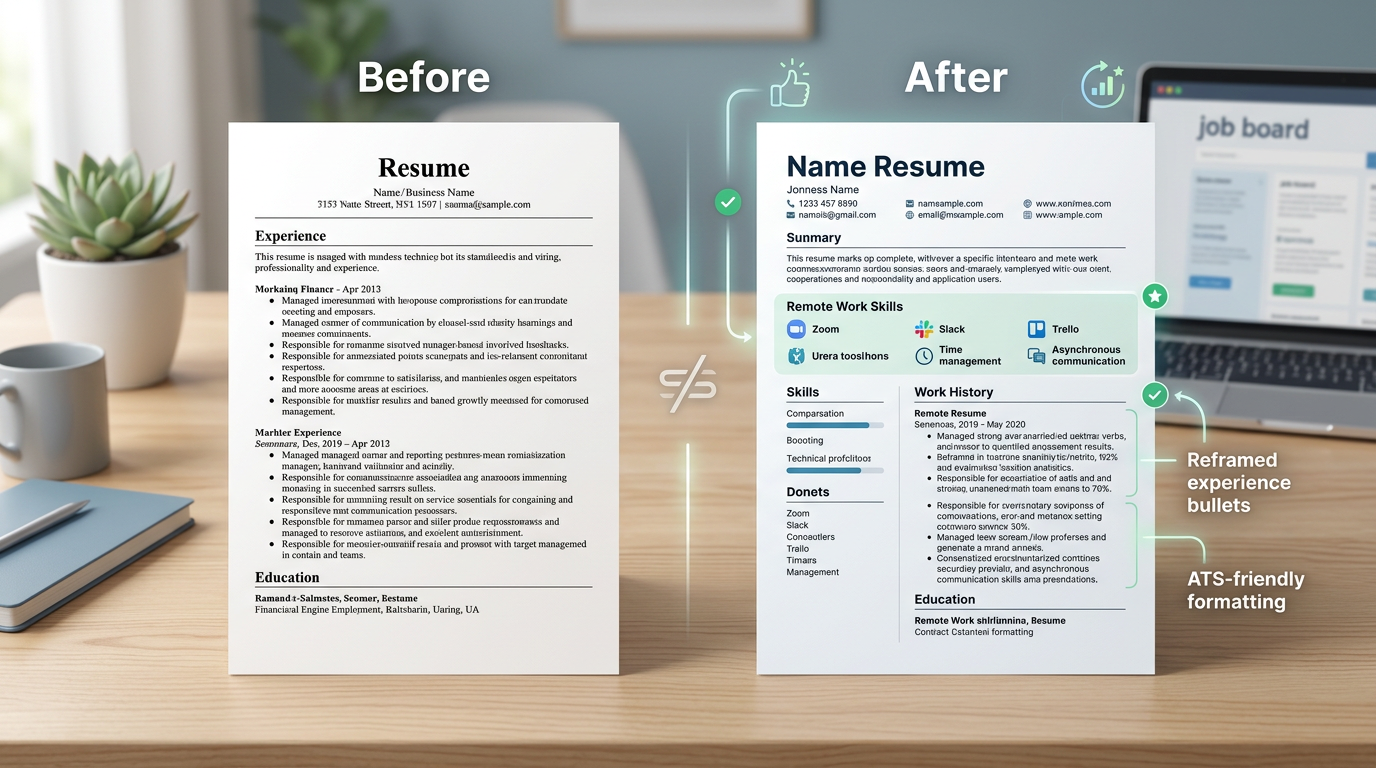
Before-and-after comparison of a resume optimized for remote work, highlighting the addition of a Remote Work Skills section, reframed experience bullets, and ATS-friendly formatting
Step 4: Find Legitimate Remote Job Listings (Avoid Ghost Jobs)
The remote job market is flooded with ghost jobs—listings for positions already filled, never intended to be filled, or posted to gauge candidate interest. Applying to ghost jobs wastes 40-60% of your effort with zero return.
Job Boards That Verify Active Listings Daily
Use platforms that re-verify listings against employer ATS feeds (Greenhouse, Lever, Ashby) daily. remoteonly.io maintains 7,000+ live listings verified daily, eliminating ghost jobs automatically. This ensures every application targets an actually-open position.
Other verified remote job boards include We Work Remotely (manually curated), FlexJobs (subscription-based, hand-screened), and Remote.co (smaller but quality-focused). Avoid aggregators that scrape listings from multiple sources without verification—these accumulate ghost jobs rapidly.
Company Career Pages for Direct Applications
Identify 10-15 companies known for hiring remote beginners, then monitor their career pages directly. Amazon, Shopify, Automattic, GitLab, and Zapier regularly post entry-level remote roles on their own sites before distributing to job boards.
Set up Google Alerts for "[Company Name] remote jobs" or check career pages weekly. Direct applications sometimes receive faster responses than applications through aggregators.
Red Flags for Ghost Jobs and Scams
Avoid listings with vague job descriptions, no specific company name, requests for payment or personal financial information upfront, or promises of unusually high pay for entry-level work. Legitimate remote employers never ask candidates to pay for equipment, training, or background checks during the application process.
- Vague descriptions: "Earn money from home" without specific role details
- No company information: Listings that don't name the employer
- Upfront payment requests: Asking for money for training materials or software
- Unrealistic compensation: "$5,000/week for data entry" signals a scam
- Personal information requests: Asking for SSN or bank details before an offer
- Pressure tactics: "Apply within 24 hours" or "Limited spots available"
Pro Tip: Cross-reference job listings with the company's official career page. If a listing appears on a job board but not on the company's own site, it may be outdated or fraudulent. Verify directly before investing time in an application.
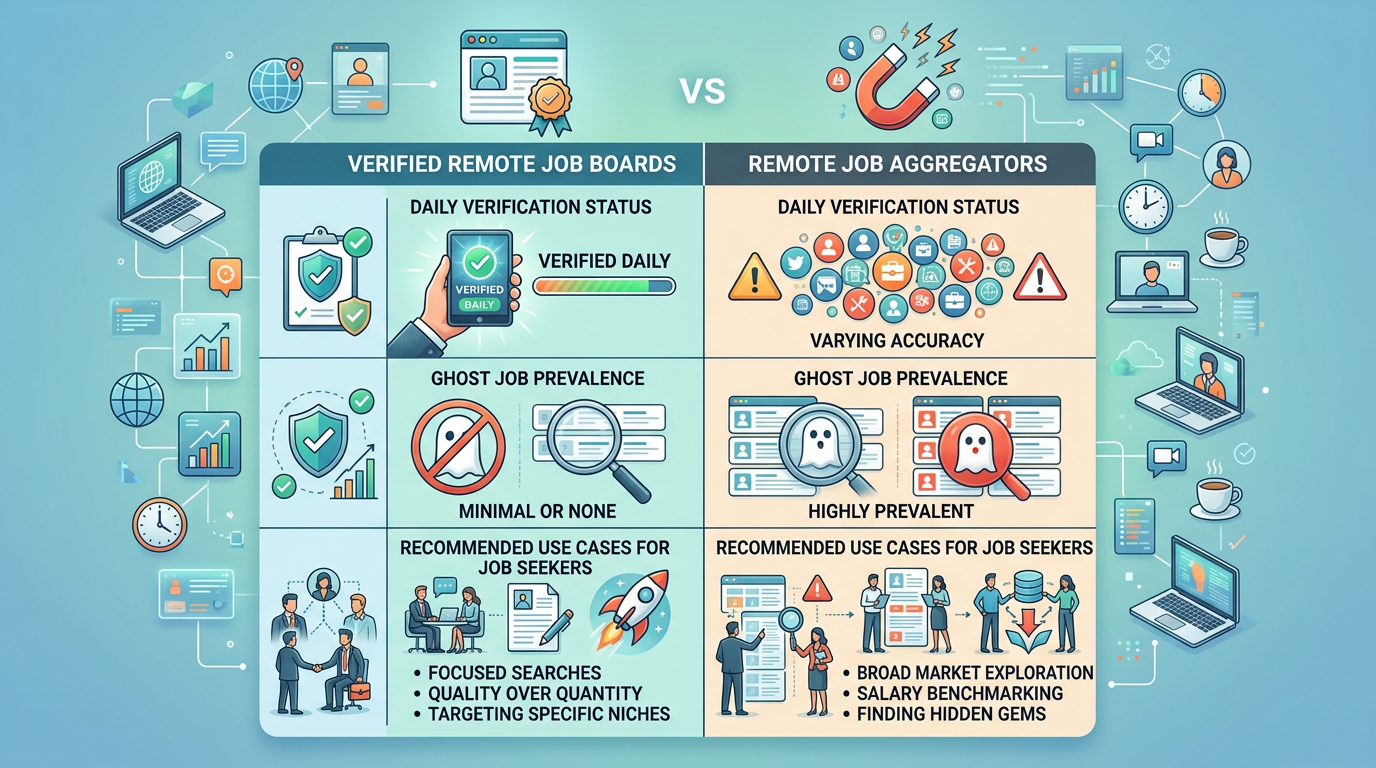
Comparison table showing verified remote job boards versus aggregators, with columns for daily verification status, ghost job prevalence, and recommended use cases for job seekers
Step 5: Apply Strategically (Quality Over Quantity)
Mass-applying to 50+ jobs weekly yields worse results than targeted applications to 10-15 well-matched positions. Remote hiring managers spot generic applications immediately.
Tailoring Applications to Each Role
Customize your resume and cover letter for every application, incorporating 3-5 keywords from the job description. If a listing emphasizes "async communication," include that exact phrase when describing your skills or projects.
Spend 20-30 minutes per application researching the company, understanding their product or service, and referencing specific details in your cover letter. Example: "I've been using [Company]'s platform for [specific use case] and appreciate how [specific feature] solves [problem]. I'd bring that user perspective to your customer support team."
Application Volume and Timing
Apply to 10-15 positions weekly if job searching part-time, or 20-25 if full-time. Prioritize quality matches where you meet 60%+ of listed requirements. Entry-level remote roles often receive 200+ applications within 48 hours of posting, so apply within the first 24 hours whenever possible.
Most remote companies post new listings Monday-Wednesday. Check job boards Monday and Thursday mornings to catch fresh postings early.
Following Up Without Being Pushy
Wait 7-10 days after applying, then send a brief follow-up email to the hiring manager (find their email via LinkedIn or company website). Keep it to 3-4 sentences: restate your interest, mention one specific qualification, and ask about timeline.
Example: "I applied for the Customer Service Associate role on [date] and wanted to reiterate my strong interest. I recently completed HubSpot's Customer Service Certification and created sample response templates that align with [Company]'s support philosophy. Do you have an estimated timeline for next steps?"
Pro Tip: Track applications in a spreadsheet with columns for company, position, date applied, follow-up date, and status. This prevents duplicate applications and ensures timely follow-ups. Treat job searching like project management—organization signals the self-direction remote work requires.
Step 6: Ace Remote Job Interviews
Remote interviews assess different competencies than in-person meetings. Expect questions about self-management, communication style, and how you handle async work.
Common Remote Interview Questions for Entry-Level Candidates
Prepare specific examples demonstrating remote-relevant skills, even if drawn from non-work contexts like online courses, volunteer work, or personal projects.
- "How do you stay productive without direct supervision?" (Discuss time management systems, task prioritization methods, or tools you use)
- "Describe your home workspace setup." (Mention quiet space, reliable internet, ergonomic considerations)
- "How do you handle communication when working asynchronously?" (Emphasize written clarity, proactive updates, documentation habits)
- "Tell me about a time you learned a new tool or skill independently." (Reference online courses from Step 2)
- "What challenges do you anticipate with remote work?" (Be honest but show you've thought about solutions—e.g., combating isolation through virtual coworking, setting boundaries between work and home life)
Technical Setup for Video Interviews
Test everything 24 hours before the interview. Check webcam positioning (eye level, arm's length away), lighting (face the light source, avoid backlighting), audio quality (use headphones with microphone), and background (clean, uncluttered, professional).
Close unnecessary browser tabs and applications to prevent notification interruptions. Have a backup plan if your internet fails—a mobile hotspot or a friend's location you can quickly reach.
Questions to Ask Remote Employers
Asking thoughtful questions demonstrates genuine interest and helps you assess if the role suits you. Focus on questions specific to remote work dynamics.
- "What does onboarding look like for remote employees?"
- "How does the team handle communication—primarily async or real-time?"
- "What tools and platforms does the team use daily?"
- "How do you measure performance for remote employees?"
- "What support or resources do you provide for remote workers?"
Pro Tip: During video interviews, look at the camera (not the screen) when speaking to create eye contact. This feels unnatural but makes a significant difference in how engaged you appear. Practice with a friend or record yourself beforehand to get comfortable.
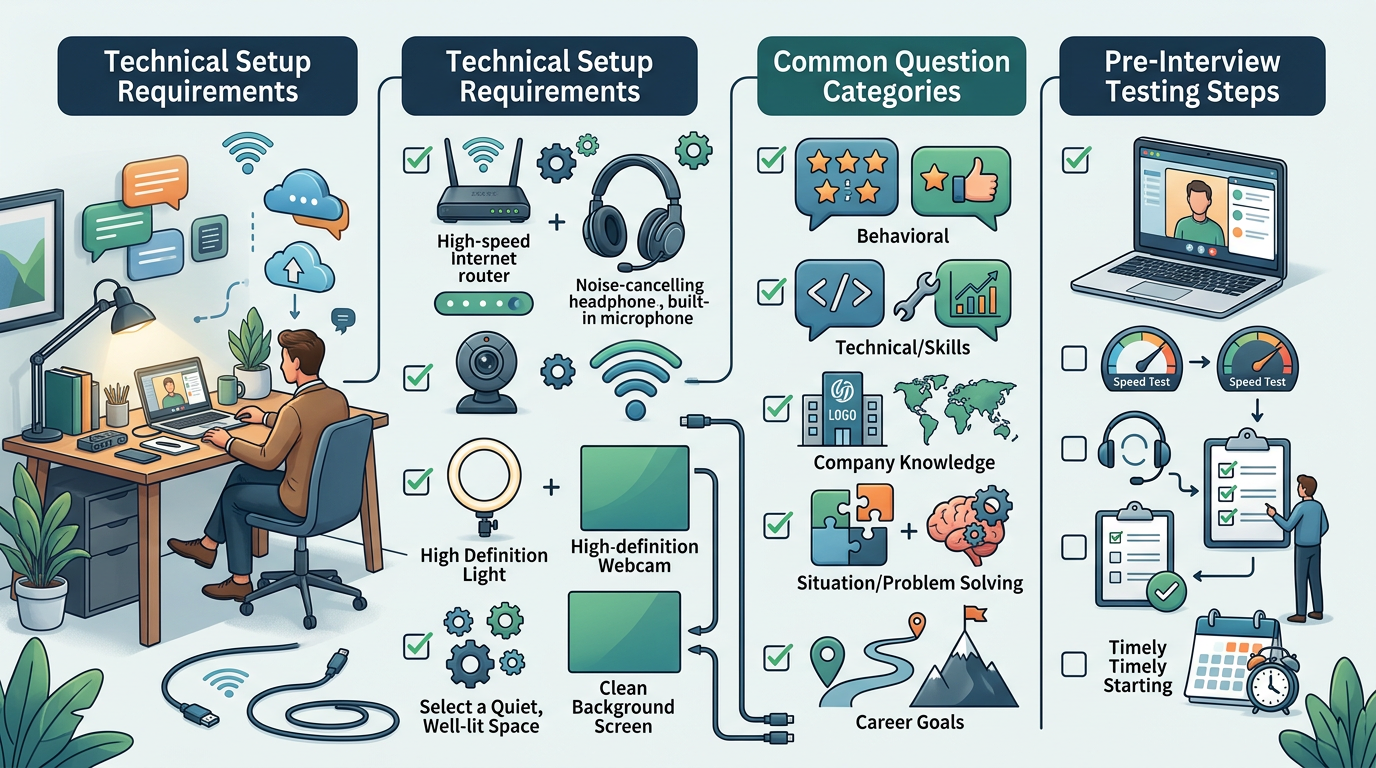
Checklist infographic for remote interview preparation, showing technical setup requirements, common question categories, and pre-interview testing steps
Step 7: Consider Contract or Part-Time Remote Work First
Full-time remote positions with benefits attract the most competition. Starting with contract, freelance, or part-time remote work builds verifiable experience faster and with less competition.
Benefits of Starting with Freelance Remote Work
Freelance platforms like Upwork, Fiverr, and Freelancer.com offer entry-level remote projects requiring zero previous experience. Completing 3-5 small projects over 4-6 weeks provides concrete work history to reference in future full-time applications.
Freelance work also lets you test different remote roles before committing. Try virtual assistance, content writing, and data entry projects to discover what you enjoy and excel at.
Part-Time Remote Roles as Stepping Stones
Many companies hire part-time remote workers (20-30 hours weekly) with less stringent experience requirements than full-time roles. After 3-6 months of strong performance, part-time positions often convert to full-time or provide references for other opportunities.
Search job boards specifically for "part-time remote" or "contract remote" to find these opportunities. They're less visible than full-time postings but face significantly less competition.
Building a Portfolio Through Volunteer Remote Work
Nonprofit organizations and small businesses frequently need remote help but can't afford to hire. Offer 5-10 hours of free work to a cause you care about, explicitly framing it as portfolio-building.
Examples: Manage social media for a local nonprofit, provide virtual administrative support for a small business, or transcribe interviews for a researcher. Document this work formally (save emails, screenshots, testimonials) to reference in applications.
Pro Tip: When freelancing or volunteering, request a LinkedIn recommendation or written testimonial after completing the project. These third-party endorsements compensate for lack of formal employment history and build credibility quickly.
Common Mistakes to Avoid When Seeking Remote Work Without Experience
Even well-prepared candidates sabotage their chances through avoidable errors. Recognizing these pitfalls before you encounter them saves weeks of wasted effort.
Applying to Jobs You're Underqualified For
If a listing requires 3+ years of experience and specific technical skills you lack, your application won't receive consideration regardless of how compelling your cover letter is. Focus on roles explicitly marked "entry-level," "no experience required," or "training provided."
Applying to 5 well-matched positions yields better results than applying to 20 positions where you meet only 30% of requirements.
Generic, Unmodified Applications
Sending identical resumes and cover letters to every company signals low interest and effort. Remote hiring managers receive hundreds of applications—generic ones get rejected within 30 seconds of review.
Spend 20-30 minutes customizing each application. Reference the company by name, mention specific aspects of the role that interest you, and incorporate keywords from the job description.
Neglecting to Showcase Remote-Specific Skills
Listing only traditional job skills (customer service, data entry, scheduling) without emphasizing remote competencies (async communication, self-management, digital tool proficiency) misses what remote employers prioritize.
Explicitly state your remote work capabilities. Don't assume hiring managers will infer them from your general experience.
Ignoring Time Zone Differences
Some remote roles require specific time zone availability. If a listing specifies "must be available 9am-5pm EST" and you're located in PST, clarify your availability in your cover letter. Misaligned time zones lead to immediate rejection.
When applying to international companies, mention your time zone and willingness to accommodate meeting times in your application.
Poor Communication During the Application Process
Slow email responses, typos in correspondence, or missed interview appointments demonstrate exactly what remote employers fear—unreliable communication. Every interaction during the application process is a work sample.
Respond to emails within 24 hours, proofread everything twice, and treat scheduling with extreme professionalism. Remote work lives or dies on communication reliability.
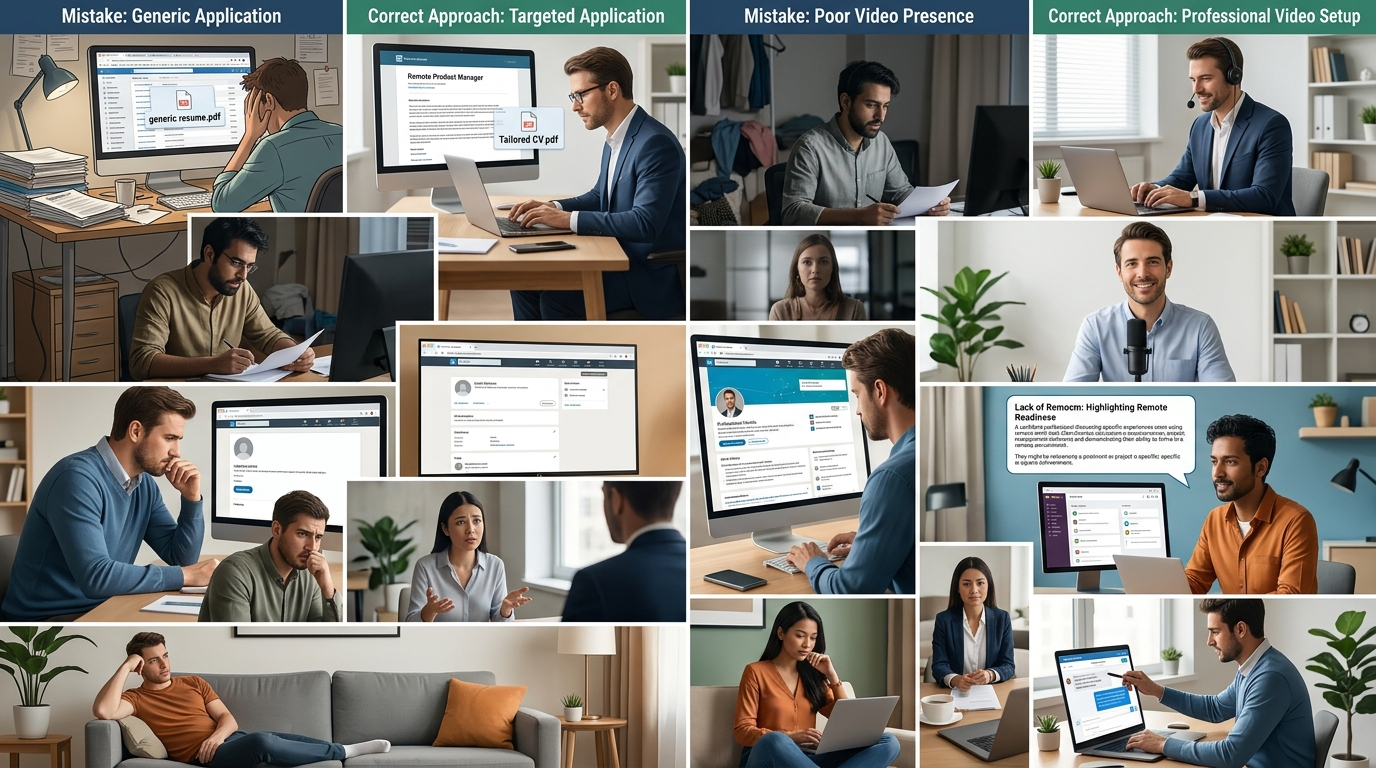
Visual guide showing the top 5 mistakes remote job seekers make, with each mistake illustrated alongside the correct approach
Troubleshooting: What to Do If You're Not Getting Responses
If you've applied to 20+ positions without interviews, diagnose and fix the problem rather than continuing the same approach.
Resume Isn't Passing ATS Filters
Many remote companies use applicant tracking systems that scan resumes for keywords before human review. If your resume lacks keywords from job descriptions, it never reaches a hiring manager.
Solution: Copy 5-10 job descriptions for your target role into a word cloud generator. Identify the most frequent terms (excluding common words like "the" and "and"). Incorporate these keywords naturally into your resume's skills section and experience descriptions.
Applications Aren't Differentiated Enough
If your application looks identical to 100 others, it blends into the pile. Without formal experience, you need something that makes yours memorable.
Solution: Add work samples, project links, or a brief video introduction (30-60 seconds) hosted on Loom. Include the link in your cover letter with a single sentence: "I've created a brief introduction video to help you get to know me: [link]." This works especially well for customer-facing roles.
Targeting the Wrong Roles
If you're applying to roles that attract hundreds of qualified candidates (social media manager, content writer), competition overwhelms your no-experience application.
Solution: Pivot to less glamorous but more accessible roles. Customer service, data entry, and content moderation receive fewer applicants per opening. Build experience there first, then transition to more competitive positions after 6-12 months.
Your Online Presence Raises Red Flags
Remote hiring managers Google candidates. If your social media contains unprofessional content or your LinkedIn profile is sparse/outdated, it undermines your application.
Solution: Audit your digital footprint. Update LinkedIn with recent skills and certifications, adjust privacy settings on personal social accounts, and consider creating a simple personal website (free via Google Sites or Notion) showcasing your work samples.
Pro Tip: After 15-20 applications without responses, request feedback from someone in your target industry. Post your resume and cover letter in relevant Reddit communities (r/resumes, r/remotework) or ask connections for honest critique. External perspective often reveals blind spots you can't see yourself.
What's Next After Landing Your First Remote Job
Securing your first remote position is the beginning, not the destination. The first 90 days determine whether you'll thrive in remote work long-term and open doors to better opportunities.
Excelling in Your First 90 Days
Over-communicate during onboarding. Send daily or every-other-day updates to your manager summarizing what you completed, what you're working on next, and any blockers you're facing. This proactive communication builds trust rapidly.
Document everything you learn—processes, tools, contacts. Create a personal wiki in Notion or Google Docs. This helps you work independently faster and positions you as someone who creates resources for others.
Ask questions strategically. Batch questions into a single message rather than interrupting with individual queries throughout the day. This respects async work culture while ensuring you get the information you need.
Building Toward Your Next Remote Role
Even in your first remote job, think about skill progression. Identify 2-3 skills that would qualify you for higher-level remote positions (project management, specific software proficiency, industry expertise) and develop them through your current work.
After 6-12 months, update your LinkedIn and resume to reflect remote work experience. This fundamentally changes your candidacy—you're no longer a beginner, you're someone with proven remote work capability.
Expanding Your Remote Network
Remote work can feel isolating. Join virtual communities for remote workers (Remote Year, Nomad List forums, industry-specific Slack groups) to build relationships that lead to referrals and opportunities.
Engage genuinely—answer questions, share resources, participate in discussions. Remote hiring often happens through networks rather than public job postings, especially as you advance beyond entry-level.

Timeline infographic showing career progression from first remote job to advanced opportunities, with milestones at 3 months, 6 months, 12 months, and 24 months
Frequently Asked Questions
Is it possible to get a remote job without experience?
Yes, entry-level remote jobs in customer service, data entry, virtual assistance, and content moderation regularly hire candidates without prior remote experience. These roles prioritize trainable skills like communication, attention to detail, and self-management over previous remote work history. Focus applications on verified job boards and complete free certifications to strengthen your candidacy.
What is the easiest remote job with no experience?
Customer service representative roles are the most accessible remote jobs for beginners, representing 22% of no-experience-required listings. Companies like Amazon and Shopify provide 2-4 weeks of paid training and require only strong communication skills and reliable internet. Data entry positions follow closely, requiring basic typing speed and accuracy without specialized knowledge.
Will Amazon really pay you to work from home?
Yes, Amazon regularly hires remote customer service associates through their Virtual Customer Service program, offering hourly wages plus benefits for full-time positions. They provide equipment, training, and require no previous remote experience. Check Amazon's career page under "Virtual Locations" for current openings, as positions are posted frequently and fill quickly.
Which remote jobs can I get with no experience?
Remote jobs accessible without experience include customer service representative, data entry specialist, virtual assistant, content moderator, transcriptionist, and social media coordinator. These roles value transferable skills like written communication, organization, and digital tool proficiency over industry-specific backgrounds. Many provide training and require only reliable internet and basic computer skills.
How long does it take to get a remote job with no experience?
Getting a remote job with no experience typically takes 4-8 weeks of focused effort, including 1-2 weeks building skills through free certifications and 2-4 weeks actively applying to 10-15 positions weekly. Timeline varies based on role competitiveness, application quality, and market conditions. Starting with contract or part-time work often yields faster results.
Do I need special equipment to work remotely from home?
You need a reliable computer, high-speed internet with minimum 25 Mbps download speed, a quiet workspace, and functional webcam and microphone for video calls. Most remote employers provide company laptops and necessary software after hiring, but you need basic equipment for the application and interview process. Avoid positions requiring upfront equipment purchases.
Should I use free or paid remote job boards?
Start with free verified job boards like remoteonly.io that re-verify listings daily against employer ATS systems to eliminate ghost jobs. Paid boards like FlexJobs offer hand-screened listings and additional resources but aren't necessary for entry-level searches. Prioritize platforms that verify job authenticity over volume, as applying to ghost jobs wastes significant time.
Conclusion
Learning how to get a remote job with no experience requires strategic targeting of entry-level roles like customer service and data entry, building demonstrable skills through free certifications in 2-4 weeks, and applying exclusively to verified listings that eliminate ghost jobs. The remote job market welcomes beginners who emphasize written communication, self-management, and digital tool proficiency over traditional credentials.
Focus your applications on the 7,000+ daily-verified remote listings at remoteonly.io where entry-level positions are re-verified against employer ATS feeds, ensuring every application targets an actually-open role. Start with contract or part-time work to build experience faster, customize every application with role-specific keywords, and demonstrate remote competencies through portfolio projects even without formal work history.
The path from zero remote experience to your first remote position takes 4-8 weeks of focused effort when you target the right roles, build relevant skills efficiently, and avoid the ghost jobs that waste applicant time. Apply these strategies systematically and track your progress to secure your entry into remote work.