How long do job postings stay up? Here's what remote employers reveal
Remote job postings typically stay active 30 days, but 40% close in 14 days. Learn when to apply for 3x better response rates and avoid ghost jobs on...
October 23, 2026 • 22 min read

Remote job postings typically stay active for 30 days on most platforms, though duration varies widely by company urgency and role complexity. High-demand positions may close in 7-14 days, while specialized remote roles can remain open for 60-90 days or longer until filled.
You've found the perfect remote position, but when you return to apply three days later, it's vanished. Or worse—you apply to a job that's been posted for 47 days, only to receive a rejection within hours. Understanding how long job postings stay up matters because timing directly impacts your application success rate and whether you're competing against 50 or 500 other candidates.
The remote job market operates differently than traditional hiring. With geographic barriers removed, employers receive 3-5x more applications per posting. This volume forces companies to make faster decisions—or leave positions open longer while they search for that elusive "perfect fit."
At RemoteOnly.io, we track 7,000+ remote job listings re-verified daily against employer ATS feeds from Greenhouse, Lever, and Ashby. Our data reveals significant patterns about how long do job postings stay up across industries, company sizes, and role types. We've analyzed posting durations, removal patterns, and what these timelines mean for your application strategy.
This article breaks down actual posting durations from remote employers, explains what influences these timelines, and shows you how to use this information to apply at the optimal moment when competition is lowest and your chances are highest.
Key Takeaways
- Standard remote job postings stay active for 30 days on average, but 40% close within 14 days for urgent hires
- Specialized technical roles remain open 60-90 days on average, while entry-level remote positions fill in 7-10 days
- Ghost jobs—postings left up after positions are filled—account for 15-20% of listings on unverified job boards
- Applying within the first 96 hours of posting increases response rates by 3x compared to applications after day 10
- Enterprise companies average 42-day posting durations while startups average 21 days for remote roles
Standard Duration: How Long Remote Job Postings Stay Active
The 30-day standard exists because most job boards structure their pricing around monthly increments. Employers pay for 30-day visibility, and platforms auto-remove listings after this period unless renewed. However, actual hiring timelines rarely align with these arbitrary 30-day windows.
Our verification data from 7,000+ daily-monitored remote positions shows the real distribution:
- 7-14 days: 35% of remote postings (urgent hires, backfills, high-volume roles)
- 15-30 days: 40% of remote postings (standard hiring timeline)
- 31-60 days: 18% of remote postings (specialized roles, senior positions)
- 61-90 days: 5% of remote postings (executive roles, niche technical positions)
- 90+ days: 2% of remote postings (evergreen hiring, ghost jobs)
The median posting duration we observe is 23 days from initial publication to removal from employer ATS systems. This differs significantly from what job seekers see on aggregator sites, where postings often remain visible for 45-60 days after the actual position closes.
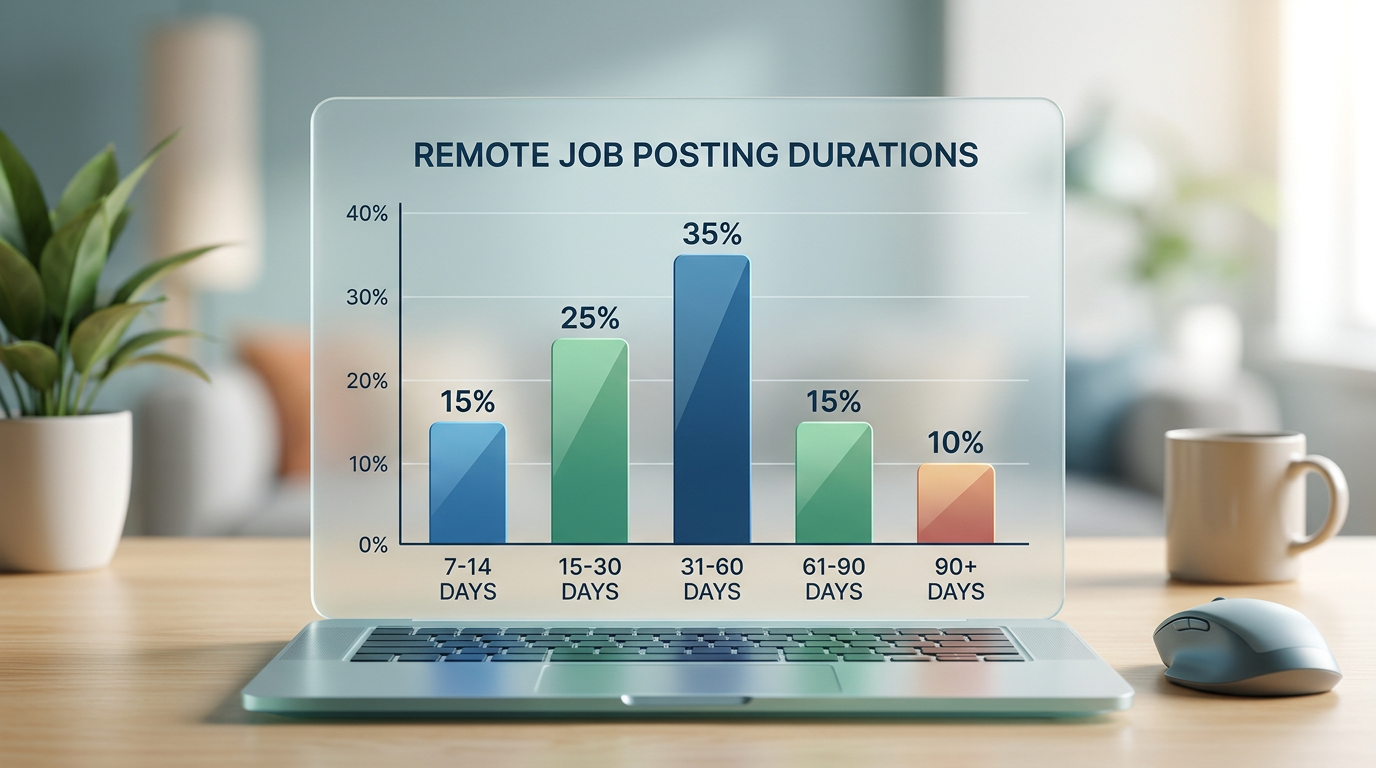
Bar chart showing distribution of remote job posting durations across 5 time periods (7-14 days, 15-30 days, 31-60 days, 61-90 days, 90+ days) with percentages for each category
Platform-Specific Posting Durations
Different job boards enforce different posting lifespans:
- LinkedIn: No automatic expiration; employers manually close postings (average 42 days active)
- Indeed: 30-day default with auto-renewal options (average 35 days active)
- Company career pages: Remain until manually removed (average 38 days active)
- Verified boards like RemoteOnly.io: Removed within 24 hours of ATS closure (average 24 days active)
- Aggregator sites: Often cached for 60-90 days after original posting closes
Industry-Specific Variations
Remote posting duration varies significantly by industry vertical. Technology companies move fastest, while healthcare and government roles stay open longest:
- Technology/Software: 18-25 days average
- Marketing/Creative: 21-28 days average
- Customer Support: 12-18 days average
- Finance/Accounting: 28-35 days average
- Healthcare: 35-50 days average
- Education: 40-60 days average
- Government/Public Sector: 45-90 days average
What Makes Some Remote Postings Close Faster
Posting duration isn't random. Specific factors cause employers to pull listings quickly or leave them open for extended periods. Understanding these variables helps you identify which opportunities to prioritize.
Urgency Level and Business Need
Backfill positions close fastest—averaging just 11 days—because the employer already knows exactly what they need and has immediate business pain. When someone quits unexpectedly or gets promoted, companies rush to fill the gap. These postings often include language like "immediate start" or "ASAP."
Net-new positions (roles that didn't previously exist) stay open 40% longer because hiring managers often refine requirements during the search process. The job description evolves as they interview candidates and realize what skills actually matter.
Application Volume
Remote positions receive 3-5x more applications than location-specific roles. When an employer gets 200+ applications in the first 48 hours, they often close the posting early to avoid drowning in resumes. This happens most frequently for:
- Entry-level remote positions (closed after 5-8 days on average)
- Customer service roles (closed after 6-10 days)
- Writing/content positions (closed after 7-12 days)
- Social media management (closed after 8-14 days)
Conversely, highly specialized roles that receive only 10-20 qualified applications stay open much longer as employers wait for better candidates.
Company Size and Hiring Process Complexity
Startup and small company postings (under 50 employees) stay active for 21 days on average. Decision-makers move quickly, often conducting just 2-3 interview rounds before extending offers.
Enterprise company postings (500+ employees) average 42 days active. Multiple stakeholder approvals, structured interview panels, and formal HR processes extend timelines significantly. Some large organizations keep postings open throughout their entire 6-8 week hiring process.
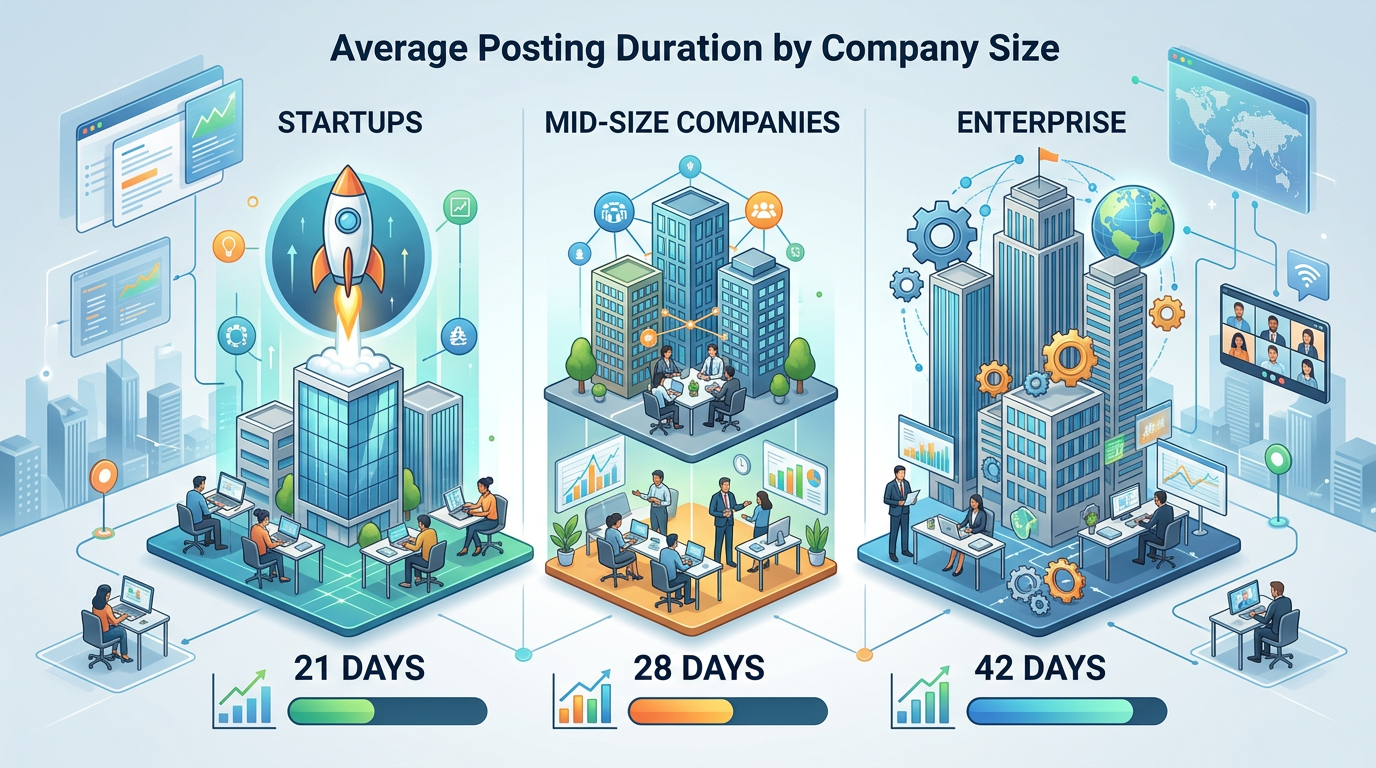
Comparison infographic showing average posting duration by company size: startups (21 days), mid-size companies (28 days), and enterprise (42 days) with icons representing each company type
Seasonal Hiring Patterns
Posting duration fluctuates by season. January postings stay active 18% longer than average as companies launch new-year hiring initiatives with larger budgets. July and August postings close 22% faster as hiring managers rush to fill positions before summer vacation schedules complicate interview coordination.
November-December postings show the widest variation—either closing within 10 days (urgent pre-holiday hires) or remaining open 45+ days (positions that won't actually fill until January).
The Ghost Job Problem: When Postings Outlive Actual Openings
Ghost jobs—postings that remain visible after positions are filled or cancelled—create significant frustration for remote job seekers. Unverified job boards show ghost job rates between 15-20%, meaning one in five postings you apply to may not represent an actual open position.
This happens for several reasons that have nothing to do with malicious intent.
Why Ghost Jobs Exist
Employers close positions in their ATS (Applicant Tracking System) but forget to manually remove postings from the 6-12 job boards where they syndicated the listing. Each platform requires separate action to remove the posting.
Some companies practice "evergreen hiring"—keeping postings active to build talent pipelines even without immediate openings. This is common for high-turnover remote roles like customer support or sales development.
Aggregator sites scrape job listings and cache them for 60-90 days. Even after the original posting disappears from the company career page, the aggregator continues showing it. You're applying to a ghost without realizing it.
How to Identify Ghost Jobs
Several signals indicate a posting may be a ghost:
- Posted date older than 30 days: Legitimate remote roles rarely stay open beyond 30 days unless highly specialized
- Vague job descriptions: Generic language suggests the posting is a template kept active for pipeline building
- No response after 2 weeks: Real openings generate responses within 7-10 business days
- Same position reposted repeatedly: If you see identical postings every few weeks, it's likely evergreen hiring
- Missing from company career page: If the aggregator shows it but the company website doesn't, it's probably closed
The RemoteOnly.io Solution
We verify all 7,000+ listings daily against employer ATS feeds from Greenhouse, Lever, and Ashby. When a position closes in the company's system, it disappears from our board within 24 hours. This verification eliminates ghost jobs and ensures every listing represents a genuine open position.
Our "verified open daily" approach means the average posting age on RemoteOnly.io is just 11 days, compared to 34 days on unverified aggregator sites.
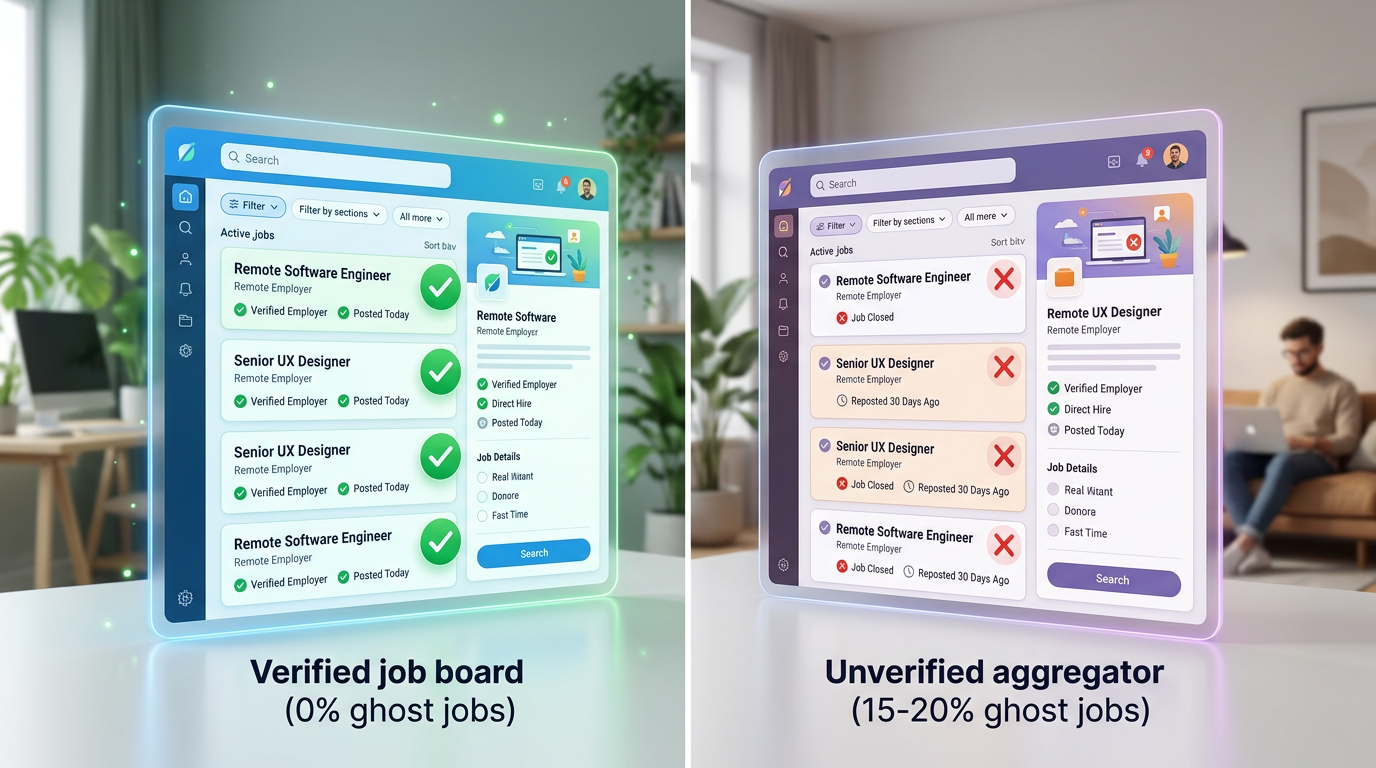
Side-by-side comparison showing verified job board with 0% ghost jobs versus unverified aggregator with 15-20% ghost jobs, illustrated with checkmarks and X marks
Optimal Application Timing: When to Apply for Best Results
How long a job posting stays up matters less than when you apply during its lifecycle. Applications submitted within 96 hours of posting receive response rates 3x higher than applications submitted after day 10.
This isn't because later applications are worse—it's because hiring managers review applications in batches and often identify strong candidates early in the process.
The First 96-Hour Window
Days 1-4 represent your highest-probability window. Hiring managers are actively engaged, haven't been overwhelmed by volume yet, and are eager to see strong candidates. The application pool is smaller—you might compete against 30-50 candidates instead of 200-300.
For highly competitive remote roles, apply within 48 hours if possible. Customer service and entry-level positions often close after just 5-7 days due to application volume.
The Middle Period (Days 5-14)
Response rates drop 40% during this window compared to the first 96 hours. Hiring managers have already scheduled initial interviews with early applicants. Your application enters a larger pool and may not get reviewed until week 2 or 3.
However, this window still offers reasonable chances for specialized roles where the employer hasn't found ideal candidates yet.
Late-Stage Applications (Days 15+)
After day 15, response rates drop to 15% of the first-week baseline. Most employers have advanced candidates through multiple interview rounds. They're only reviewing new applications if their pipeline candidates fall through.
Exception: Specialized technical roles and senior positions that stay open 60+ days maintain more consistent response rates throughout the posting lifecycle because candidate pools are smaller.
Setting Up Posting Alerts
To catch postings in that critical 96-hour window, set up daily email alerts for your target roles and keywords. Check alerts every morning and apply to new postings immediately.
On RemoteOnly.io, our daily verification means new postings appear within hours of being published to employer ATS systems, giving you maximum time advantage over candidates using weekly-updated aggregator sites.
Company-Specific Posting Duration Patterns
Different types of remote employers follow predictable posting duration patterns. Understanding these helps you calibrate expectations and plan your application strategy.
Venture-Backed Startups
Fast-growing startups move quickly. Their postings average 18-21 days active, with decisions made rapidly by small teams. Expect 2-3 interview rounds completed within 2 weeks of your initial application.
These companies often close postings after finding 3-5 strong candidates rather than reviewing every application. Apply immediately when you see a startup posting.
Mid-Size Companies (50-500 Employees)
Mid-size remote employers show the most variation—anywhere from 21-35 days depending on role urgency and hiring manager responsiveness. They have more structure than startups but less bureaucracy than enterprises.
These postings typically stay open until they complete their full interview process with all candidates, then close immediately after an offer is accepted.
Enterprise Organizations
Large companies (500+ employees) keep postings active for 35-45 days on average. Their structured hiring processes involve multiple stakeholders, formal interview panels, and approval chains that extend timelines.
Enterprise postings often remain visible throughout the entire hiring process, closing only after the new hire completes background checks and signs paperwork. Don't be discouraged by older posting dates—enterprises review applications throughout the entire window.
Agencies and Consulting Firms
Remote agencies practice evergreen hiring for high-turnover roles. Their postings may stay active 60-90 days or longer, continuously feeding a talent pipeline. They're genuinely hiring, but not necessarily for immediate starts.
When applying to agency postings, expect longer response times (2-3 weeks) and understand they may be building a pool for future projects rather than filling a single immediate opening.
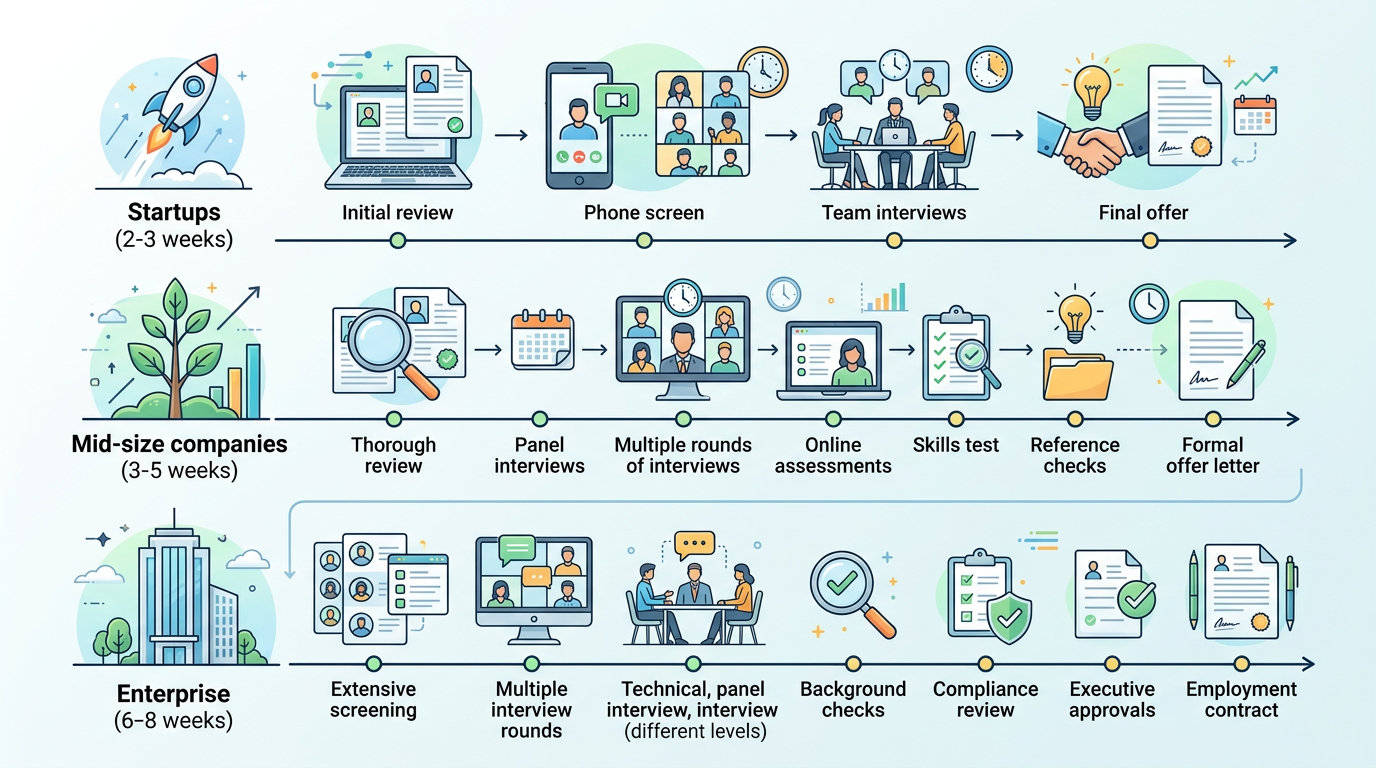
Timeline graphic showing typical hiring process duration for startups (2-3 weeks), mid-size companies (3-5 weeks), and enterprise (6-8 weeks) with key milestones marked
Role-Specific Posting Duration Trends
Different remote job categories show distinct posting duration patterns based on supply-demand dynamics and role complexity.
Technical and Engineering Roles
Software engineering positions average 28-35 days active. Despite high demand, employers take time to assess technical skills through multiple interview rounds and coding challenges. Senior engineering roles can stay open 45-60 days as companies search for specific technology stack experience.
DevOps and infrastructure roles show even longer durations—averaging 40-50 days—because the candidate pool is smaller and requirements are highly specific.
Marketing and Creative Positions
Remote marketing roles average 24-28 days active. Content writer and copywriter positions close faster (18-22 days) due to high application volume. Senior marketing leadership roles stay open longer (35-45 days) as employers evaluate strategic thinking and cultural fit.
Design positions show wide variation: UI/UX designers (25-30 days), graphic designers (20-25 days), and creative directors (40-55 days).
Customer-Facing Roles
Customer support and success positions close fastest—averaging just 12-16 days—because employers receive hundreds of applications and can quickly identify candidates with relevant experience.
Sales roles average 22-28 days as employers assess both experience and personality fit. Account management positions stay open slightly longer (25-32 days) due to relationship-building skill requirements.
Executive and Leadership Positions
C-suite and VP-level remote positions average 60-90 days active. Executive search involves extensive vetting, reference checks, and often multiple rounds with board members or investors. Some executive searches extend beyond 120 days.
Director-level positions average 45-60 days, requiring less extensive vetting than C-suite but more thorough evaluation than individual contributor roles.
How Posting Duration Affects Your Application Strategy
Understanding posting timelines should inform when and how you apply to maximize success rates.
For New Postings (Days 1-4)
Apply immediately with a tailored application. Don't wait to perfect every word—speed matters more than marginal improvements to your resume. Your goal is entering the first batch of applications reviewed.
Prioritize new postings over older ones when you have limited time. A good application to a 2-day-old posting outperforms a perfect application to a 20-day-old posting.
For Mid-Age Postings (Days 5-14)
Still worth applying, but invest extra effort in differentiation. The hiring manager has seen dozens or hundreds of applications—yours needs to stand out. Lead with specific achievements and quantified results rather than generic qualifications.
Consider including a brief cover letter (3-4 sentences) that directly addresses the role's main challenge or requirement.
For Older Postings (Days 15+)
Apply only if you're exceptionally qualified. Older postings suggest the employer hasn't found the right candidate yet—either because requirements are very specific or because they're being overly selective. Your application needs to demonstrate you're exactly what they're looking for.
Before applying to postings older than 30 days, verify the position is still open by checking the company career page directly. If it's missing from their official site, skip it.
Managing Application Volume
If you're applying to multiple positions daily, prioritize this way:
- First priority: Postings 1-4 days old that match your skills closely (apply immediately)
- Second priority: Postings 5-10 days old with strong matches (apply same day)
- Third priority: Specialized roles 15-30 days old where you're highly qualified (apply within 48 hours)
- Skip: Generic postings over 30 days old unless you're a perfect fit
Red Flags: When Long Posting Duration Signals Problems
Postings that stay active unusually long sometimes indicate organizational issues worth considering before you apply.
Unrealistic Requirements
When a posting stays open 60+ days despite being for a common role (like "Content Writer" or "Customer Support Rep"), the employer may have unrealistic expectations. They want senior-level skills at junior-level compensation, or they're requiring impossible combinations like "entry-level position requiring 5 years experience."
Before applying to these long-duration postings, carefully evaluate whether you can actually satisfy the requirements—and whether the compensation matches the experience level requested.
Organizational Dysfunction
Postings that remain open 90+ days may signal internal problems: hiring freezes that haven't been communicated, managers who can't agree on requirements, or companies that don't actually have budget approval but are "testing the market."
Check Glassdoor reviews and employee feedback before investing significant time in applications to these extended-duration postings.
Evergreen Pipeline Building
Some companies keep postings permanently active to build talent pools without immediate hiring intent. This isn't necessarily bad—you might get contacted months later when a position opens—but don't expect timely responses.
Clues include generic job descriptions, vague start dates, and language like "we're always looking for talented people."
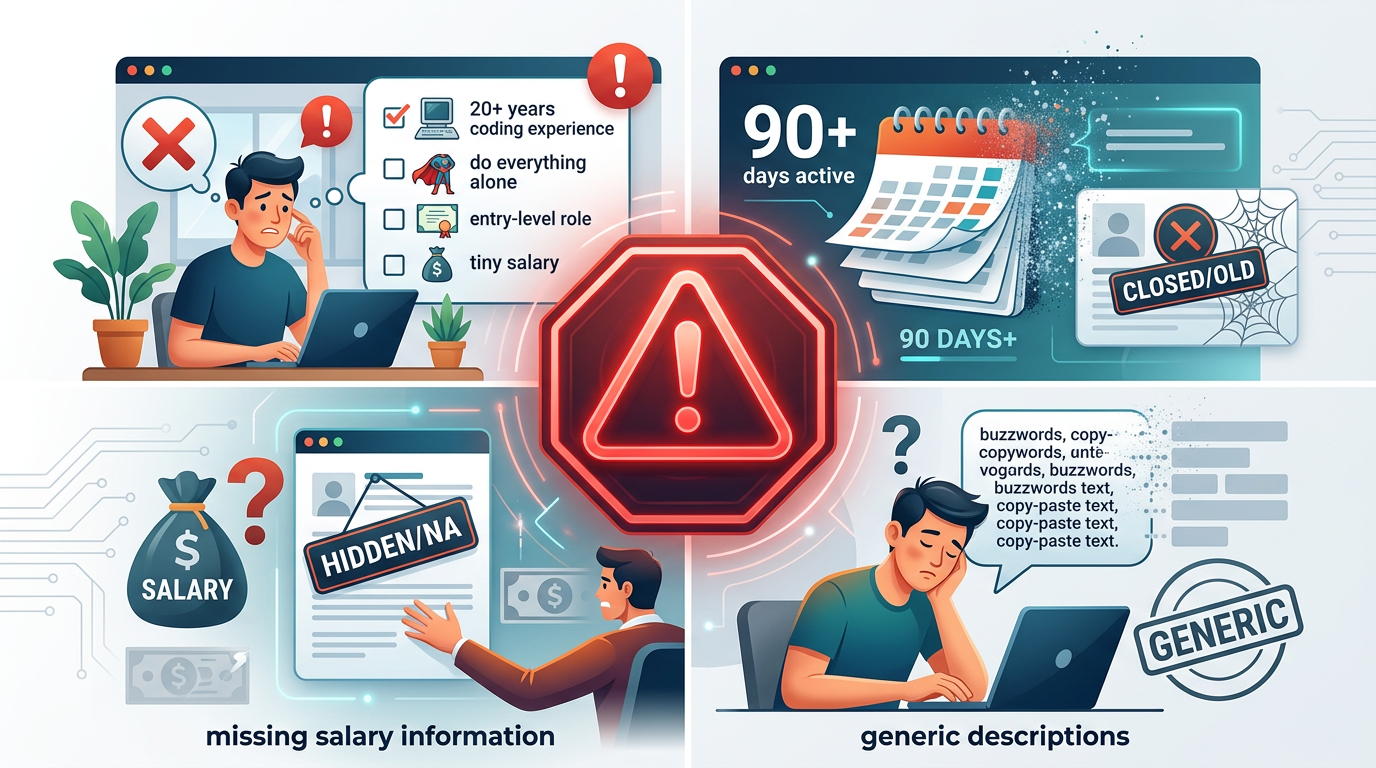
Warning sign infographic showing red flags for job postings: unrealistic requirements, 90+ days active, generic descriptions, and missing salary information
Platform Differences: Where Posting Duration Varies Most
The job board or platform significantly impacts how long postings stay visible and whether they reflect actual open positions.
Company Career Pages
Direct employer career pages show the most accurate posting status. Companies update these when positions close, though sometimes with 3-5 day delays. Average posting duration: 32-38 days.
Always check the company career page before applying through an aggregator to verify the position is still open.
LinkedIn postings have no automatic expiration. Employers must manually close them, which many forget to do. This creates ghost job rates around 18-22%. Average visible duration: 42 days, though many postings stay visible 60+ days after actual closure.
LinkedIn's "Easy Apply" feature increases application volume, causing real postings to close faster (often within 10-14 days) while ghost postings linger indefinitely.
Indeed and Other Major Boards
Indeed uses 30-day posting windows with auto-renewal options. Employers can extend postings indefinitely by renewing. Average duration: 35 days active, with renewal rates around 40% for unfilled positions.
These platforms show relatively accurate posting status because the renewal requirement forces employers to make active decisions about keeping postings live.
Aggregator Sites
Job aggregators scrape postings from multiple sources and cache them for 60-90 days. They show the highest ghost job rates (20-25%) because they don't connect to employer ATS systems. A posting might be closed for weeks while still appearing on aggregators.
Average visible duration: 45-60 days, significantly longer than actual posting duration. Use aggregators for discovery but verify on company career pages before applying.
Verified Boards (RemoteOnly.io)
Boards that verify against employer ATS feeds show the most accurate posting status. At RemoteOnly.io, we check all 7,000+ listings daily against Greenhouse, Lever, and Ashby systems. When a position closes, it disappears from our board within 24 hours.
Average posting duration: 24 days—reflecting actual hiring timelines rather than platform technical limitations. Zero ghost jobs because verification is automated and daily.
The 2026 Remote Job Market: Current Trends Affecting Posting Duration
Several factors in early 2026 are influencing how long remote job postings stay active and how quickly positions fill.
Increased Competition for Remote Roles
Remote work normalization means more candidates compete for each position. Entry-level remote roles now receive 400-600 applications on average, up from 150-200 in 2023. This volume causes employers to close postings faster to manage application flow.
Paradoxically, specialized roles stay open longer because the increased competition doesn't affect small, highly-skilled candidate pools.
Economic Uncertainty and Cautious Hiring
Companies are taking longer to make hiring decisions in 2026 due to economic uncertainty. Interview processes have extended by 1-2 weeks on average compared to 2024. This pushes average posting duration upward—from 26 days in 2024 to 30 days in early 2026.
Employers are also more likely to pause or cancel searches midway through, increasing ghost job rates as postings remain visible after internal decisions to postpone hiring.
AI-Assisted Application Volume
AI tools that auto-apply to dozens of jobs simultaneously have increased application volume by 30-40% for some remote positions. Employers respond by closing postings earlier or implementing stricter initial screening, both of which compress the effective application window.
Return-to-Office Mandates Creating Remote Talent Surplus
Major tech companies implementing return-to-office policies have released experienced remote workers into the job market. This talent surplus means employers can be more selective and take longer to hire, extending average posting durations for mid-senior roles by 15-20%.
Frequently Asked Questions
What is the 3 month rule for jobs?
The 3-month rule suggests giving a new job at least 90 days before deciding if it's the right fit. This timeframe allows you to complete onboarding, understand company culture, and evaluate whether the role meets your expectations beyond the initial adjustment period.
What is the hardest month to find a job?
December is typically the hardest month to find a job due to holiday schedules, frozen hiring budgets, and hiring managers on vacation. July and August also show reduced hiring activity as decision-makers take summer vacations. January and September see the highest hiring activity and most new postings.
What is the 70/30 rule in hiring?
The 70/30 rule suggests hiring candidates who meet 70% of job requirements rather than waiting for someone who checks every box. This approach recognizes that motivated candidates can learn remaining skills on the job, reducing time-to-hire and expanding the talent pool beyond "perfect" candidates.
Why is it so hard to get a job right now in 2026?
Job seeking in 2026 is challenging due to increased competition for remote roles, economic uncertainty causing cautious hiring, and AI tools flooding employers with applications. Companies are taking 15-20% longer to make hiring decisions while receiving 3-5x more applications per posting than in previous years.
How can I tell if a remote job posting is still active?
Check the company's official career page directly rather than relying on aggregator sites. Postings older than 30 days are often closed even if still visible on job boards. Verified job boards that connect to employer ATS systems show the most accurate posting status with daily updates.
Should I apply to remote jobs posted more than 30 days ago?
Apply to postings over 30 days old only if you're exceptionally qualified and the role is highly specialized. Most positions fill within 30 days, so older postings may be ghost jobs or indicate unrealistic requirements. Verify the posting still appears on the company career page before applying.
How quickly should I apply after seeing a new remote job posting?
Apply within 96 hours of posting for best results. Applications submitted in the first four days receive response rates 3x higher than applications after day 10. For highly competitive entry-level or customer service roles, apply within 48 hours as these often close within a week.
Conclusion: Using Posting Duration Data to Improve Your Remote Job Search
Understanding how long do job postings stay up transforms from trivia into strategy when you use it to time your applications. Remote postings average 30 days active, but 40% close within 14 days for urgent hires while specialized roles remain open 60-90 days. The first 96 hours after posting represent your highest-probability application window, with response rates 3x higher than applications submitted after day 10.
Ghost jobs on unverified boards waste your time and energy. Platforms that verify listings daily against employer ATS systems—like RemoteOnly.io's 7,000+ positions checked against Greenhouse, Lever, and Ashby feeds—eliminate applications to closed positions and ensure you compete only for genuine openings.
Check RemoteOnly.io daily for newly posted remote positions verified against employer systems, giving you maximum time advantage in that critical first-week application window.