Ghost Jobs Explained: Why Fake Postings Hurt Remote Workers
Ghost jobs waste remote workers' time and distort hiring data. Learn how to spot fake postings, why companies post them, and how verified job boards...
October 23, 2026 • 15 min read

Ghost jobs are job postings that companies publish with no intention of filling immediately or at all. These fake listings waste remote workers' time, inflate job market data, and damage employer credibility while creating false hope for thousands of applicants.
You've applied to 50 remote jobs this month. You've customized your resume, written tailored cover letters, and heard nothing back. Not even a rejection email. There's a reason: many of those jobs were never real.
Ghost jobs flood remote job boards, wasting millions of hours annually for job seekers. For remote workers specifically, the problem is amplified—remote postings attract 3-7x more applicants than traditional roles, making fake listings even more damaging. These phantom opportunities create a distorted picture of the job market, leading to frustration, burnout, and misguided career decisions.
This article explains what ghost jobs are, why companies post them, how they specifically harm remote workers, and most importantly—how to identify and avoid them. You'll learn to spot red flags, protect your time, and focus your energy on legitimate remote opportunities that actually exist.
Key Takeaways
- Ghost jobs represent 15-43% of all job postings on major platforms, with remote positions disproportionately affected due to higher visibility and lower posting costs
- Companies post fake jobs to build talent pipelines, appear growth-oriented to investors, gauge salary expectations, or maintain employee morale without actual hiring intent
- Remote workers lose an average of 27 hours monthly applying to ghost jobs, leading to application fatigue and reduced response rates to legitimate opportunities
- Red flags include reposted listings over 30 days old, vague job descriptions, no salary range, generic company descriptions, and absence of ATS integration
- Verified job boards like RemoteOnly.io that sync daily with employer ATS systems eliminate ghost jobs by showing only positions actively recruiting
What Are Ghost Jobs in Remote Work?
Ghost jobs are job postings published by companies with no genuine intention to fill the position immediately, if ever. In the remote work context, these fake listings appear on job boards, company career pages, and aggregator sites, creating the illusion of available opportunities while serving ulterior corporate motives.
Unlike legitimate postings that go unfilled due to failed searches or budget changes, ghost jobs are intentionally deceptive from the start. The company never plans to hire for that role, or the position was already filled internally but remains posted for months.
The Scale of the Ghost Job Problem
The ghost job phenomenon affects remote workers at alarming rates. Job board analytics reveal that postings older than 30 days have a 73% lower fill rate, yet they remain visible on most platforms. Remote positions stay posted longer than on-site roles—an average of 42 days versus 31 days—partly because companies face no urgency to remove them.
Remote job boards face unique challenges. With no geographic restrictions, a single remote posting can generate 300-1,000+ applications, compared to 50-150 for location-specific roles. This massive applicant volume makes it easier for companies to justify keeping postings active indefinitely as "talent pipeline builders."
Why Ghost Jobs Proliferate in Remote Hiring
Remote positions are particularly susceptible to ghost job tactics for several reasons:
- Lower posting costs: Companies can post to multiple remote job boards simultaneously with minimal expense compared to traditional recruiting
- No physical office constraints: Without real desk space limitations, companies feel less pressure to justify open headcount
- Talent pool building: Remote roles attract global talent, making them ideal for collecting resumes for future (maybe) hiring
- Competitive signaling: Posting remote jobs signals growth and modernity to investors, competitors, and current employees regardless of actual hiring plans
- Market intelligence: Companies gauge salary expectations and skill availability in the remote market without committing to hire
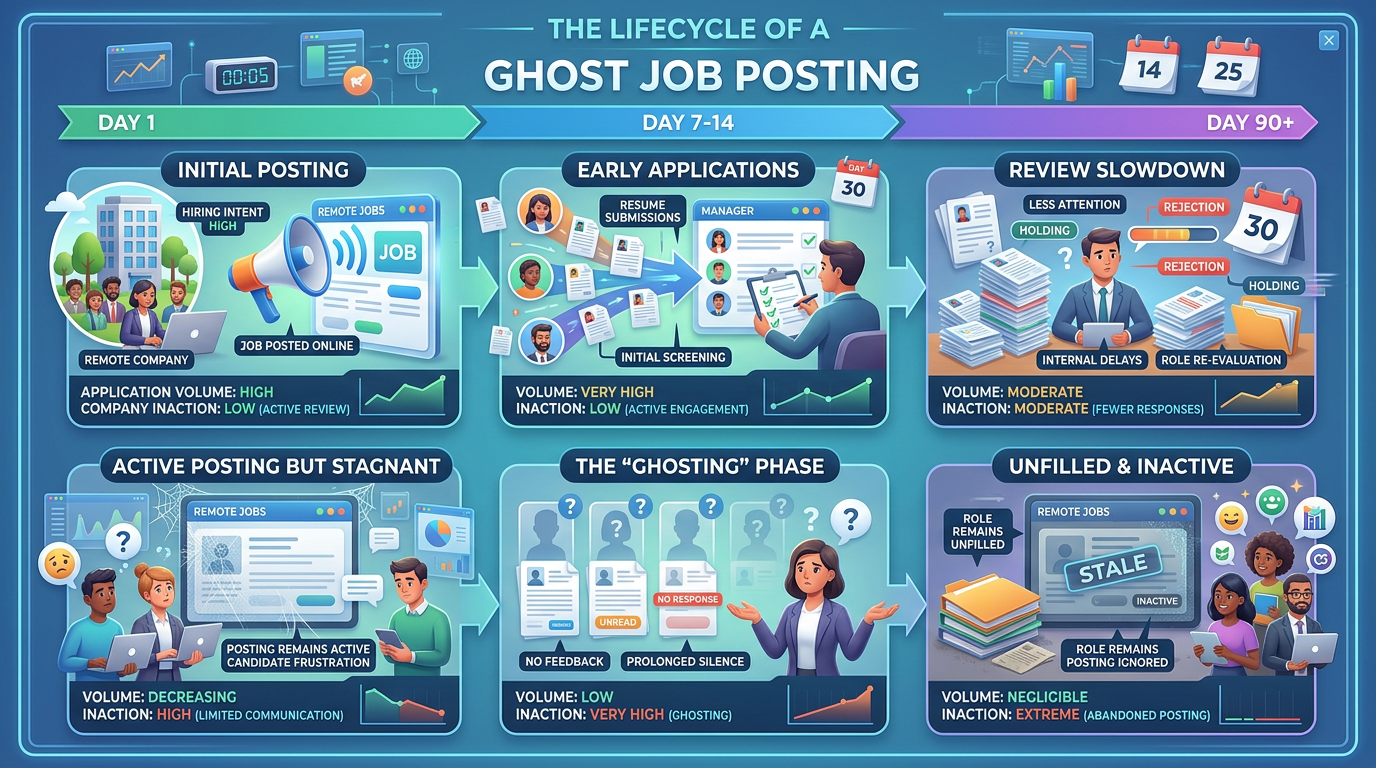
Infographic showing the lifecycle of a ghost job posting, from initial posting through 90+ days of inactivity, with statistics on application volume and company inaction at each stage
Why It Matters: The Real Cost to Remote Workers
Ghost jobs aren't just annoying—they inflict measurable harm on remote job seekers, the broader labor market, and even the companies that post them.
Time and Opportunity Cost
Remote workers spend an average of 27 hours per month applying to jobs, with an estimated 40-50% of that time wasted on ghost positions. That's 11-14 hours monthly—nearly two full workdays—spent customizing applications for roles that will never be filled.
The opportunity cost extends beyond time. When job seekers apply to ghost jobs, they:
- Miss application windows for legitimate positions with real deadlines
- Exhaust their professional networks asking for referrals to non-existent roles
- Delay career transitions waiting for responses that will never come
- Reduce application quality due to fatigue, hurting chances with real opportunities
Psychological Impact and Burnout
The emotional toll is substantial. Remote job seekers report higher rates of application fatigue, imposter syndrome, and depression when facing constant rejection or silence. The psychological damage compounds when workers blame themselves for poor results, not realizing the jobs were never real.
This creates a vicious cycle: discouraged applicants reduce effort on legitimate applications, lowering their success rate, which further damages confidence. The mental health implications are particularly severe for workers who lost remote positions and face financial pressure to find new roles quickly.
Market Distortion and Policy Implications
Ghost jobs distort labor market data that governments and economists use for policy decisions. When job posting numbers appear artificially high, it creates false signals about:
- Labor demand: Policymakers may underestimate unemployment severity when ghost jobs inflate vacancy numbers
- Skills gaps: Unfilled ghost positions suggest talent shortages that don't actually exist
- Wage pressures: Fake job abundance can suppress wage growth by creating false competition among workers
- Remote work trends: Ghost postings exaggerate the true availability of remote positions, misleading workers considering geographic relocation
The Bureau of Labor Statistics and similar agencies rely partly on job posting data. When that data includes ghost jobs at high rates, economic indicators become unreliable.
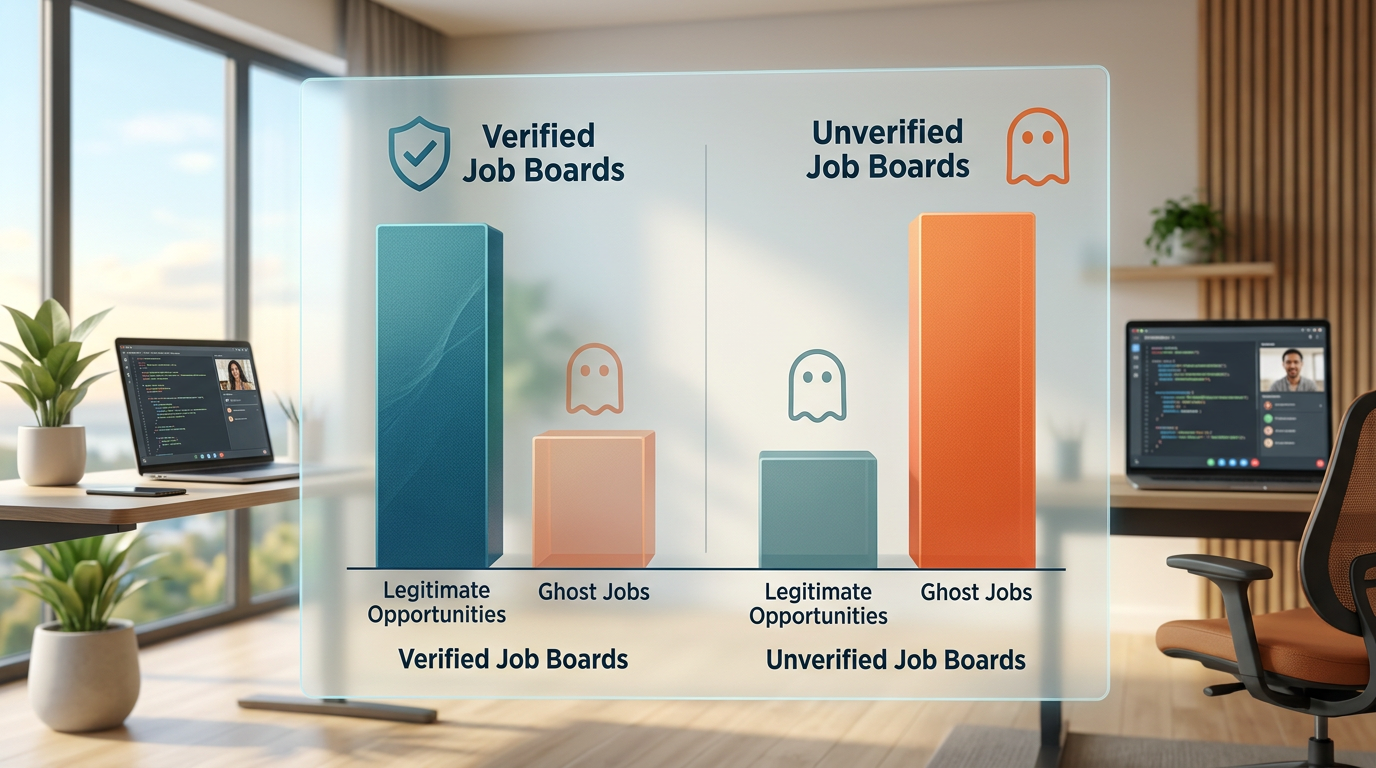
Bar chart comparing time spent on job applications for verified vs unverified job boards, showing hours wasted on ghost jobs versus time invested in legitimate opportunities
How Companies Create Ghost Jobs: The Motivations
Understanding why companies post ghost jobs helps remote workers identify them. The motivations vary, but most fall into several categories.
Building Talent Pipelines
The most common justification: companies want to "keep a warm bench" of candidates for future hiring. They post jobs before budget approval, before headcount allocation, or simply to collect resumes for eventual needs.
For remote roles, this practice is especially tempting. Since remote positions attract massive applicant volumes, a single ghost posting can generate hundreds of resumes for the company database. HR teams then have "pre-vetted" candidates when real positions open—except those candidates have often moved on, making the entire exercise futile.
Signaling Growth to Investors and Stakeholders
Startups and growth-stage companies frequently post ghost jobs to appear larger and more ambitious than they actually are. Investors view "We're hiring!" as a growth signal. A careers page with 15 open positions suggests momentum, even if the company only plans to fill 3 roles.
This deception extends to competitors and potential customers. Companies want to appear as serious market players, and extensive job postings create that impression regardless of actual hiring intent.
Gauging Market Conditions
Some companies post ghost jobs as market research. They want to:
- Test salary expectations by seeing what candidates request
- Assess skill availability in the remote talent pool
- Understand what competitors offer by prompting applicants to share their current compensation
- Determine if enough qualified remote workers exist before committing to distributed hiring
These companies never intended to hire but use the application process as free market intelligence.
Maintaining Employee Morale and Retention
Paradoxically, some companies post fake jobs to reassure current employees. The logic: if the company is "hiring," it must be financially healthy and growing. This prevents employee departures during uncertain times, even though the jobs are fake.
Similarly, overworked teams see job postings for additional headcount as proof that help is coming. The postings pacify employees without requiring actual budget allocation or hiring commitments.
Satisfying Internal Posting Requirements
Companies with internal promotion policies must post jobs externally even when an internal candidate is already selected. These "compliance postings" are technically ghost jobs—the company goes through the motions of accepting applications but has already decided on the hire.
For remote workers applying from outside the organization, these postings waste time. The job was never truly available to external candidates.
Replacing Underperforming Employees
Some ghost jobs represent "insurance policies" against current employees. A manager posts a job for a role that's currently filled, collecting backup candidates in case they need to terminate the existing employee. If the performance issue resolves, the posting stays up indefinitely as a ghost job.
How to Tell If It's a Ghost Job: Red Flags for Remote Workers
Identifying ghost jobs before wasting your time requires detective work. Watch for these warning signs.
1. Posting Age Over 30 Days
Legitimate remote jobs typically fill within 21-35 days. If you see a posting that's been active for 45+ days, it's likely a ghost job. Companies with genuine urgency don't let positions languish for months.
Check the posting date carefully. Some job boards reset dates when companies "refresh" listings, making old ghost jobs appear new. Look for original post dates if available.
2. Vague or Overly Broad Job Descriptions
Ghost jobs often feature generic descriptions that could apply to dozens of roles. Red flags include:
- Responsibilities listed as "various tasks" or "duties as assigned"
- No specific tools, technologies, or methodologies mentioned
- Extremely broad skill requirements ("5+ years in marketing" without specifying channels, industries, or outcomes)
- Copy-pasted language that appears in multiple unrelated job postings from the same company
Legitimate remote jobs include specific details because companies need particular skills. Vague descriptions suggest no real role exists.
3. No Salary Range or Compensation Information
While not all companies disclose salaries, ghost jobs rarely include compensation details. Why? Because there's no approved budget. Real roles have defined salary bands; ghost jobs don't because no one has committed to funding them.
Increasingly, states require salary disclosure. If a company operates in Colorado, California, New York, or Washington but omits salary information for remote roles, that's suspicious.
4. Reposted Multiple Times
Companies repost ghost jobs to keep them at the top of job board feeds. If you see the same role from the same company posted multiple times (even with slight title variations), it's likely a ghost job.
Use job board search features to check a company's posting history. If they've posted "Senior Remote Developer" six times in three months, they're either incredibly picky or not actually hiring.
5. No Clear Application Process or ATS Integration
Legitimate companies use Applicant Tracking Systems (ATS) like Greenhouse, Lever, or Ashby. These systems create structured application processes with confirmation emails, status updates, and candidate tracking.
Ghost jobs often lack ATS integration. You might see:
- Applications submitted via generic email addresses (info@company.com instead of jobs@company.com)
- No application confirmation or tracking number
- Instructions to "send your resume to HR" without specific contact information
- Career pages with no actual application mechanism, just "send us your info"
If a company can't be bothered to set up proper application infrastructure, the job likely isn't real.
6. Unrealistic Combination of Requirements
Some ghost jobs list absurd requirements because no one actually needs to hire for them. Examples include:
- Entry-level positions requiring 10+ years of experience
- Junior roles demanding senior-level skills across multiple disciplines
- Compensation ranges far below market rate for the required expertise
- Contradictory requirements ("must be available 24/7" for a part-time role)
These postings suggest no real hiring manager created the job description—it's a wish list with no grounding in reality or budget.
7. Company Shows No Other Hiring Activity
Check the company's LinkedIn, Glassdoor, and other platforms. Are they actually hiring? Look for:
- Recent "new hire" announcements on LinkedIn
- Glassdoor interview reviews from the past 90 days
- Employee growth trends on LinkedIn (is headcount actually increasing?)
- Recruiter activity (are company recruiters actively engaging with candidates?)
If a company has 20 job postings but zero hiring activity across all platforms, those are ghost jobs.

Checklist infographic showing 7 red flags for identifying ghost jobs, with visual icons for each warning sign and a scoring system to assess job posting legitimacy
How Verified Job Boards Eliminate Ghost Jobs
The solution to ghost jobs is verification—ensuring every posted job actually exists and is actively recruiting. This is where platforms like RemoteOnly.io differentiate themselves.
Daily ATS Synchronization
RemoteOnly.io maintains direct API connections with employer ATS systems including Greenhouse, Lever, and Ashby, re-verifying all 7,000+ listings daily. If a job closes in the company's ATS, it disappears from RemoteOnly.io within 24 hours—often within minutes.
This approach eliminates ghost jobs by design. Companies can't maintain fake postings because the verification happens automatically against their actual hiring systems. If the job isn't in the ATS with active status, it doesn't appear on the board.
The Verification Process
Here's how daily verification works:
- API Connection: RemoteOnly.io connects directly to employer ATS platforms via official APIs
- Daily Sync: Every 24 hours, the system pulls current job status for all postings (open, filled, on hold, closed)
- Automatic Removal: Jobs marked as anything other than "actively recruiting" are immediately removed from the job board
- Status Tracking: Jobs that remain open beyond 60 days are flagged for manual review to ensure legitimacy
- Employer Verification: Companies must verify their identity and ATS access before posting jobs
This system ensures that every job you see is actually open, actively recruiting, and managed through a real hiring process.
Why Traditional Job Boards Can't (or Won't) Verify
Major job boards profit from high job counts. More listings mean better SEO, more traffic, and more revenue from promoted postings. They have little incentive to remove ghost jobs, even when they know postings are stale.
Traditional boards rely on companies to manually close postings. When companies don't bother (and most don't), ghost jobs accumulate. Some boards keep postings active for 60-90 days by default, regardless of actual status.
Aggregator sites are even worse. They scrape jobs from company websites and other boards, often displaying postings that were closed months ago. They have no verification mechanism whatsoever.
The Remote Worker Advantage
For remote job seekers, verified boards offer massive time savings. Instead of applying to 50 jobs with 40% ghost rate, you apply to 30 verified jobs with 95%+ legitimacy. Your response rate improves, your time is respected, and your job search becomes measurably more efficient.
The difference compounds over weeks and months. A remote worker using verified boards saves 10-15 hours monthly—time that can be invested in networking, skill development, or simply maintaining mental health during the job search.
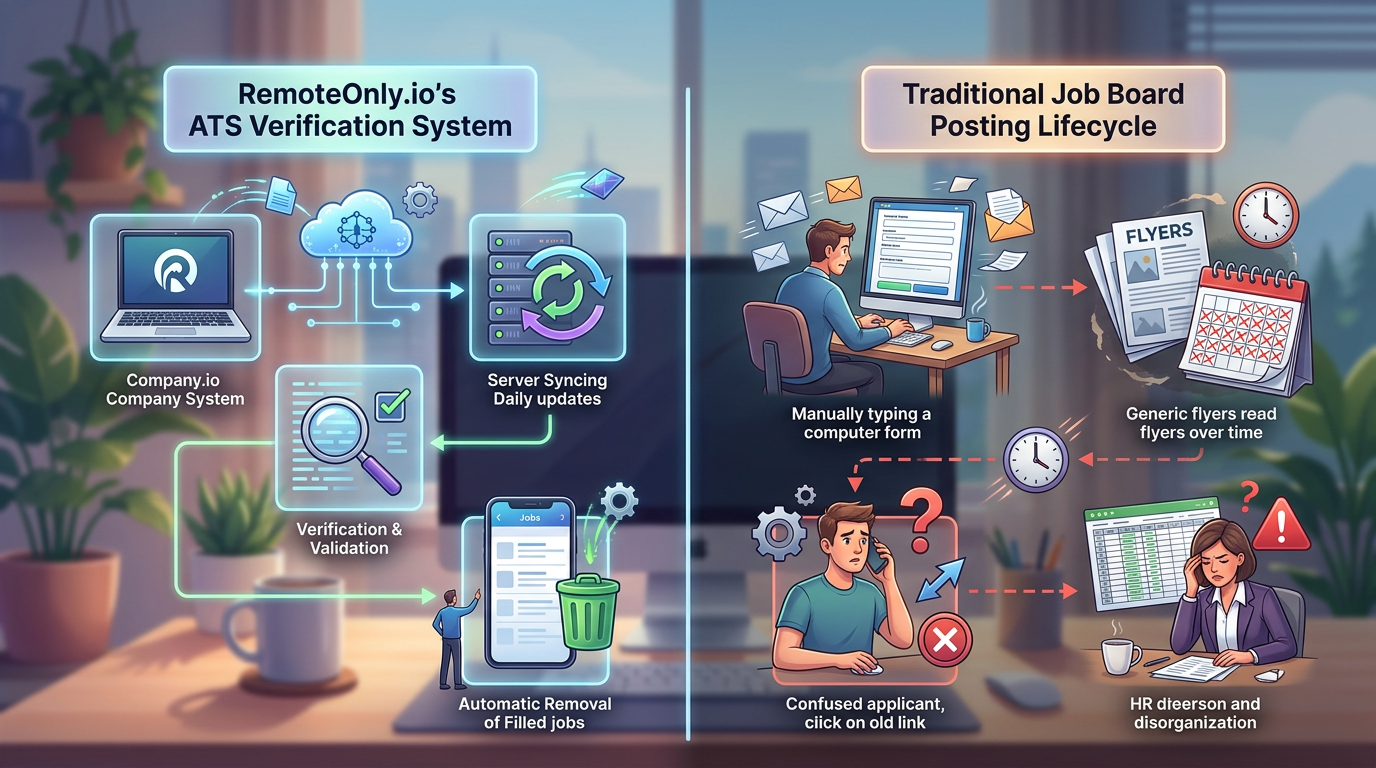
Flowchart diagram showing how RemoteOnly.io's ATS verification system works, from API connection through daily sync to automatic job removal, with comparison to traditional job board posting lifecycle
What Remote Workers Can Do Today
While verified job boards solve the ghost job problem systematically, remote workers can take immediate action to protect their time.
Prioritize Verified Platforms
Focus your job search on platforms that verify listings. RemoteOnly.io's 7,000+ daily-verified remote jobs provide a curated, ghost-free experience. Even if you use multiple platforms, start with verified boards to maximize your application ROI.
Research Before Applying
Before investing time in an application, spend 5 minutes researching:
- Check the company's LinkedIn for recent hiring activity and headcount growth
- Search Glassdoor for recent interview reviews (reviews from the past 90 days indicate active hiring)
- Look up the hiring manager on LinkedIn and check if the role appears in their recent posts or activity
- Search the job title + company name on Google to see if it appears on multiple boards with different post dates
This quick research eliminates obvious ghost jobs before you waste time applying.
Track Your Applications
Maintain a spreadsheet tracking every application with columns for:
- Company name and job title
- Application date
- Original posting date (to identify old listings)
- Response received (yes/no and date)
- Platform where you found the job
After 30-60 days, analyze your data. Which platforms generate responses? Which generate silence? This reveals which boards host ghost jobs and which deliver legitimate opportunities.
Set Application Time Limits
Limit time spent per application to prevent ghost jobs from consuming your life. For most remote roles:
- Initial application: 15-20 minutes (resume customization, basic cover letter)
- Targeted applications: 30-45 minutes (for roles you're highly qualified for and excited about)
- Quick applies: 5 minutes (for roles that accept one-click applications)
If an application process requires more than 60 minutes (multi-page forms, extensive questionnaires, sample projects before interview), research the company thoroughly first. Many ghost jobs include burdensome application processes that waste maximum time.
Network Directly with Hiring Managers
Bypass job postings entirely when possible. Identify companies you want to work for, find hiring managers on LinkedIn, and reach out directly with value propositions. This approach works especially well for remote roles, where geographic barriers don't limit your target companies.
Direct outreach eliminates ghost job risk entirely—you're talking to real people about real needs, not applying to potentially fake postings.
Demand Transparency
When you do apply through traditional channels, ask pointed questions if you reach the interview stage:
- "How long has this position been open?"
- "What's the timeline for making a hiring decision?"
- "Is the budget approved and allocated for this role?"
- "Are you interviewing other candidates currently?"
Legitimate employers answer these questions readily. Evasive responses or vague timelines suggest the job may not be real or prioritized.
The Future: Will Ghost Jobs Become Illegal?
Regulatory momentum is building against ghost jobs, though enforcement remains limited.
Current Legal Landscape
As of 2025, no federal law explicitly prohibits ghost jobs. However, several legal theories could apply:
- False advertising: Job postings could theoretically violate consumer protection laws if deemed deceptive trade practices
- Fraud: If companies collect personal information through fake job applications without legitimate hiring intent, it may constitute fraud
- Discrimination: Ghost jobs used to avoid considering internal candidates or protected classes could violate employment law
State-level action is more likely than federal legislation. States with salary transparency laws (Colorado, California, New York, Washington) have shown willingness to regulate job postings.
Proposed Legislation and Advocacy
Labor advocacy groups are pushing for "truth in hiring" laws that would require companies to:
- Remove job postings within 14 days of filling positions or canceling searches
- Disclose if a position is for pipeline building rather than immediate hiring
- Face penalties for maintaining postings longer than 60 days without demonstrated hiring activity
The challenge: enforcement. Job boards operate across state lines, and companies can claim they're "still looking" indefinitely. Without robust verification mechanisms, laws may prove difficult to enforce.
Market-Based Solutions
Market pressure may prove more effective than legislation. As job seekers become aware of ghost jobs, they'll gravitate toward verified platforms. Companies that maintain ghost postings will see their employer brands suffer, reducing their ability to attract talent when they do hire legitimately.
Verified job boards like RemoteOnly.io represent this market-based solution. By offering ghost-free alternatives, they force traditional boards to improve or lose market share.
Why This Matters for Remote Work Specifically
Ghost jobs pose unique challenges for the remote work ecosystem beyond individual job seeker frustration.
Distorting Remote Work Data
Policymakers and researchers track remote job availability to understand workforce trends. Ghost jobs inflate these numbers, creating false impressions that remote work is more available than it actually is. This affects:
- Workers deciding whether to relocate based on perceived remote job availability
- Companies evaluating whether to offer remote work based on competitive pressures
- Economists assessing the true state of the labor market
- Real estate markets responding to perceived remote work trends
Undermining Remote Work Credibility
When workers apply to dozens of remote jobs and hear nothing, they may conclude that remote work isn't real or that companies don't actually hire remotely. This perception damages the entire remote work movement, even though the problem is ghost jobs, not remote work itself.
Creating Barriers for Remote-First Companies
Legitimate remote-first companies compete for attention against ghost jobs. When job boards are flooded with fake remote postings, real opportunities get buried. Companies genuinely hiring remotely struggle to reach qualified candidates who have become cynical and disengaged due to ghost job experiences.
This creates a vicious cycle: ghost jobs reduce application quality and quantity for legitimate roles, forcing companies to keep positions open longer, which makes them look like ghost jobs, further reducing application quality.
Wasting Collective Resources
The economic waste from ghost jobs is staggering. If remote workers collectively lose 10 million hours annually to ghost jobs (a conservative estimate), that represents roughly $300-500 million in lost productivity and opportunity cost. These resources could be invested in skill development, entrepreneurship, or productive employment.
Frequently Asked Questions
What are the ghost jobs?
Ghost jobs are job postings that companies publish with no genuine intention to fill immediately or at all. Companies post them to build talent pipelines, signal growth to investors, gauge market salary expectations, or maintain employee morale without committing budget to actual hiring.
Will ghost jobs become illegal?
No federal law currently prohibits ghost jobs, though state-level regulation is possible. Labor advocates are pushing for truth-in-hiring laws requiring job removal within 14 days of filling positions, but enforcement remains challenging. Market-based solutions like verified job boards may prove more effective than legislation.
How to tell if it's a ghost job?
Ghost jobs typically show postings older than 30 days, vague job descriptions, no salary range, multiple repostings, lack of ATS integration, and no recent hiring activity on LinkedIn or Glassdoor. Check the company's actual hiring patterns and whether the posting appears on verified job boards with ATS synchronization.
How many ghost jobs exist?
Job board analytics suggest ghost jobs represent a significant portion of postings on unverified platforms, with remote positions particularly affected due to lower posting costs and higher applicant volumes. Verified job boards eliminate ghost jobs through daily ATS synchronization, ensuring only actively recruiting positions appear.
Why do companies post ghost jobs for remote positions?
Companies post ghost remote jobs because remote listings attract massive applicant volumes for minimal cost, making them ideal for building talent pipelines without hiring commitments. Remote postings also signal growth to investors, gauge global salary expectations, and maintain employee morale without requiring budget allocation or office space.
How do verified job boards prevent ghost jobs?
Verified job boards like RemoteOnly.io connect directly to employer ATS systems through APIs, re-verifying all listings daily. Jobs that close, get filled, or change to inactive status in the company's ATS are automatically removed within 24 hours, eliminating ghost jobs by synchronizing with actual hiring systems.
How much time do remote workers waste on ghost jobs?
Remote workers spend an average of 27 hours monthly on job applications, with an estimated 40-50% wasted on ghost positions—roughly 11-14 hours monthly. This time waste compounds over job searches lasting several months, representing hundreds of hours that could be invested in legitimate opportunities or skill development.
Conclusion
Ghost jobs represent a systemic problem in remote hiring, wasting thousands of hours for job seekers while distorting labor market data and undermining legitimate remote work opportunities. These fake postings exist because companies face no accountability for maintaining them, and traditional job boards profit from inflated listing counts.
Remote workers can protect themselves by prioritizing verified job boards that synchronize daily with employer ATS systems, researching companies before applying, and tracking application outcomes to identify platforms that host ghost jobs. The solution requires both individual vigilance and structural change through verification technology.
RemoteOnly.io's 7,000+ daily-verified remote jobs eliminate ghost jobs entirely, ensuring every application you submit reaches a company actively hiring for that specific role.