How to ace executive assistant interview questions: remote work edition
Remote executive assistant interview questions focus on virtual coordination, digital tools, and self-direction. Master the preparation strategies that land...
October 23, 2026 • 27 min read

Executive assistant interview questions for remote roles assess your ability to manage virtual communication, coordinate across time zones, and maintain executive productivity without in-person oversight. Key questions focus on digital tool proficiency, self-direction, time management, and building trust remotely through proactive communication and reliable task execution.
Introduction
Remote executive assistant positions receive an average of 250+ applications per opening on verified job boards. The difference between landing the role and being passed over often comes down to how you answer executive assistant interview questions tailored specifically for distributed work environments.
Unlike traditional EA roles where you might work steps away from your executive, remote positions demand a different skill set. Interviewers want proof you can anticipate needs across time zones, troubleshoot technology independently, and maintain confidentiality when working from home. The executive assistant interview questions you'll face for remote roles dig deeper into your digital communication skills, self-management abilities, and experience with virtual collaboration tools.
This guide breaks down the exact questions remote employers ask, what they're really evaluating, and how to craft answers that demonstrate you're built for distributed work. You'll learn the preparation strategies that separate average candidates from those who receive offers, plus common mistakes that eliminate otherwise qualified applicants.
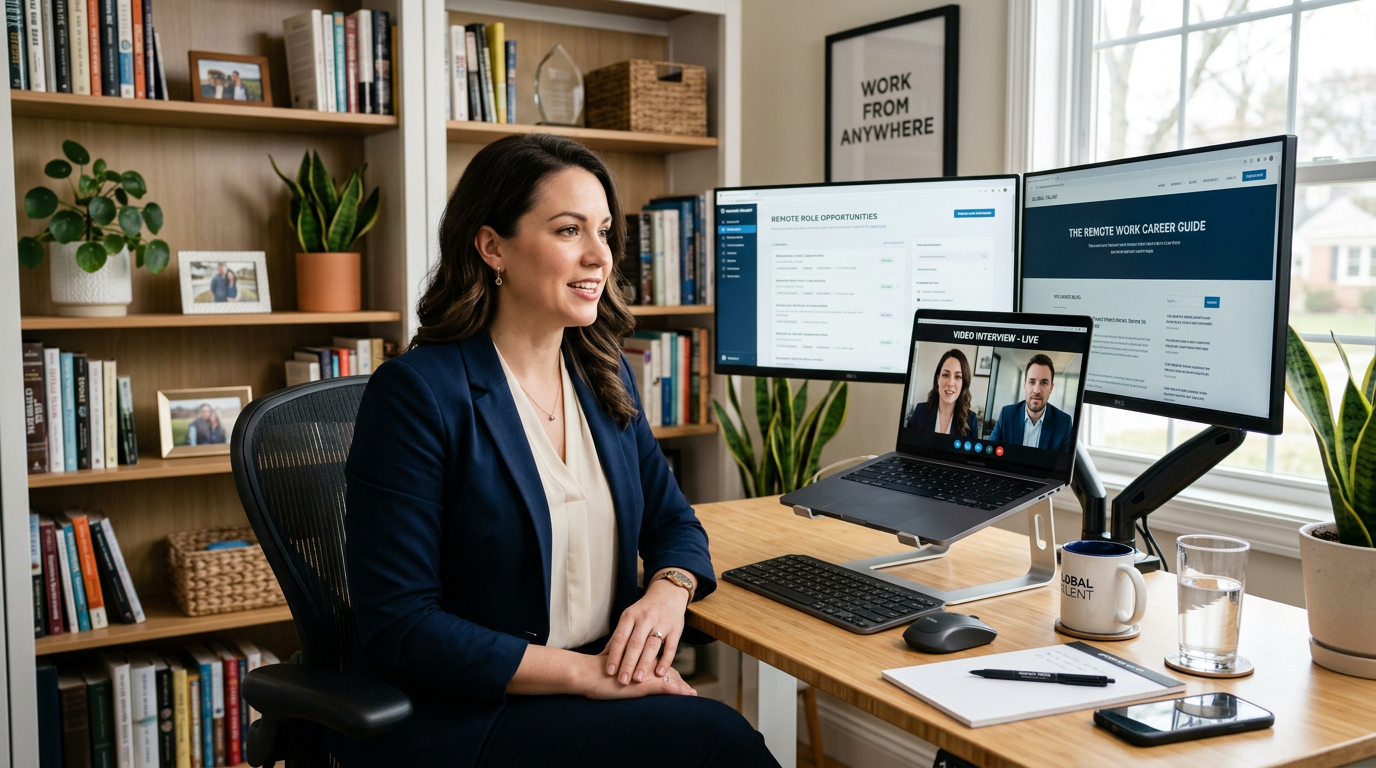
Professional woman in home office setting participating in video interview on laptop, with organized desk showing dual monitors and professional background
Key Takeaways
- Remote EA interviews focus heavily on digital tool proficiency, self-direction, and asynchronous communication skills beyond traditional administrative questions
- Preparation requires testing your tech setup, documenting specific remote work examples, and researching the company's distributed work culture
- The STAR method combined with remote-specific metrics (response times, time zone coordination, digital security practices) creates compelling answers
- Common disqualifiers include poor video interview setup, vague answers about remote tools, and lack of proactive communication examples
- Post-interview follow-up should demonstrate the same organizational skills and attention to detail you'll use in the role
What You'll Need Before the Interview
Preparation for remote executive assistant interview questions requires more than reviewing your resume. Your technical setup, documented examples, and research directly impact your ability to answer confidently and demonstrate remote work competency.
Technical Requirements
- Reliable high-speed internet connection (test your speed at speedtest.net and know your numbers)
- Professional video conferencing setup with proper lighting and neutral background
- Backup communication method (phone number, secondary device) in case of technical issues
- Familiarity with common platforms: Zoom, Google Meet, Microsoft Teams, Slack
- Headphones with microphone for clear audio quality
Documentation to Prepare
- List of remote collaboration tools you've used (Asana, Monday.com, Notion, Trello, etc.) with specific use cases
- 3-5 STAR method examples specifically from remote or virtual work experiences
- Metrics that demonstrate your remote work effectiveness (response time averages, projects coordinated, executives supported)
- Examples of how you've handled confidential information in a home office environment
- Time zone coordination examples if you've worked across multiple regions
Company Research Checklist
- Company's remote work policy (fully remote, hybrid, time zone requirements)
- Executive's background, communication style, and public presence (LinkedIn, company bio)
- Tools and platforms mentioned in the job description
- Company culture indicators from employee reviews on remote-focused platforms
- Recent company news, funding rounds, or organizational changes
Pro Tip: Create a one-page cheat sheet with your key examples, metrics, and company facts. Keep it visible but off-camera during video interviews for quick reference without breaking eye contact with the camera.
Step 1: Master Your Technical Interview Setup
Your interview environment is your first answer to unspoken executive assistant interview questions about your professionalism and remote work capabilities. Interviewers assess your setup before you speak a word.
Optimize Your Video Presence
Position your camera at eye level to create natural eye contact and professional framing. Sit 2-3 feet from your camera with your head and shoulders in frame. Test this 30 minutes before your interview, not 2 minutes before.
- Place your primary light source in front of you, not behind (windows behind you create silhouettes)
- Use a ring light or desk lamp pointed at your face to eliminate shadows
- Select a neutral, organized background or use a professional virtual background
- Close unnecessary browser tabs and applications to prevent notifications
- Set your phone to Do Not Disturb mode
Test Your Technology
Run a complete technology check 24 hours before your interview and again 15 minutes prior. Join the video call 5 minutes early to resolve any connection issues.
- Test your microphone and speakers using the platform's audio check feature
- Verify your camera works and is properly positioned
- Check your internet speed (minimum 10 Mbps download, 5 Mbps upload recommended)
- Have the interviewer's phone number and email accessible for backup communication
- Keep your phone nearby with a mobile hotspot as internet backup
Pro Tip: Record a 2-minute practice video of yourself answering a sample question. Watch it to identify distracting habits (looking away from camera, fidgeting, poor posture) and adjust before the real interview.

Split-screen comparison showing poor vs optimal remote interview setup, highlighting camera angle, lighting, background, and professional appearance
Step 2: Prepare for Core Remote EA Questions
Remote executive assistant interview questions fall into predictable categories that assess your distributed work competency. Prepare specific examples for each category using the STAR method (Situation, Task, Action, Result).
Time Management and Prioritization Questions
Interviewers want evidence you can manage competing priorities without in-person guidance. These questions evaluate your ability to make judgment calls independently and communicate proactively when priorities conflict.
Common questions in this category:
- How do you prioritize tasks when your executive is in back-to-back meetings and unreachable?
- Describe your system for managing multiple time-sensitive requests across different time zones
- Walk me through how you organize your day when supporting executives in different locations
- Tell me about a time you had to reprioritize your entire day due to an urgent request
Structure your answers to include specific tools (task management software), processes (daily review routines), and communication protocols (how you keep executives informed of priority shifts).
Digital Communication Questions
Remote work eliminates casual desk-side conversations. Interviewers assess whether you can maintain executive effectiveness through digital channels alone.
- How do you decide whether to send an email, Slack message, text, or schedule a call?
- Describe your approach to keeping an executive informed without overwhelming them with messages
- Give an example of how you've built rapport with an executive you've never met in person
- How do you handle miscommunication or unclear instructions in a remote setting?
Your answers should demonstrate understanding of communication hierarchy, response time expectations, and proactive clarification skills.
Technology and Tool Proficiency Questions
Remote EAs troubleshoot technology independently. Expect detailed questions about your digital toolkit and learning agility with new platforms.
- What project management tools have you used, and how did you implement them?
- Describe a time you had to learn a new software platform quickly to complete a project
- How do you maintain document organization and version control in a cloud environment?
- What's your process for scheduling across multiple time zones using digital calendars?
Pro Tip: When discussing tools, mention specific features you've used (not just the tool name). Instead of saying "I use Asana," say "I use Asana's custom fields to track project status and dependencies, with automated reminders for stakeholders 48 hours before deadlines."
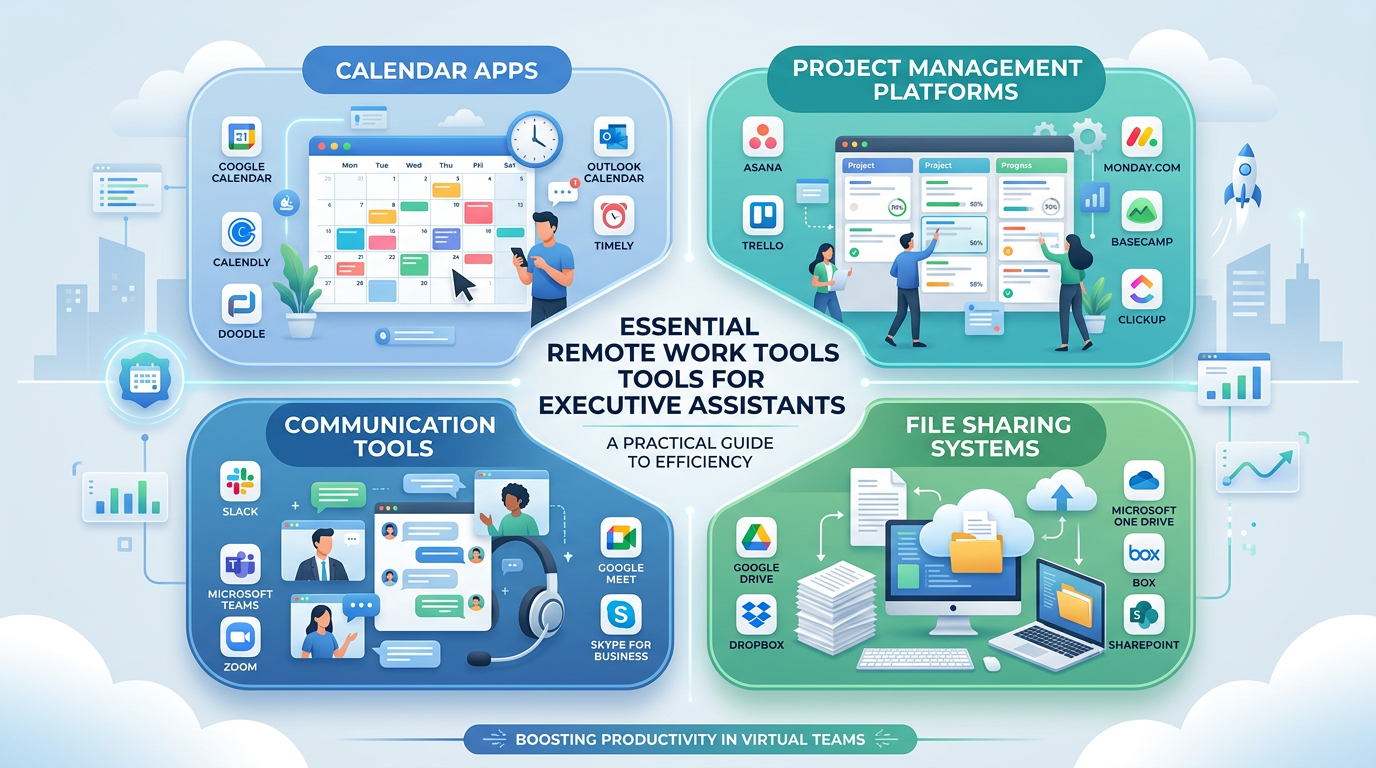
Infographic showing common remote work tools for executive assistants including calendar apps, project management platforms, communication tools, and file sharing systems
Step 3: Craft Compelling STAR Method Answers
The STAR method (Situation, Task, Action, Result) provides structure for behavioral interview questions. For remote executive assistant interview questions, add specific remote work elements to each component.
Situation: Set Remote Context
Establish the remote work environment and constraints in your opening 1-2 sentences. Include details like time zone differences, virtual team composition, or distributed work challenges.
Example: "In my previous role supporting a VP across 3 time zones, our team operated fully remotely with no overlapping work hours between the executive and the East Coast team."
Task: Define Your Remote Responsibility
Clarify what you needed to accomplish and why it was challenging in a remote environment. This demonstrates your understanding of distributed work complexities.
Example: "I needed to coordinate a board presentation involving 8 stakeholders across 4 countries, with materials requiring confidential review and approval, all within a 72-hour deadline."
Action: Highlight Remote-Specific Skills
Detail the specific steps you took, emphasizing remote work competencies like digital communication, asynchronous coordination, and virtual collaboration tools.
- Explain the digital tools you selected and why
- Describe your communication strategy for keeping stakeholders aligned
- Highlight proactive measures you took to prevent issues
- Include how you maintained security and confidentiality remotely
Result: Quantify Remote Work Outcomes
Provide specific metrics that demonstrate successful remote execution. Numbers make your accomplishments concrete and memorable.
Strong result examples include:
- "Delivered the presentation materials 6 hours ahead of schedule with zero errors"
- "Reduced executive meeting prep time by 40% through automated briefing documents"
- "Maintained 2-hour average response time across 9-hour time zone difference"
- "Coordinated 50+ remote events with 98% attendance rate and no technical issues"
Pro Tip: Keep your STAR answers under 2 minutes. Practice with a timer. Interviewers lose interest in rambling stories, and concise answers demonstrate the communication efficiency required for remote work.
Step 4: Address Remote-Specific Competency Questions
Certain executive assistant interview questions appear exclusively in remote role interviews. These assess competencies that don't matter in traditional office settings but are critical for distributed work success.
Self-Direction and Accountability
Without in-person supervision, remote EAs must demonstrate self-motivation and ownership. Interviewers want evidence you'll maintain productivity and quality without someone watching over your shoulder.
Prepare for questions like:
- How do you stay motivated and productive when working alone?
- Describe your workspace setup and daily routine
- How do you handle distractions or personal interruptions during work hours?
- Give an example of a project you completed with minimal supervision
Your answers should include specific routines, boundaries, and self-management systems that demonstrate discipline and professionalism.
Security and Confidentiality in Home Office
Remote EAs handle sensitive executive information from home networks. Expect detailed questions about your security practices.
- How do you ensure confidentiality when working from home with family members present?
- What security measures do you take with your home network and devices?
- Describe a time you had to handle sensitive information in a non-office environment
- How do you secure physical documents and dispose of confidential materials at home?
Strong answers mention specific tools (VPNs, password managers, encrypted storage), physical security measures (locked office door, shredder, privacy screens), and established protocols.
Building Trust Remotely
Executive-EA relationships rely on trust. Remote settings make trust-building more challenging and deliberate.
Questions focus on:
- How do you build rapport with an executive you've never met in person?
- Describe your communication style for keeping executives informed without micromanaging
- How do you demonstrate reliability when your work isn't visible?
- Give an example of how you've anticipated an executive's needs remotely
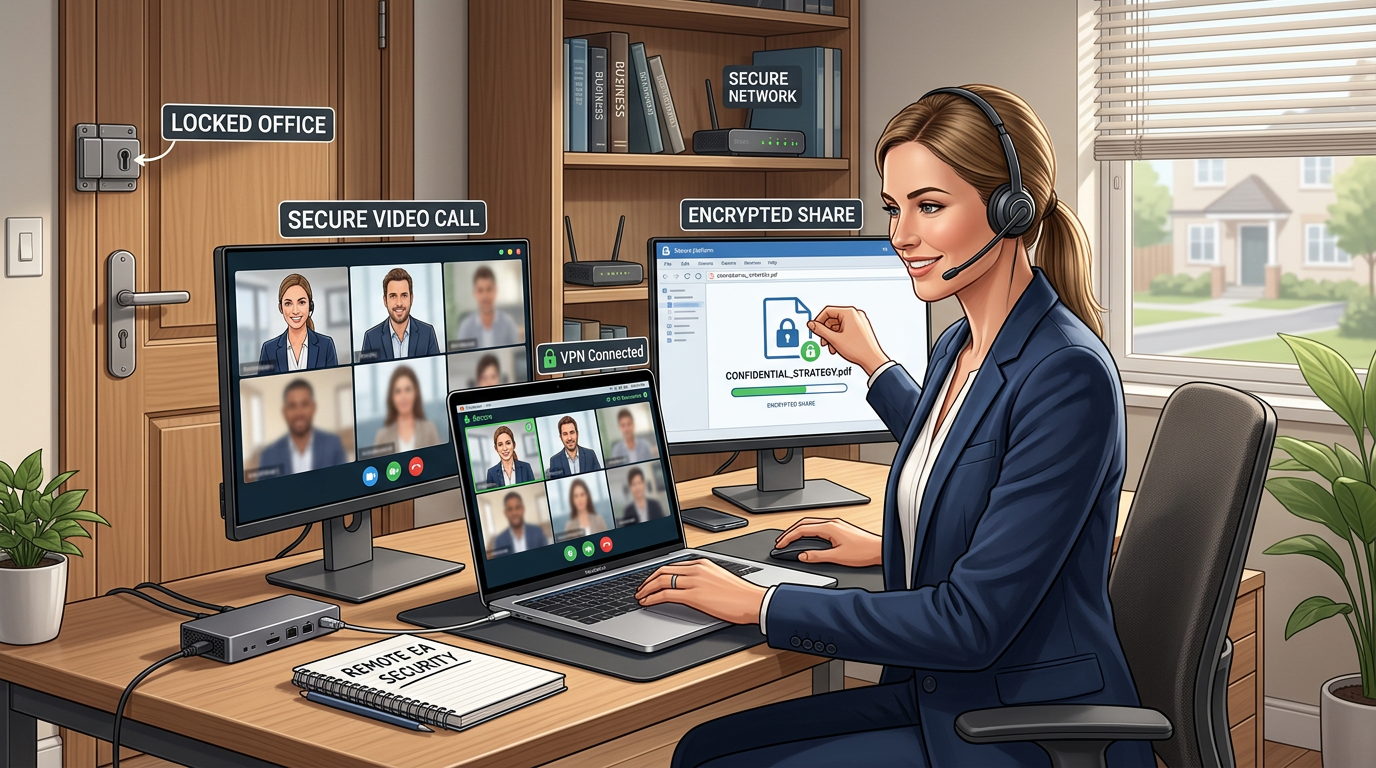
Illustration of remote executive assistant demonstrating security practices including VPN usage, secure video calls, locked home office, and encrypted file sharing
Step 5: Prepare Questions to Ask Interviewers
The questions you ask reveal your remote work sophistication and genuine interest in the role. Asking no questions signals lack of preparation or engagement. Prepare 5-7 questions and select 3-4 based on interview flow.
Questions About Remote Work Structure
- What does a typical day look like for the executive, and what are their core working hours?
- How does the executive prefer to receive information and updates (email, Slack, daily standup)?
- What time zones does the team operate across, and are there expected core collaboration hours?
- How often does the team meet synchronously versus working asynchronously?
Questions About Success Metrics
- What would success look like in this role after 30, 60, and 90 days?
- What are the top 3 priorities for the EA in the first quarter?
- How is performance evaluated for remote executive assistants?
- What challenges has the executive faced with remote support in the past?
Questions About Tools and Processes
- What is the current tech stack for executive support (calendar, project management, communication)?
- Are there established processes I'd be following, or would I help create them?
- How does the company handle information security for remote executive assistants?
- What equipment and software does the company provide versus expect me to supply?
Pro Tip: Take notes during the interview and reference them when asking questions. "You mentioned the executive travels frequently—how does that affect the EA's scheduling responsibilities?" This demonstrates active listening and engagement.
Common Mistakes to Avoid
Certain mistakes eliminate otherwise qualified candidates from consideration for remote EA roles. These errors signal lack of remote work experience or poor judgment about distributed work dynamics.
Technical and Setup Failures
Poor audio/video quality immediately suggests you can't manage the basic technology requirements of remote work. Interviewers won't trust you to troubleshoot executive technology issues if you can't optimize your own setup.
- Joining from a location with background noise (coffee shops, cars, rooms with other people)
- Using laptop camera positioned too low, creating unflattering angles
- Visible clutter or unprofessional items in your background
- Frequent "Can you hear me?" or "You're breaking up" moments
- Not testing technology before the interview starts
Vague or Generic Answers
Generic answers that could apply to any administrative role fail to demonstrate remote work competency. Interviewers need proof you understand distributed work challenges.
- Saying "I'm very organized" without specific systems or tools
- Claiming "I'm good with technology" without naming platforms you've mastered
- Providing examples from only in-office work experiences
- Answering questions about remote work with "I'd figure it out" instead of proven strategies
- Failing to quantify your accomplishments with specific metrics
Communication Red Flags
- Rambling answers that exceed 3 minutes (shows poor communication efficiency)
- Interrupting the interviewer or talking over them due to audio lag
- Not asking any questions about the role or company
- Failing to follow up with a thank-you email within 24 hours
- Using overly casual language or slang inappropriate for executive-level support
Missing Remote Work Awareness
Answers that ignore remote work realities suggest you haven't thought through the challenges of distributed executive support.
- Not mentioning time zone considerations in scheduling examples
- Ignoring asynchronous communication in your workflow descriptions
- Failing to address how you'd build trust without in-person interaction
- Not discussing information security in home office environments
- Assuming you'll have real-time access to executives for quick questions
Troubleshooting Common Interview Challenges
Even with thorough preparation, unexpected issues arise during remote interviews. How you handle these challenges demonstrates your problem-solving abilities and grace under pressure.
Technical Difficulties During the Interview
Technical issues will happen. Your response matters more than the problem itself.
If your internet connection drops:
- Immediately call the interviewer using your backup phone number
- Briefly explain the issue and ask if they'd prefer to continue by phone or reschedule
- If continuing by phone, reference your previously visible documents verbally
- Follow up with an email apologizing for the disruption and reiterating your interest
If you can't hear or see the interviewer clearly:
- Politely interrupt once: "I apologize, but I'm having trouble hearing you clearly. Could you please repeat that?"
- If issues persist, suggest switching platforms or moving to phone audio
- Don't pretend to hear—asking for clarification is better than answering the wrong question
Difficult or Unexpected Questions
If you're asked a question you're unprepared for, use a structured approach rather than freezing or rambling:
- Buy yourself 5-10 seconds: "That's a great question. Let me think about the best example..."
- If you truly don't have experience with what they're asking, say so honestly and pivot to a related skill
- Example: "I haven't used that specific platform, but I learned Asana in 2 days for a previous role and am confident I can quickly master new tools"
- Never make up experience or lie about skills—it will surface later
Interview Running Over Time
If you have a hard stop and the interview is running long:
- Mention your time constraint politely when 5 minutes remain: "I want to be respectful of your time—I know we're scheduled until 2:00"
- Offer to continue: "I'm happy to continue if you have time, or we can schedule a follow-up call"
- If you must leave, apologize professionally and express enthusiasm for continuing the conversation
- Never abruptly end the call without acknowledgment
Understanding the 5 C's and Other Interview Frameworks
Several interview frameworks help structure your preparation and responses for executive assistant interview questions. Understanding these models gives you a mental framework during the interview.
The 5 C's of Interviewing
The 5 C's framework evaluates candidates across five competency areas: Competence, Character, Communication, Culture Fit, and Career Direction. Remote EA interviews weigh Communication and Character more heavily than traditional roles due to the trust required in distributed work.
For remote EA roles, demonstrate:
- Competence: Specific technical skills, tool proficiency, and remote work experience with measurable outcomes
- Character: Self-direction, integrity with confidential information, and reliability without supervision
- Communication: Clear digital communication, proactive updates, and appropriate channel selection
- Culture Fit: Alignment with company's remote work values and executive's working style
- Career Direction: Long-term interest in remote executive support, not treating it as a temporary position
The 30-60-90 Day Plan Framework
The 30-60-90 rule refers to outlining what you'll accomplish in your first three months. Many interviewers ask candidates to describe their plan for the first 90 days.
Structure your answer:
- First 30 days: Learning phase—understand executive's preferences, master tools, establish communication protocols, build relationships with key stakeholders
- Days 31-60: Contributing phase—take ownership of core responsibilities, optimize existing processes, identify improvement opportunities
- Days 61-90: Optimizing phase—implement process improvements, anticipate needs proactively, expand support scope
For remote roles, emphasize relationship-building activities in the first 30 days despite physical distance.
SMART Goals for Executive Assistants
Interviewers may ask about your professional goals or how you'd measure success. The SMART framework (Specific, Measurable, Achievable, Relevant, Time-bound) provides structure.
Five SMART goals relevant to remote executive assistants:
- Response Time: Maintain 2-hour average response time to executive requests during business hours, measured monthly
- Meeting Efficiency: Reduce executive meeting prep time by 30% within 90 days through automated briefing document templates
- Stakeholder Satisfaction: Achieve 90%+ satisfaction rating from key stakeholders in quarterly feedback surveys
- Process Documentation: Create comprehensive process documentation for all recurring tasks within 6 months to ensure business continuity
- Professional Development: Complete certification in advanced project management tools (Asana, Monday.com) within first quarter
Pro Tip: When discussing goals, tie them directly to executive productivity and business outcomes, not just your own skill development. Frame goals as "enabling the executive to focus on strategic priorities" rather than "improving my organizational skills."

Visual framework showing 30-60-90 day plan for remote executive assistant with specific milestones and activities for each phase
What's Next: Post-Interview Actions
Your actions after the interview are part of the evaluation process. Remote EAs are assessed on follow-through and communication quality, which your post-interview behavior demonstrates.
Immediate Follow-Up (Within 24 Hours)
- Send a personalized thank-you email to each interviewer within 24 hours
- Reference specific conversation points from your interview (not a generic template)
- Reiterate your interest and highlight one key qualification that aligns with their needs
- Keep it concise—3-4 paragraphs maximum
- Proofread carefully for errors (sloppy emails eliminate EA candidates immediately)
If You Don't Hear Back
Follow the timeline they provided. If they said "We'll be in touch by Friday," wait until the following Monday before following up.
Your follow-up email should:
- Reaffirm your interest in the position
- Ask about timeline and next steps
- Offer to provide additional information or references
- Remain professional and positive (never demanding or entitled)
Continue Your Preparation
While waiting for responses:
- Apply to other remote EA positions (don't put all hopes on one opportunity)
- Deepen your skills with the tools mentioned in the interview
- Request informational interviews with current remote EAs to learn best practices
- Update your portfolio or examples based on questions you struggled to answer
- Review and refine your STAR method examples for future interviews
Frequently Asked Questions
How to prepare for an executive assistant interview?
Prepare by documenting 3-5 STAR method examples from remote work experiences, testing your video setup 24 hours in advance, researching the executive's background and communication style, and creating a list of specific tools you've mastered. Practice answering common questions about time management, digital communication, and self-direction while timing yourself to keep responses under 2 minutes.
What are the 5 C's of interviewing?
The 5 C's are Competence, Character, Communication, Culture Fit, and Career Direction. For remote executive assistant roles, Communication and Character carry extra weight because distributed work requires clear digital communication and self-direction without in-person oversight. Demonstrate these through specific examples of remote collaboration, proactive updates, and independent problem-solving.
What is the 30-60-90 rule in an interview?
The 30-60-90 rule is a framework outlining your plan for the first three months: days 1-30 focus on learning systems and building relationships, days 31-60 on taking ownership of core responsibilities, and days 61-90 on optimizing processes and expanding your impact. For remote roles, emphasize relationship-building strategies that work across distance in your first 30 days.
What are the 5 smart goals for an executive assistant?
Five SMART goals include: maintaining 2-hour average response time to executive requests, reducing meeting prep time by 30% through automation within 90 days, achieving 90%+ stakeholder satisfaction in quarterly surveys, documenting all recurring processes within 6 months, and completing advanced project management tool certification within first quarter. Each goal should be specific, measurable, and tied to executive productivity.
What questions should I ask in a remote EA interview?
Ask about the executive's typical day and core working hours, their preferred communication channels and update frequency, time zones the team operates across, current tech stack for executive support, and what success looks like after 30-60-90 days. These questions demonstrate remote work sophistication and genuine interest in the role's specific requirements.
How do I demonstrate remote work skills without previous remote EA experience?
Draw from any remote or virtual collaboration experience including freelance work, remote volunteer roles, or distributed team projects. Focus on transferable skills like asynchronous communication, digital tool proficiency, self-directed work, and time zone coordination. Emphasize your home office setup, security practices, and proactive communication style that translates to remote executive support.
What's the biggest mistake candidates make in remote EA interviews?
The biggest mistake is providing examples only from in-office work without translating them to remote contexts. Interviewers need proof you understand distributed work challenges like asynchronous communication, time zone coordination, building trust remotely, and maintaining security from home. Every answer should include remote-specific elements like digital tools used, virtual communication strategies, or self-direction without supervision.
Conclusion
Acing executive assistant interview questions for remote roles requires preparation beyond traditional EA interviews. Your answers must demonstrate digital communication proficiency, self-direction, and proven ability to build trust and maintain productivity across distance. The candidates who receive offers come prepared with specific remote work examples, quantified metrics, and sophisticated understanding of distributed work dynamics.
Success starts with technical preparation—optimizing your video setup, testing your connection, and creating a professional environment. It continues with structured STAR method examples that highlight remote-specific competencies like asynchronous coordination, time zone management, and virtual relationship-building. The questions you ask reveal your remote work sophistication as much as the answers you provide.
Remote executive assistant positions on verified job boards like RemoteOnly.io offer opportunities to support leaders while maintaining location flexibility. Browse current openings with daily verification to find roles matching your skills and career goals.