Employer of Record Cost: Breaking Down Pricing for Remote Teams
Employer of record cost runs $199-$650 per employee monthly. See real pricing from 7+ providers, hidden fees to avoid, and when EORs beat entity setup costs.
October 23, 2026 • 22 min read

Employer of record cost typically ranges from $199 to $650 per employee per month, depending on the provider, country, and services included. This fee covers payroll processing, tax compliance, benefits administration, and legal employment responsibilities for remote workers across international borders, eliminating the need for companies to establish foreign entities.
Remote hiring has exploded—companies now access talent in 50+ countries without opening physical offices. But employing someone in Poland, Brazil, or Singapore legally requires navigating local labor laws, tax codes, and compliance requirements. That's where an Employer of Record (EOR) becomes critical.
The employer of record cost is often the deciding factor for companies scaling remote teams internationally. Understanding what you're paying for—and what drives these fees—determines whether an EOR makes financial sense versus establishing a legal entity abroad.
This guide breaks down EOR pricing models, hidden fees, country-specific cost variations, and how to calculate total employment expenses. You'll see real numbers from 7+ providers, learn what impacts pricing, and discover when an EOR delivers ROI for remote teams.
Key Takeaways
- EOR services cost $199-$650 per employee monthly, with pricing varying significantly by country and provider
- Total employment cost includes EOR fees plus employee salary, benefits, taxes, and mandatory contributions—often 130-180% of base salary
- Hidden fees like onboarding charges ($200-$500), offboarding costs, and currency conversion can add 10-15% to annual expenses
- EORs become cost-effective when hiring 1-15 employees internationally; above 15-20, entity establishment often costs less
- High-compliance countries (Germany, France, Brazil) have higher EOR fees than low-complexity markets (UK, Canada, Australia)
What Is an Employer of Record and Why It Matters for Remote Teams
An Employer of Record is a third-party organization that becomes the legal employer for your remote workers in foreign countries. You manage the employee's daily work, but the EOR handles all legal employment responsibilities.
The EOR manages payroll, tax withholding, benefits administration, employment contracts, and compliance with local labor laws—allowing you to hire internationally in days instead of months. This eliminates the need to establish a foreign subsidiary, which typically costs $78,000-$128,000 and takes 4-8 months.
For remote teams, EORs solve three critical problems: legal compliance in unfamiliar jurisdictions, speed to hire (often 48-72 hours), and cost predictability. Companies hiring in 3-5 countries would otherwise need separate legal entities, accounting firms, and HR teams in each location.
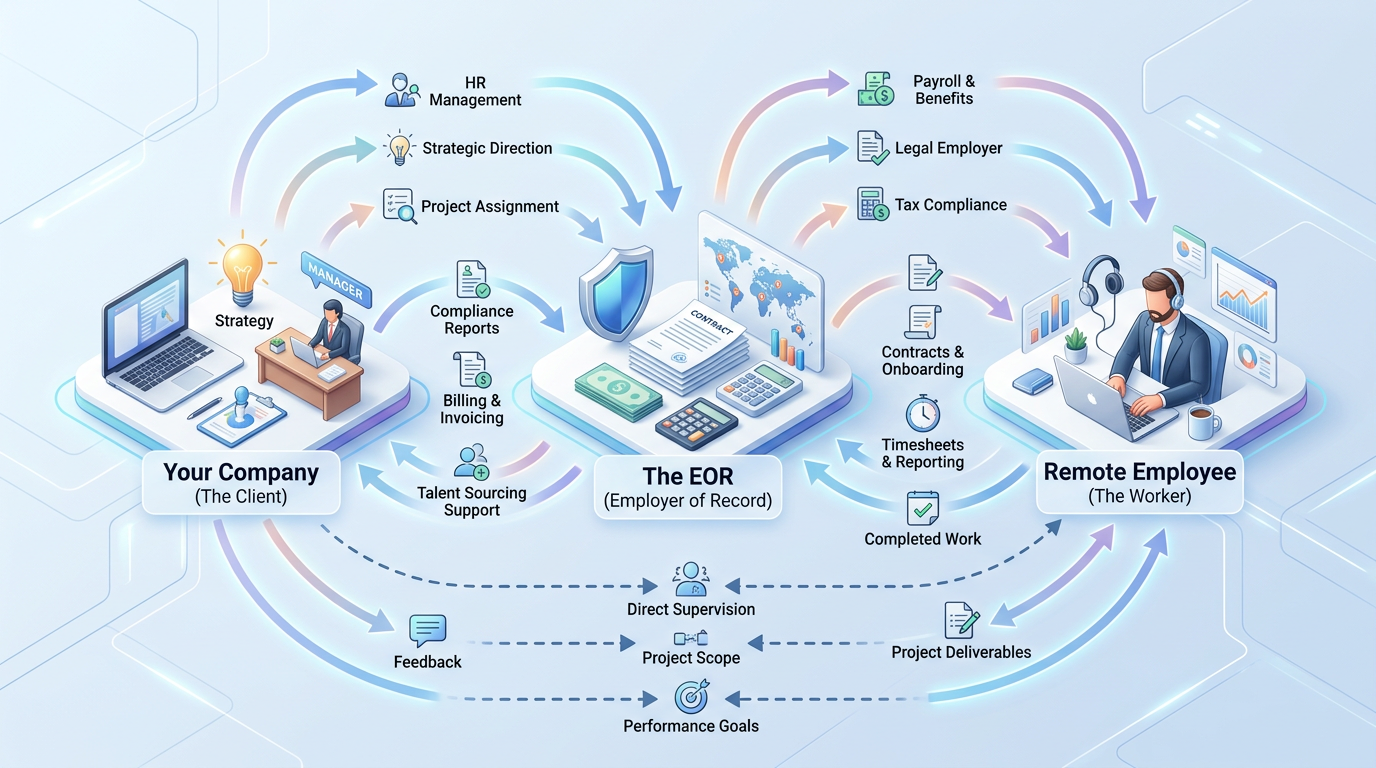
Diagram showing how an Employer of Record works with three entities: your company, the EOR, and the remote employee, with arrows indicating relationships and responsibilities
How EORs Enable Fast International Hiring
Traditional international expansion requires registering a business entity, opening local bank accounts, establishing payroll systems, and hiring local HR expertise. This process takes months and requires significant upfront investment.
EORs already have established legal entities in 50-150+ countries. When you hire someone in Portugal, the EOR's Portuguese entity employs them legally while you direct their work. The employee receives compliant contracts, local benefits, and payments in their currency—all within days.
This speed matters for competitive remote hiring. Top candidates in high-demand markets receive multiple offers. Companies using EORs can extend compliant offers in 2-3 days versus 2-3 months for entity establishment.
The Legal Protection EORs Provide
Employment law varies dramatically by country. Germany requires works councils for companies with 5+ employees. France mandates 5 weeks paid vacation. Brazil has complex termination rules requiring government approval.
Misclassifying employees as contractors creates massive liability—some countries impose fines of 30-40% of unpaid taxes plus penalties. EORs assume this legal risk, ensuring contracts, terminations, and benefits meet local requirements.
For companies on our guide to understanding employer of record services, this legal protection often justifies the monthly fees alone.
Employer of Record Cost Breakdown: What You're Actually Paying For
Understanding employer of record costs requires separating the EOR service fee from total employment expenses. Most providers charge a monthly fee per employee, but the total cost includes salary, taxes, benefits, and mandatory contributions.
The EOR service fee covers platform access, compliance expertise, legal employment responsibility, payroll processing, benefits administration, and ongoing regulatory updates—essentially outsourcing your international HR function.
Monthly Service Fees: The Base Cost
EOR providers charge $199-$650 per employee monthly as their service fee. This fee structure breaks down into three tiers:
- Budget providers ($199-$299/month): Basic compliance and payroll, limited support, self-service platforms, often restricted country coverage
- Mid-tier providers ($300-$450/month): Full compliance, dedicated support, comprehensive benefits, 50-100+ countries, most common for growing remote teams
- Premium providers ($500-$650/month): White-glove service, custom benefits packages, legal consultation, priority support, ideal for executive hires or complex situations
These fees typically decrease with volume. Hiring 10+ employees often reduces per-person costs by 15-25%. Some providers offer tiered pricing: $599 for 1-5 employees, $499 for 6-15, $399 for 16+.
Country-Specific Cost Variations
EOR fees vary significantly by country based on regulatory complexity, mandatory benefits, and local compliance requirements. High-complexity countries cost 30-50% more than simple markets.
High-cost countries ($450-$650/month per employee):
- Germany: Complex tax system, mandatory health insurance, works council requirements
- France: Strict labor protections, high social contributions (45-50% of salary)
- Brazil: Intricate labor code, mandatory 13th-month salary, complex termination rules
- Italy: High compliance burden, significant bureaucracy, mandatory contributions
Medium-cost countries ($300-$450/month per employee):
- Spain: Moderate complexity, standard EU labor protections
- Netherlands: Straightforward but comprehensive employment law
- Singapore: Clear regulations, moderate administrative burden
- Mexico: Growing complexity, regional variations
Low-cost countries ($199-$350/month per employee):
- United Kingdom: Streamlined system, clear regulations
- Canada: Straightforward provincial systems
- Australia: Well-defined employment framework
- Ireland: Simple compliance requirements

World map showing EOR cost tiers by country with color coding for high-cost (red), medium-cost (yellow), and low-cost (green) regions
Total Employment Cost: Beyond the EOR Fee
The EOR service fee represents only 10-20% of total employment cost. To calculate true expenses, add salary, employer taxes, mandatory benefits, and statutory contributions.
Total employment cost formula:
- Base salary (what the employee receives)
- Employer taxes and social contributions (15-45% of salary depending on country)
- Mandatory benefits (health insurance, pension, unemployment insurance)
- EOR monthly service fee
- Optional benefits (private health insurance, additional vacation, equity)
Example for a $60,000 annual salary employee in Germany:
- Base salary: $60,000
- Employer social contributions (19.5%): $11,700
- Mandatory benefits: $3,000
- EOR fees ($550 × 12): $6,600
- Total annual cost: $81,300 (135.5% of base salary)
In contrast, the same employee in the UK:
- Base salary: $60,000
- Employer National Insurance (13.8%): $8,280
- Mandatory pension (3%): $1,800
- EOR fees ($350 × 12): $4,200
- Total annual cost: $74,280 (123.8% of base salary)
This 10-12% difference in total employment cost often matters more than the $200/month EOR fee difference when deciding where to hire.
Hidden Fees and Additional Costs to Watch For
Advertised EOR pricing rarely tells the complete story. Hidden fees can add 10-25% to annual costs, turning a seemingly affordable provider into an expensive option.
Transparent providers list all fees upfront in service agreements, while others bury charges in fine print or add them during onboarding—always request a complete fee schedule before committing.
Onboarding and Setup Charges
Many EORs charge one-time setup fees of $200-$500 per employee to create accounts, draft contracts, and establish payroll. Some providers waive this for annual contracts or higher-volume clients.
Contract drafting fees ($100-$300) apply if you need custom employment agreements beyond standard templates. Legal review charges ($200-$500) occur when local counsel must verify complex arrangements.
Background check fees ($50-$200 per employee) often appear as separate line items. Some countries require specific checks by law, while others make them optional.
Offboarding and Termination Costs
Terminating employees through an EOR incurs fees beyond standard severance. Offboarding charges ($150-$400) cover final payroll processing, document preparation, and compliance verification.
Severance calculations vary by country—some require 1 month per year worked, others mandate specific formulas. The EOR calculates and processes these payments, but you pay the actual severance amount.
Countries with complex termination procedures (France, Germany, Brazil) may require legal consultation, adding $500-$1,500 to offboarding costs for contested terminations.
Currency Conversion and Payment Processing Fees
Paying employees in local currency requires conversion from your company's currency. EORs typically charge 1-3% above mid-market exchange rates or add flat conversion fees ($15-$50 per transaction).
For a $5,000 monthly salary, a 2% conversion markup costs $100/month or $1,200 annually per employee. Across 10 employees, that's $12,000 in hidden fees—more than many EOR service fees.
Some providers offer better rates by batching payments or using multi-currency accounts. Ask specifically about FX margins and whether you can pay in local currency directly to avoid conversion fees.
Benefits Administration and Insurance Markups
EORs often mark up supplementary benefits like private health insurance, life insurance, or additional retirement contributions by 10-20%. They negotiate group rates but add administrative margins.
A health insurance policy costing $200/month might appear as $240 on your invoice. Across multiple employees and benefits, these markups add thousands annually.
Request itemized benefits costs and compare against direct insurance quotes in the employee's country. Some EORs allow you to source benefits independently, paying only for mandatory items through them.

Infographic showing breakdown of hidden EOR fees including onboarding charges, currency conversion costs, benefits markups, and offboarding fees with percentage impacts on total cost
How to Calculate Total Employer of Record Costs for Your Remote Team
Accurate cost projection requires calculating per-employee expenses across all countries where you're hiring, then multiplying by headcount and adding company-wide fees.
Use this formula: (Base Salary × Country Multiplier) + (EOR Monthly Fee × 12) + One-Time Fees = Annual Cost Per Employee. The country multiplier accounts for taxes and mandatory benefits (typically 1.15-1.45).
Step-by-Step Cost Calculation Process
- List each country and planned hires: Identify where you're hiring and how many employees per location
- Determine base salaries: Research competitive salaries for each role in local markets using sites like remoteonly.io
- Find country multipliers: Calculate employer taxes and mandatory contributions as percentage of salary (EOR can provide this)
- Add EOR service fees: Use provider's per-employee monthly rate × 12 months
- Include one-time costs: Onboarding fees, setup charges, background checks
- Factor in benefits: Add optional benefits you'll provide beyond mandatory minimums
- Calculate FX costs: Estimate 1-3% of annual salary for currency conversion
- Sum total costs: Add all components for comprehensive annual expense per employee
Real Example: 5-Person Remote Team Across 3 Countries
Company hiring: 2 developers in Poland, 2 designers in Portugal, 1 marketer in Spain. Base salaries: $50,000 (developers), $45,000 (designers), $48,000 (marketer). EOR provider charges $399/month per employee.
Poland (2 employees):
- Base salary: $50,000 × 2 = $100,000
- Employer contributions (22%): $22,000
- EOR fees: $399 × 12 × 2 = $9,576
- Onboarding: $300 × 2 = $600
- Subtotal: $132,176
Portugal (2 employees):
- Base salary: $45,000 × 2 = $90,000
- Employer contributions (23.75%): $21,375
- EOR fees: $399 × 12 × 2 = $9,576
- Onboarding: $300 × 2 = $600
- Subtotal: $121,551
Spain (1 employee):
- Base salary: $48,000
- Employer contributions (30%): $14,400
- EOR fees: $399 × 12 = $4,788
- Onboarding: $300
- Subtotal: $67,488
Total annual cost for 5-person team: $321,215 ($64,243 average per employee)
Breaking this down: $283,000 in salaries, $57,775 in employer taxes/contributions, $23,940 in EOR fees, $1,800 in onboarding. The EOR fees represent 7.5% of total employment costs—a reasonable expense for full compliance and fast hiring.
When EOR Costs Make Financial Sense
EORs deliver ROI when hiring 1-15 employees across multiple countries. Beyond 15-20 employees in a single country, establishing a legal entity typically costs less annually.
Entity establishment costs $78,000-$128,000 upfront plus $30,000-$60,000 annual maintenance (accounting, legal, HR). For 20 employees, that's $2,500-$4,000 per employee annually versus $4,800-$7,800 in EOR fees.
However, EORs remain cost-effective when:
- Hiring across 3+ countries with fewer than 10 employees per location
- Testing new markets before committing to entity establishment
- Needing speed—hiring in days instead of months justifies higher per-employee costs
- Lacking internal HR/legal expertise for international compliance
- Avoiding entity establishment risk in politically unstable regions

Graph comparing total cost of EOR services versus entity establishment over time, showing break-even point at approximately 15-20 employees in a single country
Comparing EOR Pricing Models: Flat Fee vs. Percentage-Based
EOR providers use two primary pricing structures: flat monthly fees per employee or percentage-based fees calculated from employee salaries. Each model creates different cost dynamics for remote teams.
Flat-fee models ($299-$650/month per employee) provide cost predictability regardless of salary, making them ideal for senior hires, while percentage-based models (3-12% of salary) work better for large teams with varied compensation levels.
Flat Monthly Fee Models
Most EOR providers charge fixed monthly rates per employee. A company pays $399/month whether hiring a $40,000 junior developer or a $150,000 senior engineer.
Advantages of flat fees:
- Predictable budgeting—costs don't fluctuate with raises or bonuses
- Better for high-salary employees—$499/month on a $200,000 salary is 3% annually versus 8-10% with percentage pricing
- Simpler invoicing and expense tracking
- No penalty for competitive compensation or performance bonuses
Disadvantages of flat fees:
- Higher relative cost for junior employees—$399/month on a $30,000 salary equals 16% annually
- No volume discounts based on total payroll
- Can be expensive for large teams of entry-level workers
Percentage-Based Fee Models
Some providers charge 3-12% of gross monthly salary instead of flat fees. A $5,000/month employee costs $150-$600 monthly in EOR fees depending on the percentage.
Percentage models typically use tiered structures: 8% for salaries under $3,000/month, 6% for $3,000-$6,000, 4% above $6,000. This creates progressive pricing where junior employees cost less in absolute terms.
Advantages of percentage pricing:
- Lower absolute costs for junior employees
- Scales proportionally with compensation levels
- Can be cheaper for large teams with mixed seniority
Disadvantages of percentage pricing:
- Unpredictable costs—raises and bonuses increase EOR fees
- Very expensive for senior hires—10% of a $200,000 salary is $20,000 annually
- Complex invoicing with variable monthly charges
- May discourage competitive compensation
Which Pricing Model Saves Money for Your Team
For teams with average salaries above $60,000, flat-fee models typically cost less. A $499 monthly fee equals 10% of a $60,000 salary annually—above this threshold, flat fees become more economical.
For teams hiring primarily junior roles ($30,000-$50,000 salaries), percentage models can save 20-40%. An 8% fee on $40,000 is $3,200 annually versus $4,800-$6,000 for flat-fee providers.
Mixed teams benefit from hybrid approaches—some providers offer flat fees with volume discounts or tiered flat rates based on salary bands, combining predictability with proportional pricing.
What Drives Employer of Record Cost Variations
EOR pricing differences stem from five factors: country complexity, service level, provider scale, technology sophistication, and legal risk assumption. Understanding these drivers helps evaluate whether higher-priced providers deliver proportional value.
Regulatory Complexity and Compliance Burden
Countries with intricate labor laws require more legal expertise, ongoing monitoring, and administrative work. Germany's co-determination laws, France's 3,000+ page labor code, and Brazil's CLT regulations demand specialized knowledge.
EORs operating in high-complexity markets employ local legal teams, maintain relationships with government agencies, and invest in continuous training. These costs get passed to clients through higher per-employee fees.
Conversely, countries with straightforward employment frameworks (UK, Australia, Canada) require less legal overhead, enabling lower pricing.
Service Level and Support Quality
Budget EORs ($199-$299/month) typically offer self-service platforms with email support and 48-72 hour response times. Mid-tier providers ($300-$450) include dedicated account managers and same-day support.
Premium providers ($500-$650) deliver white-glove service: assigned HR specialists, legal consultation, custom contract negotiation, and priority issue resolution. For executive hires or complex situations, this support justifies premium pricing.
Support quality directly impacts compliance risk—missed payroll deadlines or incorrect tax filings create legal liability that cheap providers may not adequately manage.
Provider Scale and Country Coverage
Global EORs operating in 100+ countries leverage economies of scale, spreading infrastructure costs across larger client bases. Regional providers covering 10-20 countries have higher per-country overhead.
However, regional specialists often provide better local expertise and relationships with government agencies. A Latin America-focused EOR may deliver superior service in Brazil versus a global provider treating it as one of 150 markets.
Scale also affects pricing power—large providers negotiate better rates with benefits providers and insurance companies, potentially offering lower total employment costs despite similar service fees.
Technology and Platform Capabilities
Modern EOR platforms offer self-service portals, automated compliance tracking, real-time payroll visibility, and integration with HRIS systems. These features reduce administrative burden but require significant technology investment.
Providers with sophisticated platforms charge premium fees but deliver efficiency gains—automated onboarding reduces time-to-hire from 5 days to 2, and self-service payroll changes eliminate support tickets.
Legacy providers using manual processes and email-based communication charge less but create more work for your team, potentially costing more in internal time than the fee savings.

Comparison table showing features across budget, mid-tier, and premium EOR providers including response times, platform capabilities, country coverage, and support levels
Cost Comparison: EOR vs. Entity Establishment vs. Contractor Classification
Companies hiring internationally choose between three models: using an EOR, establishing a foreign entity, or classifying workers as contractors. Each approach has distinct cost structures and risk profiles.
EORs cost $4,800-$7,800 per employee annually, entity establishment requires $78,000-$128,000 upfront plus $30,000-$60,000 yearly, while contractor classification appears free but creates misclassification risks costing 30-40% of unpaid taxes plus penalties if challenged.
Foreign Entity Establishment Costs
Setting up a legal entity in a foreign country involves registration fees, legal counsel, accounting setup, and ongoing compliance costs.
Initial setup expenses:
- Entity registration and incorporation: $5,000-$15,000
- Legal fees for document preparation: $10,000-$25,000
- Local office or registered address: $2,000-$8,000 annually
- Accounting system setup: $3,000-$8,000
- Payroll system implementation: $5,000-$12,000
- HR policy development: $8,000-$15,000
- Bank account setup: $1,000-$3,000
- Initial compliance consultation: $5,000-$10,000
Annual maintenance costs:
- Accounting and bookkeeping: $12,000-$30,000
- Legal compliance and updates: $8,000-$15,000
- Payroll processing: $6,000-$12,000
- Tax filing and reporting: $4,000-$10,000
- Annual audits (if required): $8,000-$20,000
For 20 employees, entity costs average $3,500-$5,000 per employee annually after amortizing setup costs. This becomes cheaper than EOR fees of $4,800-$7,800 per employee.
However, setup takes 4-8 months, requires ongoing management attention, and creates permanent establishment tax obligations even if you later exit the market.
Contractor Classification Risks
Classifying international workers as independent contractors avoids EOR fees and entity setup costs—you simply pay invoices. But misclassification creates severe legal and financial risks.
Countries use different tests to determine employment status. Factors include work schedule control, exclusivity, provision of equipment, integration into business operations, and financial dependence. Workers meeting employment criteria must be classified as employees regardless of contract labels.
Misclassification penalties include:
- Back payment of employer taxes and social contributions (often 20-45% of all compensation paid)
- Penalties of 10-40% of unpaid amounts
- Mandatory benefits owed retroactively (health insurance, pension, vacation pay)
- Legal fees defending against claims or government audits: $15,000-$100,000+
- Reputational damage and difficulty hiring in that country
A contractor reclassified as an employee after 2 years at $60,000 annually could trigger $30,000-$50,000 in back taxes plus $10,000-$20,000 in penalties—far exceeding the $9,600-$15,600 EOR fees you would have paid.
When Each Model Makes Financial Sense
Use an EOR when:
- Hiring 1-15 employees per country
- Operating in 2+ countries
- Testing new markets before committing
- Needing to hire within days or weeks
- Lacking international HR/legal expertise
Establish an entity when:
- Hiring 20+ employees in a single country
- Planning long-term market presence (5+ years)
- Needing full control over benefits and HR policies
- Operating in low-complexity countries with reasonable setup costs
Use contractors when:
- Hiring truly independent professionals for project work
- Workers maintain multiple clients and control their schedule
- Engagement is genuinely temporary (under 6 months)
- Workers provide their own equipment and workspace
Never use contractor classification to avoid employment costs for workers who function as employees—the risk far exceeds potential savings.
How to Reduce Employer of Record Costs Without Sacrificing Compliance
Strategic approaches can reduce EOR expenses by 15-30% while maintaining full compliance and service quality. Cost optimization focuses on provider negotiation, country selection, and operational efficiency.
Negotiate Volume Discounts and Annual Contracts
EOR providers offer 10-25% discounts for annual prepayment versus month-to-month contracts. Committing to 12 months upfront reduces per-employee fees from $499 to $399-$425.
Volume discounts kick in at 5-10 employees. Providers might charge $549 for 1-4 employees, $449 for 5-9, $399 for 10-19, and $349 for 20+. Hiring strategically to cross thresholds saves thousands annually.
Multi-country packages bundle services across regions. Instead of paying $499 per employee in 5 countries, negotiate a flat rate of $425 per employee regardless of location for teams of 10+.
Choose Lower-Cost Countries When Possible
When talent quality is comparable, hiring in lower-cost EOR countries reduces total employment expenses significantly. A developer in Romania costs 25-30% less in total employment expenses than the same role in Germany.
Cost-effective countries for common remote roles:
- Software development: Poland, Romania, Portugal, Czech Republic
- Design: Spain, Portugal, Argentina, Colombia
- Customer support: Philippines, South Africa, Mexico, Portugal
- Marketing: UK, Ireland, Canada, Netherlands
This doesn't mean always choosing the cheapest location—talent quality, time zones, language skills, and cultural fit matter. But when multiple countries offer equivalent talent, selecting lower-complexity markets saves 15-20% on EOR fees and 10-15% on total employment costs.
Minimize Optional Benefits and Markups
Provide only mandatory benefits through the EOR, then offer optional benefits directly to employees. This avoids EOR markups on supplementary insurance, additional retirement contributions, or wellness programs.
For example, mandatory health insurance costs $200/month in a country. The EOR charges $220 (10% markup). Instead, provide the mandatory coverage through the EOR and offer employees a $250/month benefits stipend to purchase additional coverage independently.
This approach requires more employee education but can reduce benefits costs by 8-12% while giving workers more choice.
Optimize Currency Conversion and Payment Timing
Reduce FX costs by paying in local currency when possible or using multi-currency accounts. Some EORs allow you to fund payroll in the employee's currency, eliminating conversion fees.
Batch payments monthly instead of bi-weekly to reduce transaction fees. Two $2,500 payments incur double the flat fees of one $5,000 payment.
Use forward contracts or FX hedging for large teams to lock in exchange rates, protecting against currency fluctuations and reducing conversion costs by 0.5-1.5%.
Transition to Entity Establishment at Scale
Plan to transition from EOR to entity establishment once you reach 15-20 employees in a single country. This requires 6-12 months of planning but reduces per-employee costs by 30-50% long-term.
Some EORs offer entity setup services, helping you transition while maintaining continuity. Others provide hybrid models where you establish an entity but outsource payroll and compliance administration at reduced rates ($150-$250 per employee monthly).

Flowchart showing decision tree for optimizing EOR costs based on employee count, countries, and hiring timeline
Frequently Asked Questions
Why are EORs so expensive?
EOR services cost $199-$650 monthly per employee because providers assume legal employment liability, maintain entities in 50+ countries, ensure ongoing compliance with changing regulations, process payroll and taxes, and provide HR support. These fees cover expertise, infrastructure, and risk that would otherwise require establishing foreign entities costing $78,000-$128,000 upfront.
What are the risks of using an EOR?
Primary EOR risks include provider bankruptcy leaving employees unpaid, misclassification if the relationship doesn't meet legal requirements, permanent establishment tax exposure if you exercise too much control, and vendor dependency making transitions difficult. Choose established providers with strong financials, proper insurance, and clear service agreements to mitigate these risks.
How to calculate employer cost?
Calculate total employer cost by adding base salary, employer taxes and social contributions (15-45% of salary), mandatory benefits, EOR monthly fees, and optional benefits. Use this formula: (Base Salary × Country Multiplier) + (EOR Fee × 12) + One-Time Costs. Total employment cost typically ranges from 120-180% of base salary depending on country.
What does an Employer of Record mean?
An Employer of Record is a third-party organization that becomes the legal employer for your workers in foreign countries, handling payroll, taxes, benefits, and compliance while you manage day-to-day work. EORs enable companies to hire internationally without establishing foreign entities, reducing setup time from months to days and eliminating $78,000-$128,000 in entity costs.
Do EOR fees decrease with more employees?
Most EOR providers offer volume discounts of 15-25% when hiring 10+ employees. Typical tiers: $549 for 1-4 employees, $449 for 5-9, $399 for 10-19, and $349 for 20+. Annual contracts provide additional 10-15% discounts versus month-to-month pricing. Negotiate multi-country packages for teams distributed across several locations.
Is it cheaper to use an EOR or establish an entity?
EORs cost less for 1-15 employees per country, averaging $4,800-$7,800 annually per employee. Entity establishment requires $78,000-$128,000 upfront plus $30,000-$60,000 yearly maintenance, becoming cost-effective at 20+ employees in one location. EORs remain cheaper when hiring across multiple countries with fewer employees per location.
What hidden fees do EOR providers charge?
Common hidden EOR fees include onboarding charges ($200-$500), offboarding costs ($150-$400), currency conversion markups (1-3% of salary), benefits administration fees (10-20% markup), background checks ($50-$200), and contract drafting ($100-$300). These can add 10-15% to annual costs. Request complete fee schedules upfront to avoid surprises.
Conclusion
Understanding employer of record cost requires looking beyond monthly service fees to total employment expenses including salaries, taxes, benefits, and hidden charges. EOR services ranging from $199-$650 per employee monthly enable fast, compliant international hiring without the $78,000-$128,000 investment of entity establishment.
For remote teams hiring 1-15 employees across multiple countries, EORs deliver clear ROI through speed, compliance protection, and operational simplicity. Strategic provider selection, volume negotiation, and country optimization can reduce costs by 15-30% while maintaining full legal compliance.
Calculate total employment costs using the country multiplier method, factor in all fees including currency conversion and onboarding charges, and compare EOR expenses against entity establishment at scale. For most remote teams, EORs represent the most cost-effective path to building distributed teams across borders.