CSM Interview Questions: Remote Hiring Guide
47 customer success manager interview questions for remote hiring, plus evaluation frameworks, red flags, and structured processes to identify top...
October 23, 2026 • 25 min read

Customer success manager interview questions for remote hiring assess communication skills, self-management, customer empathy, technical proficiency, and problem-solving abilities. Effective questions include scenario-based queries about handling difficult customers remotely, time zone management strategies, and examples of proactive customer engagement. Remote CSM interviews require evaluating both traditional customer success competencies and distributed work capabilities.
Remote customer success manager roles now represent 42% of all CSM positions on verified job boards, yet 67% of hiring managers report difficulty identifying candidates who can excel in distributed environments. The challenge isn't finding people with customer success experience—it's finding those who can deliver exceptional customer outcomes without face-to-face interaction.
When evaluating customer success manager interview questions for remote positions, you need a different framework than traditional in-office hiring. Remote CSMs must demonstrate self-direction, asynchronous communication mastery, and the ability to build trust through screens. This guide provides 47 targeted interview questions across 8 competency areas, specifically designed for remote customer success hiring.
You'll learn which questions reveal true remote work capability, how to structure virtual interview processes, and what answers separate exceptional remote CSMs from those who merely sound good on video calls. Whether you're hiring your first remote customer success team or refining your process after unsuccessful hires, these customer success manager interview questions focus on the competencies that actually predict remote performance.
Key Takeaways
- Remote CSM interviews require 8 core competency areas: communication, self-management, customer empathy, technical skills, problem-solving, proactive engagement, collaboration, and metrics-driven thinking
- Scenario-based questions reveal actual remote work capability better than hypothetical questions—ask candidates to describe specific past situations with measurable outcomes
- Structured interview processes with consistent rubrics reduce bias by 58% and improve remote hire success rates when evaluating distributed CSM candidates
- The 30-60-90 day framework helps assess how candidates plan to onboard, build relationships, and deliver value in remote customer success roles
- Red flags include vague answers without metrics, inability to describe remote collaboration tools, and lack of examples showing independent problem-solving
Core Competencies for Remote Customer Success Managers
Remote customer success manager interview questions must evaluate competencies that matter specifically in distributed environments. Traditional CSM skills like empathy and product knowledge remain important, but remote work adds layers of complexity around communication, autonomy, and digital relationship-building.
Communication Skills in Asynchronous Environments
The best remote CSMs excel at written communication because 73% of customer interactions happen via email, chat, or documentation rather than synchronous calls. Your interview questions should assess how candidates structure written updates, explain complex concepts without visual aids, and maintain clarity across time zones.
Ask candidates to describe their documentation habits. Strong answers include specific examples of creating customer playbooks, maintaining detailed account notes, or building knowledge bases. Weak answers focus only on verbal communication skills or lack concrete examples of written artifacts they've created.
Self-Management and Accountability
Remote CSMs work without direct supervision for extended periods. Your questions must reveal how candidates prioritize competing demands, structure their workdays, and maintain productivity without office environments. Look for evidence of systems they've built to track responsibilities and self-imposed accountability measures.
Questions about time management should elicit specific tools, frameworks, or routines. Candidates who mention blocking calendar time for deep work, using task management systems, or establishing daily rituals demonstrate the self-direction remote work requires.
Technical Proficiency and Digital Tools
Remote customer success depends on technology stacks that facilitate virtual collaboration, customer health monitoring, and data analysis. Your interview process should verify candidates can quickly adopt new platforms and troubleshoot technical issues independently.
- Customer success platforms (Gainsight, ChurnZero, Totango)
- Video conferencing tools with screen sharing capabilities
- Asynchronous communication platforms (Slack, Teams, Loom)
- CRM systems and data visualization tools
- Project management and collaboration software
- Customer feedback and survey platforms
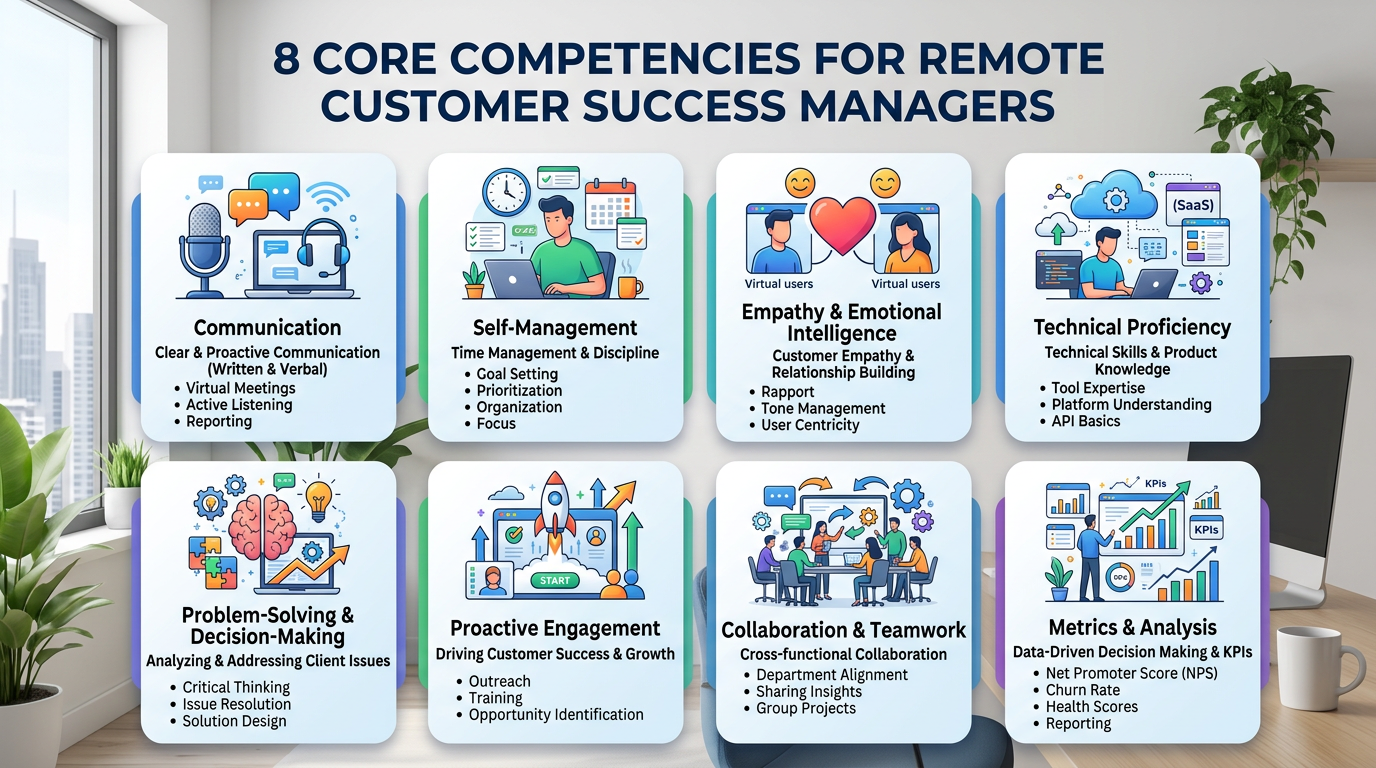
Infographic showing the 8 core competency areas for remote customer success managers with icons representing communication, self-management, empathy, technical skills, problem-solving, proactive engagement, collaboration, and metrics
Essential Customer Success Manager Interview Questions for Remote Roles
These customer success manager interview questions target the specific capabilities that predict success in remote environments. Each question includes what you're actually assessing and what strong answers reveal.
Communication and Relationship Building Questions
Remote relationship building requires intentionality that in-person interactions don't demand. These questions assess whether candidates understand how to create connection through digital channels.
- Describe how you've built trust with a customer you've never met in person. Look for specific tactics like video-first communication, consistent follow-through, proactive updates, and personalization efforts that show they understand trust-building mechanics.
- Walk me through your typical communication cadence with a mid-tier customer in a remote setting. Strong candidates specify touchpoint frequency, channel preferences, and how they balance synchronous versus asynchronous communication based on customer needs.
- How do you ensure your written communication is clear when you can't read body language or clarify in real-time? Effective answers mention techniques like summarizing key points, using formatting for emphasis, confirming understanding, and appropriate use of video messages.
- Tell me about a time you had to deliver difficult news to a customer remotely. Assess whether they chose appropriate channels, prepared the customer, showed empathy through digital means, and followed up to ensure understanding.
- How do you adapt your communication style for customers across different time zones? Look for awareness of asynchronous communication strategies, documentation practices, and respect for customer working hours.
Self-Management and Productivity Questions
Remote work success depends on internal motivation and organizational systems. These questions reveal how candidates structure their work without external accountability.
- Describe your typical workday structure when working remotely. Strong answers include specific routines, time-blocking practices, and boundaries between work and personal time.
- How do you prioritize when multiple customers need attention simultaneously? Look for frameworks like impact/urgency matrices, customer health scores, or revenue-based prioritization rather than reactive approaches.
- What systems do you use to track customer commitments and follow-ups? Effective CSMs mention specific tools and redundancy systems to ensure nothing falls through cracks.
- Tell me about a time you identified and solved a problem proactively while working remotely. This reveals whether candidates wait for direction or take initiative when they spot issues.
- How do you maintain focus during deep work when you're not in an office environment? Look for specific strategies like notification management, dedicated workspace, or time-blocking techniques.
Customer Empathy and Problem-Solving Questions
Remote CSMs must demonstrate empathy through digital channels and solve problems without immediate access to colleagues or resources.
- Describe a situation where you had to understand a customer's problem without being able to meet them face-to-face. Strong answers show active listening techniques, clarifying questions, and validation of customer concerns.
- How do you gather context about customer challenges when you can't observe their environment? Look for strategies like screen sharing sessions, requesting screenshots, or asking specific diagnostic questions.
- Tell me about a time you turned around a dissatisfied customer while working remotely. Assess their recovery process, empathy demonstration, and measurable outcomes.
- How do you identify when a customer needs more support than they're explicitly requesting? Effective answers mention monitoring usage data, engagement patterns, or reading between lines in written communication.

Flowchart showing the remote CSM interview process from screening to final decision, with key evaluation criteria at each stage
Behavioral Questions That Reveal Remote Work Capability
Behavioral questions based on past experiences predict future performance better than hypothetical scenarios. These customer success manager interview questions use the STAR method (Situation, Task, Action, Result) to evaluate real remote work competencies.
Collaboration and Cross-Functional Work
Remote CSMs must collaborate effectively with product, sales, and support teams without hallway conversations or impromptu meetings. These questions assess their distributed collaboration skills.
- Describe a time you collaborated with product or engineering teams remotely to solve a customer issue. Look for clear communication practices, documentation of customer needs, and follow-through to resolution.
- How have you built relationships with colleagues you've never met in person? Strong answers include intentional connection efforts, regular check-ins, and informal relationship-building in remote contexts.
- Tell me about a time you had to coordinate across multiple time zones to deliver customer value. Assess planning capabilities, asynchronous coordination, and consideration for others' schedules.
- Describe how you've shared customer insights with other teams in a remote environment. Look for systematic approaches to knowledge sharing rather than ad-hoc communication.
Proactive Customer Success and Growth
Remote CSMs can't rely on casual office conversations to identify expansion opportunities or prevent churn. They need systematic approaches to proactive customer management.
- How do you identify expansion opportunities when you're not regularly on-site with customers? Effective answers mention usage data analysis, regular business reviews, and strategic questioning about evolving needs.
- Describe your approach to preventing churn in a remote customer success role. Look for early warning indicators they monitor, intervention strategies, and measurable outcomes.
- Tell me about a time you anticipated a customer need before they articulated it. This reveals proactive thinking and whether they analyze patterns beyond reactive support.
- How do you stay informed about your customers' industries and business challenges remotely? Strong candidates mention specific information sources, research habits, and how they apply insights to customer relationships.
Metrics and Data-Driven Decision Making
Remote customer success requires objective measures of health and engagement since intuitive in-person reads aren't available.
- What customer health metrics do you track, and how do you act on them? Look for specific KPIs like product adoption rates, engagement scores, NPS, or support ticket trends with corresponding action plans.
- Describe a time you used data to change your approach with a customer or segment. Assess analytical thinking and willingness to adapt based on evidence rather than assumptions.
- How do you measure your own success as a remote CSM? Strong answers include both leading indicators (activities) and lagging indicators (outcomes) they monitor.

Visual representation of key customer health metrics remote CSMs should track, including product adoption, engagement frequency, support tickets, and business review completion rates
Technical and Situational Questions for Remote CSM Interviews
These scenario-based customer success manager interview questions assess how candidates think through realistic remote work challenges.
Handling Difficult Situations Remotely
Remote work removes in-person rapport that often helps navigate challenging conversations. These questions reveal conflict resolution and communication skills in digital contexts.
- A customer sends an angry email about a product issue at 11 PM your time. Walk me through your response. Look for judgment about urgency, appropriate response timing, empathy in written form, and escalation protocols.
- You're on a video call and realize the customer fundamentally misunderstands how to use the product. How do you handle this? Assess tactfulness, teaching ability, and follow-up documentation practices.
- A customer stops responding to your outreach. What's your process? Strong answers include multi-channel attempts, value-focused messaging, and knowing when to involve leadership.
- How would you handle a customer requesting a feature that's not on the roadmap? Look for expectation management, alternative solutions, and proper feedback channeling to product teams.
Onboarding and Implementation Questions
Remote onboarding requires structured processes and clear documentation since casual check-ins aren't possible.
- Describe your ideal remote onboarding process for a new customer. Effective answers include specific milestones, resource creation, check-in cadence, and success criteria.
- How do you ensure customers complete onboarding tasks when you're not physically present? Look for accountability mechanisms, progress tracking, and motivational techniques.
- Tell me about a time an implementation didn't go as planned. How did you recover? Assess problem-solving, communication during setbacks, and learning from failures.
Time Management and Scalability
Remote CSMs must balance high-touch relationships with scalable processes to manage growing customer portfolios.
- How many customer accounts can you effectively manage remotely, and what factors influence that number? Look for thoughtful consideration of customer complexity, contract value, and available resources rather than arbitrary numbers.
- Describe how you've automated or systematized parts of customer success work. Strong candidates mention email templates, automated health checks, customer education programs, or other efficiency gains.
- How do you decide which customers get synchronous time versus asynchronous communication? Assess strategic thinking about resource allocation and customer segmentation.
The 30-60-90 Day Framework for Remote CSM Candidates
The 30-60-90 rule in an interview refers to asking candidates to outline their plan for the first three months in a role. For remote customer success positions, this framework reveals how candidates approach onboarding, relationship building, and value delivery without in-person immersion.
First 30 Days: Learning and Foundation
Ask candidates: "What would your first 30 days look like in this remote CSM role?" Strong answers include specific learning activities, relationship-building intentions, and early wins they'd target.
Look for mentions of product deep-dives, reviewing customer documentation, shadowing customer calls, understanding internal processes, and introducing themselves to key stakeholders. Candidates should demonstrate awareness that remote onboarding requires more intentional information-gathering than office environments provide.
Days 31-60: Implementation and Early Value
Effective candidates describe taking ownership of customer relationships, conducting initial business reviews, identifying quick wins, and beginning to contribute to team processes. They should articulate how they'll build credibility remotely through consistent delivery and clear communication.
Days 61-90: Optimization and Strategic Impact
By day 90, strong CSM candidates plan to have fully independent customer portfolios, identify expansion opportunities, contribute process improvements, and demonstrate measurable impact on retention or growth metrics. Remote-ready candidates specifically mention establishing efficient workflows and communication rhythms that work across time zones.
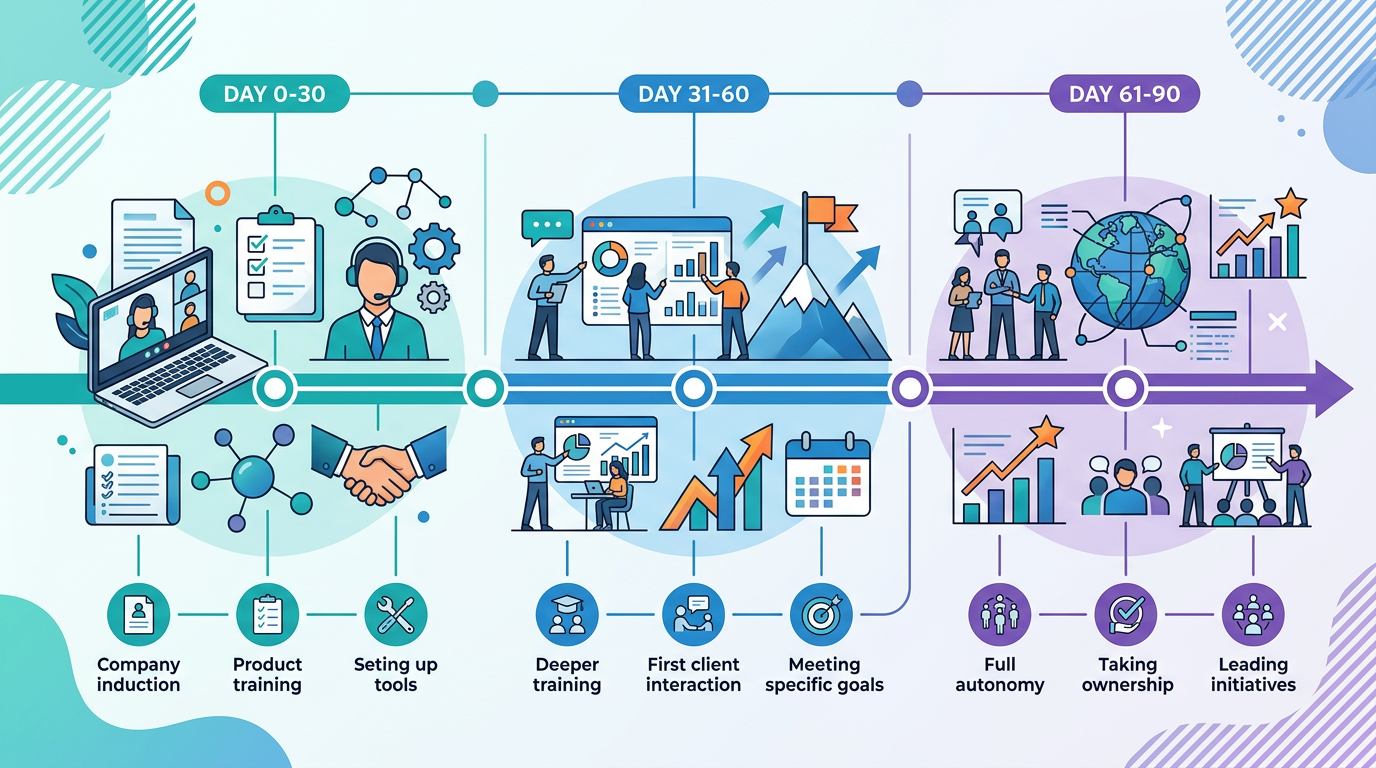
Timeline graphic showing the 30-60-90 day framework for remote CSM onboarding with key milestones and activities at each phase
The 5 C's of Interviewing for Remote Customer Success Roles
The 5 C's of interviewing—Competency, Character, Culture fit, Career direction, and Compensation—provide a framework for comprehensive candidate evaluation. For remote customer success manager positions, each element requires specific adaptation to assess distributed work capability.
Competency: Skills and Experience
Beyond traditional CSM competencies, evaluate remote-specific skills through customer success manager interview questions about asynchronous communication, self-management, and digital relationship building. Ask for work samples like customer email communications, documentation they've created, or presentation recordings.
Character: Values and Work Ethic
Remote work amplifies character traits like integrity, reliability, and accountability since managers can't directly observe daily work. Questions about handling unsupervised situations, meeting commitments without reminders, and owning mistakes reveal character more clearly than hypothetical scenarios.
Culture Fit: Alignment with Company Values
Remote culture fit extends beyond values alignment to include communication style preferences, collaboration approaches, and comfort with distributed work environments. Assess whether candidates thrive with autonomy or need more structure, prefer synchronous or asynchronous communication, and align with your company's remote work philosophy.
Career Direction: Growth and Ambition
Understand candidates' career goals within remote contexts. Some CSMs view remote work as temporary convenience while others specifically seek distributed career paths. Ask about their long-term remote work intentions and how they plan to grow professionally without traditional office visibility.
Compensation: Expectations and Equity
Remote compensation discussions involve geographic considerations, cost-of-living adjustments, and market rates across locations. Be transparent about your compensation philosophy for distributed teams and ensure alignment early in the interview process.
Red Flags and Warning Signs in Remote CSM Interviews
Certain answer patterns during customer success manager interview questions consistently predict poor remote performance. Watch for these warning signs when evaluating candidates for distributed CSM roles.
Communication Red Flags
- Vague answers without specific examples or measurable outcomes
- Over-reliance on verbal communication with no mention of documentation
- Inability to articulate complex ideas clearly in initial written assessments
- Poor video interview etiquette (unprofessional background, technical issues they don't address)
- Failure to follow up after interviews with thank-you notes or requested materials
Self-Management Concerns
- Answers suggesting they need external motivation or frequent check-ins
- Lack of personal systems for task management and organization
- No examples of independent problem-solving or initiative
- Difficulty articulating how they structure unstructured time
- History of short tenures in previous remote positions
Technical and Tool Proficiency Issues
- Unfamiliarity with standard remote collaboration tools
- Resistance to learning new platforms or technologies
- No examples of using data or metrics to drive decisions
- Technical difficulties during video interviews they can't troubleshoot
Customer-Centricity Gaps
- Answers focused on processes rather than customer outcomes
- Lack of empathy or emotional intelligence in scenario responses
- No examples of going above and beyond for customers
- Inability to articulate customer pain points in previous roles
- Defensive responses when discussing customer failures or churn
Structuring Your Remote CSM Interview Process
Effective remote hiring requires structured processes that reduce bias and consistently evaluate the competencies that matter. Your interview workflow should include multiple stages with clear evaluation criteria at each step.
Stage 1: Application and Initial Screening
Written applications reveal communication skills before you invest interview time. Request cover letters or written responses to screening questions about remote work experience and customer success philosophy. Strong candidates demonstrate writing clarity, attention to detail, and genuine interest in your specific role.
Stage 2: Asynchronous Video Assessment
Tools like Loom or async video interview platforms let candidates record responses to standard questions on their own time. This stage assesses presentation skills, communication clarity, and ability to articulate ideas without real-time interaction—all critical for remote CSM success.
Ask 3-4 questions focused on past experiences, such as describing their greatest customer success achievement or explaining how they've managed difficult customer situations remotely. Limit response time to 2-3 minutes per question.
Stage 3: Live Video Interview with Hiring Manager
This 45-60 minute conversation should use behavioral and situational customer success manager interview questions to assess competencies your async screening couldn't fully evaluate. Focus on follow-up questions that dig deeper into examples candidates provided earlier.
Use a structured scorecard with 5-7 competency areas rated on consistent scales. This reduces recency bias and allows fair comparison across candidates interviewed days apart.
Stage 4: Practical Assessment or Work Sample
Paid work samples reveal actual capabilities better than interviews alone. Consider asking candidates to:
- Draft a customer email responding to a complex scenario
- Create a brief business review presentation based on provided data
- Analyze customer health metrics and recommend interventions
- Record a video explaining a product feature to a non-technical user
Compensate candidates for work samples requiring more than 2 hours. This respects their time and provides realistic job previews.
Stage 5: Team and Cross-Functional Interviews
Include team members and collaborators from product, sales, or support in final interviews. They assess culture fit, collaboration style, and how candidates interact with various personality types—crucial for remote team dynamics.
Stage 6: Reference Checks with Remote Work Focus
Ask references specific questions about the candidate's remote work performance, communication style, self-management, and customer outcomes. Questions like "How did they handle working independently?" or "What was their approach to customer communication?" yield more useful information than generic reference calls.
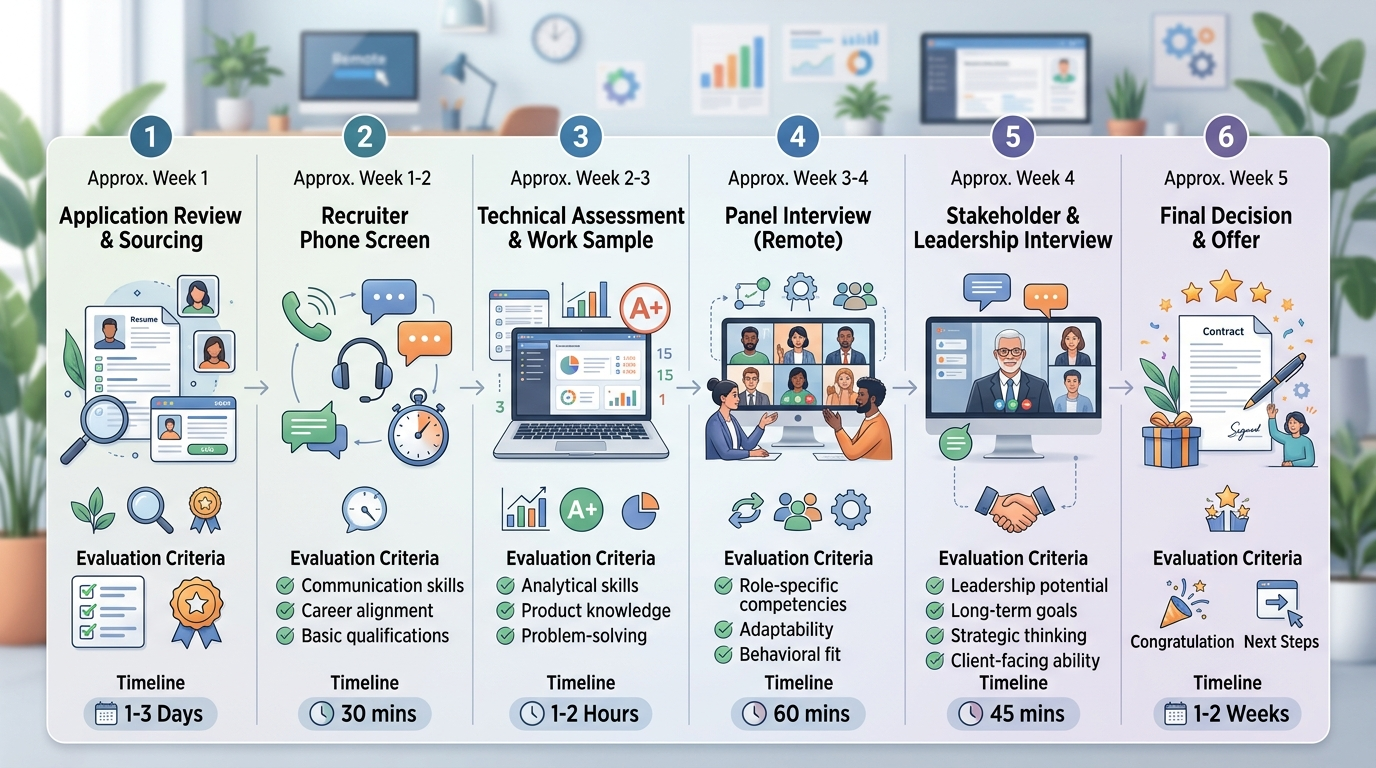
Diagram showing the 6-stage remote CSM interview process with approximate timelines and key evaluation criteria at each stage
Best Practices for Conducting Remote CSM Interviews
How you conduct customer success manager interview questions matters as much as which questions you ask. These practices improve candidate experience and evaluation accuracy.
Create Consistent Evaluation Criteria
Structured interviews with rubrics reduce hiring bias and improve quality of hire. Define 5-7 core competencies for your remote CSM role, create behavioral indicators for each, and rate candidates on consistent scales (1-5 or 1-4 to avoid middle-ground defaults).
Share rubrics with all interviewers before conversations. After interviews, have each interviewer independently complete scorecards before discussing candidates to prevent groupthink.
Test the Candidate Experience
Your interview process demonstrates your company's remote work competency. Send clear instructions, test video links before interviews, start on time, and follow up promptly. Candidates evaluate you as much as you evaluate them—especially strong CSMs with multiple offers.
Balance Selling and Assessing
Great candidates need reasons to choose your company. Allocate 10-15 minutes for candidates to ask questions and for you to share what makes your remote culture compelling. Be honest about challenges alongside benefits.
Move Quickly
Top remote CSM candidates receive multiple offers within 7-10 days of starting their search. Complete your process within 2 weeks maximum, or communicate clearly if longer timelines are necessary. Speed demonstrates respect for candidates' time and organizational efficiency.
Provide Closure to All Candidates
Send personalized rejections to candidates who reached live interview stages. Brief, specific feedback (when possible) turns rejections into positive brand experiences. Remote hiring pools are smaller than local ones—treating candidates well protects your employer brand.
Frequently Asked Questions
How to prepare for a customer success manager interview?
Research the company's product, customer base, and success metrics thoroughly. Prepare specific examples using the STAR method that demonstrate customer outcomes you've driven, including retention rates, expansion revenue, or satisfaction scores. Practice articulating your customer success philosophy and be ready to discuss remote work strategies, tools you've used, and how you've built relationships digitally.
What are the 5 C's of interviewing?
The 5 C's of interviewing are Competency, Character, Culture fit, Career direction, and Compensation. Competency assesses skills and experience, Character evaluates values and work ethic, Culture fit determines alignment with company values, Career direction explores growth ambitions, and Compensation ensures salary expectations match. For remote CSM roles, each element requires evaluation through the lens of distributed work capabilities and autonomous performance.
What is the 30-60-90 rule in an interview?
The 30-60-90 rule asks candidates to outline their plan for the first 30, 60, and 90 days in a role. Days 1-30 focus on learning the product, customers, and processes. Days 31-60 involve taking ownership of accounts and delivering early wins. Days 61-90 emphasize independent management, identifying growth opportunities, and measurable impact on key metrics like retention or expansion revenue.
What are some common customer success manager interview questions and answers?
Common questions include "How do you define customer success?" (answer with outcome-focused metrics), "Describe a time you saved an at-risk account" (use STAR method with specific results), "How do you prioritize customers?" (mention health scores and impact frameworks), and "What metrics do you track?" (list KPIs like NPS, retention rate, product adoption, and expansion revenue with how you act on them).
How many customer accounts can a remote CSM manage effectively?
Remote CSMs typically manage 15-50 accounts depending on customer complexity, contract value, and available resources. Enterprise accounts requiring high-touch engagement may limit portfolios to 10-15 customers, while mid-market accounts with established processes allow 30-50. The key factors are customer health monitoring systems, automation capabilities, and whether the role includes implementation responsibilities beyond relationship management.
What tools should remote customer success managers be familiar with?
Remote CSMs should know customer success platforms like Gainsight or ChurnZero, CRM systems such as Salesforce or HubSpot, video conferencing tools including Zoom and Google Meet, asynchronous communication platforms like Slack and Loom, and project management software such as Asana or Monday. Familiarity with data visualization tools and survey platforms like Typeform or SurveyMonkey also supports effective remote customer management.
What are red flags when interviewing remote CSM candidates?
Red flags include vague answers without metrics or specific examples, over-reliance on verbal communication without documentation habits, unfamiliarity with remote collaboration tools, lack of personal organizational systems, defensive responses about customer churn or failures, and poor follow-through after interviews. Candidates who struggle articulating how they work independently or need frequent external motivation typically underperform in remote customer success roles.
Conclusion
Effective customer success manager interview questions for remote roles must evaluate both traditional CSM competencies and distributed work capabilities. The 47 questions across 8 competency areas in this guide help you identify candidates who can build trust through screens, manage themselves without supervision, and deliver measurable customer outcomes in remote environments.
Structured interview processes with consistent evaluation rubrics, practical work samples, and focus on behavioral examples predict remote CSM success better than unstructured conversations. Remember that your interview process also serves as a candidate evaluation of your remote work culture—speed, clarity, and professionalism throughout hiring directly impact your ability to attract top distributed customer success talent.
The remote customer success manager interview questions and frameworks in this guide give you the foundation to build hiring processes that consistently identify candidates who will thrive in distributed customer success roles. Apply the 5 C's framework, use the 30-60-90 day planning question, watch for red flags, and create candidate experiences that reflect the remote work excellence you expect from your team.