Best Entry Level Remote Jobs for 2026
Entry-level remote jobs for 2026 include customer service, virtual assistant, and junior developer roles paying $30,000-$70,000. See verified openings daily.
October 23, 2026 • 27 min read

Best entry level remote jobs are positions requiring minimal experience that allow work from anywhere, verified against employer systems. Top options include customer service representative, data entry specialist, virtual assistant, social media coordinator, and content writer, with salaries ranging $30,000-$55,000 annually.
Introduction
Remote work has transformed from a pandemic necessity into a permanent career path, with over 35% of U.S. workers now working remotely at least part-time. For job seekers without extensive experience, finding legitimate remote opportunities remains challenging—ghost jobs and outdated listings plague most job boards, wasting hours of application time.
The best entry level remote jobs offer genuine opportunities to build careers from anywhere, requiring minimal previous experience while providing competitive pay and skill development. This guide examines 12 verified remote positions ideal for beginners in 2026, with real salary data and application strategies. At RemoteOnly.io, we verify all 7,000+ listings daily against employer ATS systems like Greenhouse, Lever, and Ashby—eliminating ghost jobs entirely.
Whether you're a recent graduate, career changer, or simply seeking location independence, these entry-level remote roles provide proven pathways into the remote workforce. We'll cover specific responsibilities, salary ranges, required skills, and which positions match different career goals.
Key Takeaways
- Entry-level remote jobs typically pay $30,000-$55,000 annually, with customer service and administrative roles most accessible
- Technical positions like junior developer or QA tester offer higher starting salaries ($55,000-$75,000) but require specific certifications or bootcamp completion
- Most entry-level remote roles require 0-2 years experience, strong communication skills, and reliable internet connectivity
- Verified job boards eliminate ghost listings—RemoteOnly.io re-verifies 7,000+ positions daily against employer ATS feeds
- Remote work skills like asynchronous communication and self-management matter more than traditional office experience
Quick Comparison: Best Entry Level Remote Jobs
| Job Title | Avg. Starting Salary | Experience Required | Key Skill |
|---|---|---|---|
| Customer Service Representative | $32,000-$42,000 | 0-1 year | Communication |
| Data Entry Specialist | $30,000-$38,000 | 0 years | Attention to detail |
| Virtual Assistant | $35,000-$45,000 | 0-1 year | Organization |
| Social Media Coordinator | $38,000-$48,000 | 0-2 years | Content creation |
| Content Writer | $40,000-$52,000 | 0-2 years | Writing |
| Junior Graphic Designer | $42,000-$52,000 | Portfolio required | Design software |
| Bookkeeper | $38,000-$48,000 | 0-1 year | QuickBooks |
| Sales Development Representative | $45,000-$60,000 | 0-1 year | Persuasion |
| Junior Web Developer | $55,000-$70,000 | Bootcamp/degree | HTML/CSS/JavaScript |
| QA Tester | $45,000-$58,000 | 0-1 year | Detail orientation |
| Email Marketing Specialist | $42,000-$52,000 | 0-2 years | Copywriting |
| Recruiting Coordinator | $40,000-$50,000 | 0-1 year | People skills |
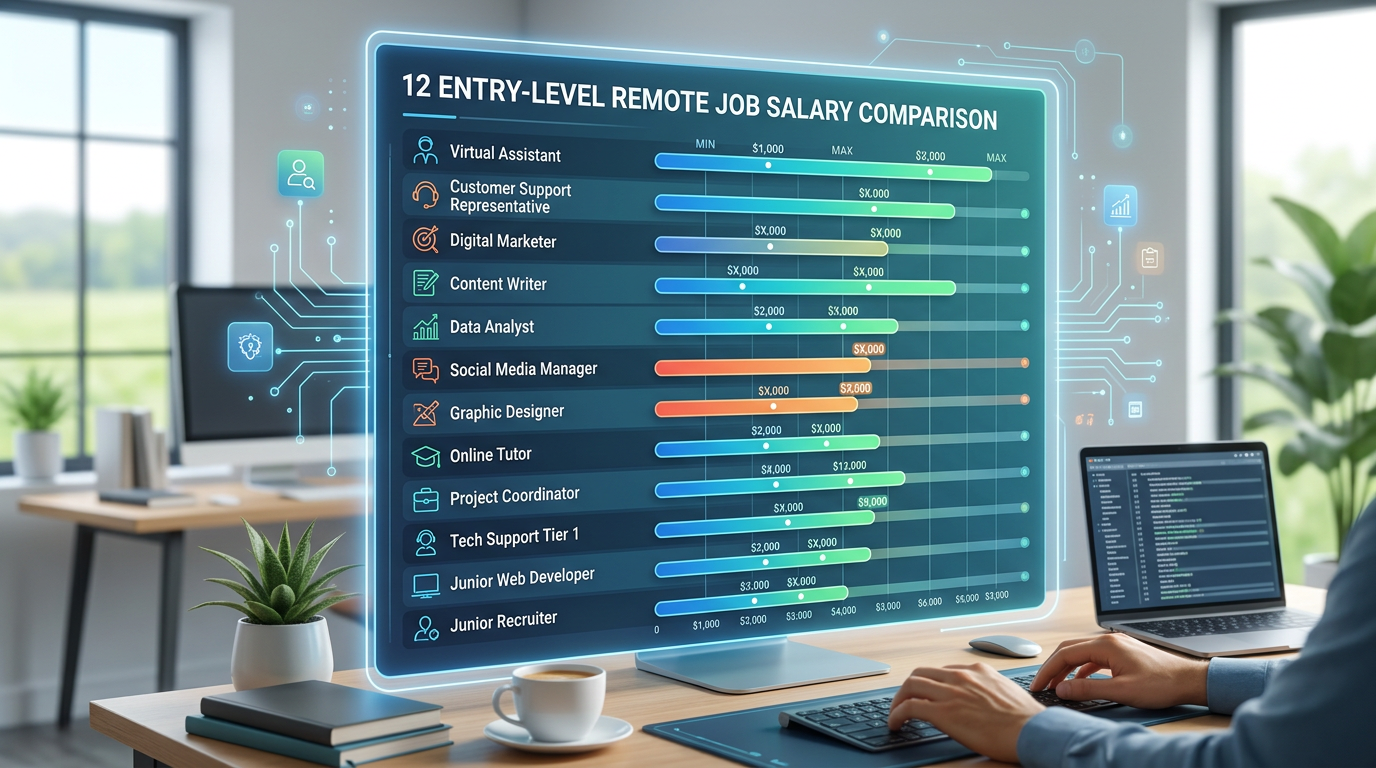
Infographic showing salary comparison chart of 12 entry level remote jobs with icons representing each role and salary ranges displayed as horizontal bars
1. Customer Service Representative
Customer service representatives handle inquiries, resolve issues, and support customers via phone, email, or chat. This role consistently ranks as the most accessible entry-level remote position, with thousands of companies hiring for remote support teams in 2026.
Remote customer service roles require no previous experience beyond strong communication skills and a quiet workspace. Companies provide comprehensive training on their products, systems, and protocols. Most positions offer scheduled shifts with some evening and weekend requirements, though flexibility varies by employer.
Starting salaries range from $32,000-$42,000 annually, with performance bonuses common. Major employers include Amazon, Apple, American Express, and numerous SaaS companies. Equipment is typically provided or reimbursed, including headsets and sometimes laptops.
Success requires patience, problem-solving abilities, and comfort with multiple software systems simultaneously. Career advancement paths lead to team lead, quality assurance, or specialized technical support roles paying $50,000-$65,000 within 2-3 years.
Pros
- Abundant openings with major companies
- Comprehensive paid training provided
- No experience required for most positions
- Clear advancement opportunities
Cons
- Scheduled shifts with limited flexibility
- High-stress interactions with upset customers
- Performance metrics closely monitored
- Lower starting salary compared to technical roles
2. Data Entry Specialist
Data entry specialists input, update, and maintain information in databases and systems. While considered basic work, remote data entry provides steady income and flexible scheduling for those with strong typing skills and accuracy.
The role involves transferring information from various sources into digital formats, verifying data accuracy, and maintaining organized records. Typing speed of 50-60 words per minute with high accuracy is the primary requirement. Most positions are contract or part-time, though full-time roles exist with larger organizations.
Compensation ranges from $30,000-$38,000 for full-time positions, with hourly rates of $15-$18 common. Healthcare companies, financial institutions, and government contractors frequently hire remote data entry workers. Be cautious of scams—legitimate employers never require payment for training or equipment.
This role suits detail-oriented individuals comfortable with repetitive tasks. While advancement opportunities are limited within data entry itself, the position provides remote work experience valuable for transitioning into administrative, operations, or analyst roles.
Pros
- Minimal skill requirements beyond typing
- Often flexible scheduling options
- Low-stress, independent work
- Many part-time and contract opportunities
Cons
- Lowest salary range among remote jobs
- Repetitive work with limited variety
- Few advancement opportunities
- Many scam postings in this category
3. Virtual Assistant
Virtual assistants provide administrative support to executives, entrepreneurs, or small businesses remotely. Tasks include email management, calendar scheduling, travel arrangements, document preparation, and various organizational duties.
This versatile role attracts career changers and those seeking diverse responsibilities. Successful virtual assistants combine organizational skills, discretion, and proactive problem-solving. Experience with tools like Google Workspace, Microsoft Office, Slack, and project management platforms is essential.
Salaries range from $35,000-$45,000 for full-time positions, with many VAs working as contractors for multiple clients at $20-$35 hourly. Specialized virtual assistants focusing on real estate, legal, or executive support command higher rates. Companies hire VAs directly, or you can work through agencies like Belay, Time Etc, or Fancy Hands.
The role offers excellent work-life balance and exposure to different industries and business operations. Many virtual assistants transition into operations management, project coordination, or start their own VA agencies after gaining experience and building client networks.
Pros
- Diverse tasks prevent monotony
- Exposure to various industries and businesses
- Flexible scheduling, especially as contractor
- Transferable skills for multiple career paths
Cons
- Juggling multiple priorities and clients
- Availability expectations can extend beyond standard hours
- Income variability as contractor
- Limited benefits unless employed full-time

Split-screen illustration showing a virtual assistant managing multiple tasks on laptop with icons for email, calendar, documents, and communication tools floating around workspace
4. Social Media Coordinator
Social media coordinators manage company social media accounts, create content, engage with followers, and track performance metrics. This entry-level marketing role suits creative individuals comfortable with platforms like Instagram, TikTok, LinkedIn, Twitter, and Facebook.
Responsibilities include scheduling posts, responding to comments and messages, monitoring brand mentions, and reporting on engagement metrics. Personal social media experience translates directly to professional skills, making this accessible for digital natives. Familiarity with scheduling tools like Hootsuite or Buffer is helpful but often taught on the job.
Starting salaries range from $38,000-$48,000, with higher compensation in tech, e-commerce, and agency settings. Many positions start part-time or contract, providing portfolio-building opportunities. Companies across all industries need social media presence, creating abundant openings.
This role offers creative expression while developing marketing analytics skills. Career progression leads to social media manager ($55,000-$75,000), content strategist, or broader digital marketing positions. Building a portfolio of successful campaigns accelerates advancement.
Pros
- Creative and engaging daily work
- Personal social media experience applicable
- Growing demand across all industries
- Clear path to marketing career advancement
Cons
- Expectation to monitor accounts outside business hours
- Handling negative comments and online criticism
- Constant platform algorithm changes
- Performance pressure for engagement metrics
5. Content Writer
Content writers create blog posts, articles, website copy, email newsletters, and other written materials for businesses. This role suits strong writers interested in marketing, journalism, or communications who want location independence.
Entry-level positions typically focus on blog content, product descriptions, or social media copy. A portfolio of writing samples matters more than formal credentials—many successful content writers are self-taught. Understanding SEO basics, WordPress, and adapting tone for different audiences are essential skills.
Full-time content writers earn $40,000-$52,000 annually, while freelancers charge $0.10-$0.50 per word initially, scaling to $0.50-$1.00+ with experience. Companies hiring include marketing agencies, SaaS companies, e-commerce brands, and media publications. Building a portfolio through personal blogs, Medium articles, or volunteer work helps secure initial opportunities.
The role provides intellectual variety and creative satisfaction. Writers can specialize in industries like technology, healthcare, finance, or lifestyle, commanding higher rates. Career paths lead to senior writer, content strategist, or freelance consulting at $75,000-$100,000+.
Pros
- Creative and intellectually stimulating work
- Portfolio-based hiring, not credential-dependent
- Strong freelance and full-time opportunities
- Learn about diverse industries and topics
Cons
- Tight deadlines and revision requests
- Writing on assigned topics, not always personal interests
- Income variability for freelancers starting out
- Competitive field requiring differentiation
6. Junior Graphic Designer
Junior graphic designers create visual content including social media graphics, marketing materials, presentations, and website elements. This creative role requires design software proficiency but welcomes entry-level candidates with strong portfolios.
Daily work involves creating designs based on briefs, incorporating feedback, maintaining brand consistency, and collaborating with marketing teams. Proficiency in Adobe Creative Suite (Photoshop, Illustrator, InDesign) or alternatives like Figma and Canva is essential. Formal education helps but isn't mandatory—many designers are self-taught through online courses and practice.
Starting salaries range from $42,000-$52,000 for full-time positions, with freelance designers charging $25-$50 hourly initially. Startups, marketing agencies, and e-commerce companies frequently hire remote junior designers. A portfolio showcasing 8-12 diverse projects is crucial for landing interviews.
The role balances creativity with client needs and brand guidelines. Designers advance to senior designer, art director, or specialized roles in UX/UI design, earning $65,000-$90,000+ within 3-5 years. Building a distinctive style and niche specialization accelerates career growth.
Pros
- Creative work with tangible visual results
- Portfolio-based hiring process
- Strong demand across industries
- Freelance opportunities abundant
Cons
- Subjective feedback and multiple revision rounds
- Software subscription costs ($50-$80 monthly)
- Competitive portfolio requirements
- Tight deadlines for campaign launches

Workspace setup showing laptop with design software interface open, graphics tablet, color swatches, and finished design examples displayed on screen
7. Bookkeeper
Remote bookkeepers manage financial records, reconcile accounts, process invoices, and prepare financial reports for small businesses and entrepreneurs. This detail-oriented role offers steady work with clear responsibilities.
Tasks include recording transactions, categorizing expenses, managing accounts payable/receivable, and ensuring accurate financial documentation. QuickBooks or similar accounting software proficiency is the primary technical requirement. Basic accounting knowledge helps, though many employers provide training. Certification as a Certified Bookkeeper (CB) enhances credibility but isn't always required for entry-level positions.
Bookkeepers earn $38,000-$48,000 annually full-time, with experienced professionals reaching $55,000-$65,000. Many work as contractors for multiple small business clients at $25-$40 hourly. Accounting firms, bookkeeping services, and individual businesses all hire remote bookkeepers.
This stable profession suits methodical individuals who enjoy working with numbers. The role provides essential business knowledge and can lead to accounting, financial analysis, or controller positions. Bookkeeping also offers excellent work-life balance with predictable monthly cycles.
Pros
- Steady, predictable work with clear processes
- Essential service always in demand
- Flexible scheduling around monthly close cycles
- Foundation for accounting career advancement
Cons
- Repetitive tasks with limited variety
- High accuracy requirements with financial stakes
- Busy periods during month-end and tax season
- Software learning curve initially
8. Sales Development Representative (SDR)
Sales Development Representatives generate leads, qualify prospects, and schedule meetings for account executives. This entry-level sales role offers the highest earning potential among non-technical positions through base salary plus commission.
SDRs conduct outbound prospecting via cold calls, emails, and social media, research potential customers, and nurture leads through the sales funnel. Resilience and communication skills matter more than sales experience—most companies provide extensive training. Comfort with CRM systems like Salesforce and high activity levels are essential.
Base salaries range from $45,000-$50,000 with on-target earnings (OTE) of $60,000-$75,000 including commissions for successful quota achievement. Top performers exceed $80,000+ in their first year. SaaS companies, tech startups, and B2B service providers hire SDRs constantly.
The role builds valuable business skills including communication, persistence, and understanding buyer psychology. Career progression to Account Executive typically occurs within 12-18 months, with earnings potential of $80,000-$150,000+ at that level. SDR experience also transfers to marketing, customer success, or business development.
Pros
- Highest earning potential with commissions
- Fast career progression (12-18 months to promotion)
- Transferable skills for multiple business roles
- Performance-based advancement opportunities
Cons
- High rejection rates require resilience
- Aggressive quotas and performance pressure
- Income variability based on commission
- High-volume cold calling can be draining
9. Junior Web Developer
Junior web developers build and maintain websites using HTML, CSS, JavaScript, and various frameworks. This technical role offers the highest starting salaries among entry-level remote positions for those willing to learn coding.
Responsibilities include implementing designs into functional websites, fixing bugs, updating content, and collaborating with senior developers. Completing a coding bootcamp or earning a computer science degree provides the necessary foundation. Self-taught developers can succeed with strong portfolios demonstrating real projects and problem-solving abilities.
Starting salaries range from $55,000-$70,000, reaching $80,000-$100,000+ within 2-3 years with skill development. Tech companies, agencies, and businesses across industries hire remote developers. GitHub portfolios showcasing 5-10 projects significantly improve hiring chances.
The role requires continuous learning as technologies evolve, but offers excellent long-term career prospects. Developers can specialize in frontend, backend, or full-stack development, transition to software engineering, or freelance at premium rates ($75-$150+ hourly).
Pros
- Highest starting salary range ($55,000-$70,000)
- Strong long-term earning potential
- High demand with abundant remote opportunities
- Creative problem-solving and continuous learning
Cons
- Significant upfront learning investment required
- Competitive job market for junior positions
- Imposter syndrome common among beginners
- Rapidly changing technologies require constant upskilling

Coding workspace showing dual monitors with HTML/CSS/JavaScript code on one screen and rendered website preview on second screen with developer tools open
10. QA Tester (Quality Assurance)
QA testers identify bugs, test functionality, and ensure software quality before release. This technical role requires no coding knowledge initially, making it an accessible entry point into tech careers.
Testers execute test cases, document defects, verify fixes, and provide feedback on user experience. Attention to detail and systematic thinking are the primary requirements—technical skills are taught on the job. Familiarity with bug tracking tools like Jira helps but isn't mandatory for entry-level positions.
QA testers earn $45,000-$58,000 starting, with senior testers and automation specialists reaching $70,000-$90,000. Software companies, game developers, and any business with digital products hire QA professionals. Certifications like ISTQB enhance credibility but aren't always required initially.
The role provides tech industry exposure without coding barriers. Many QA testers transition to automation testing (requiring coding), product management, or business analysis. The systematic problem-solving skills transfer broadly across technology roles.
Pros
- Tech industry entry without coding requirements
- Systematic, process-oriented work
- Growing demand with software expansion
- Path to automation testing and higher salaries
Cons
- Repetitive testing cycles can be monotonous
- Tight release deadlines create pressure
- Manual testing roles declining versus automation
- Sometimes viewed as less prestigious than development
11. Email Marketing Specialist
Email marketing specialists create, send, and analyze email campaigns to engage customers and drive conversions. This marketing role combines copywriting, design, and data analysis for those interested in digital marketing.
Daily tasks include writing email copy, designing templates, segmenting audiences, A/B testing subject lines, and analyzing open rates and click-through rates. Familiarity with email platforms like Mailchimp, Klaviyo, or HubSpot is valuable but often taught during onboarding. Understanding marketing fundamentals and basic HTML helps.
Specialists earn $42,000-$52,000 starting, advancing to $60,000-$75,000 as senior specialists or email marketing managers. E-commerce companies, SaaS businesses, and marketing agencies hire for these roles. Demonstrating successful campaigns (even personal projects) strengthens applications.
The role offers measurable impact through campaign metrics and direct revenue attribution. Email marketing provides excellent ROI for businesses, ensuring continued demand. Career paths include marketing manager, growth marketer, or marketing automation specialist roles.
Pros
- Blend of creative and analytical work
- Measurable impact on business revenue
- Growing demand in e-commerce expansion
- Foundation for broader marketing career
Cons
- Pressure to hit open rate and conversion targets
- Constant testing and optimization required
- Spam regulations and deliverability challenges
- Weekend campaign launches occasionally needed
12. Recruiting Coordinator
Recruiting coordinators support hiring processes by scheduling interviews, communicating with candidates, maintaining applicant tracking systems, and coordinating hiring logistics. This people-focused role suits organized individuals interested in human resources.
Responsibilities include posting job openings, screening resumes, coordinating interview schedules across multiple time zones, conducting reference checks, and ensuring positive candidate experiences. Strong communication and organizational skills are essential, with no HR experience required for entry-level positions. Familiarity with tools like Greenhouse, Lever, or Workday is helpful.
Coordinators earn $40,000-$50,000 annually, with career progression to recruiter ($55,000-$75,000) or HR specialist roles. Tech companies, staffing agencies, and growing businesses hire remote recruiting coordinators. The role provides exposure to business operations and company culture.
This position offers variety through interactions with diverse candidates and hiring managers. Recruiting skills transfer across industries and provide foundations for HR careers, talent acquisition leadership, or people operations. Many coordinators advance to recruiter roles within 18-24 months.
Pros
- People-focused, relationship-building work
- Exposure to various business roles and departments
- Clear progression to recruiter positions
- Essential function with consistent demand
Cons
- Coordinating schedules across time zones challenging
- Candidate no-shows and last-minute changes
- Administrative tasks can be repetitive
- Pressure to fill positions quickly

Professional home office setup showing video interview in progress on laptop screen with scheduling calendar visible on second monitor and headset on desk
How to Land Entry Level Remote Jobs Without Experience
Securing your first remote position requires different strategies than traditional job hunting. Remote employers prioritize self-management, communication skills, and comfort with digital tools over office experience.
Build Remote-Specific Skills
Demonstrate proficiency with remote work tools before applying. Familiarity with Slack, Zoom, Google Workspace, Trello, and Asana signals remote readiness to employers. Take free online courses on platforms like Coursera, LinkedIn Learning, or YouTube to gain certificates in relevant software.
Develop asynchronous communication skills by practicing clear, comprehensive written communication. Remote work relies heavily on documentation and written updates rather than quick verbal check-ins. Strong writing abilities across emails, messages, and documentation set candidates apart.
Create a Portfolio or Work Samples
Portfolio-based roles like writing, design, and development require work samples. Create spec projects even without client work: design social media graphics for fictional brands, write blog posts on topics you're passionate about, or build simple websites.
For non-portfolio roles, document relevant projects or volunteer work. Customer service candidates can describe conflict resolution scenarios. Virtual assistants can outline organizational systems they've implemented. Quantify accomplishments whenever possible.
Optimize for Remote Job Boards
Use specialized remote job boards rather than general platforms. RemoteOnly.io verifies all 7,000+ listings daily against employer ATS systems, eliminating ghost jobs that waste application time. Other legitimate boards include We Work Remotely, FlexJobs, and Remote.co.
Tailor applications for each position by mirroring language from job descriptions. Many companies use applicant tracking systems that filter applications based on keyword matches. Address remote-specific requirements explicitly: mention your home office setup, internet reliability, and time zone availability.
Emphasize Transferable Skills
Translate non-remote experience into remote-relevant skills. Retail work demonstrates customer service abilities. Project management from any context shows organizational skills. Volunteer coordination proves communication and collaboration.
Highlight self-directed projects, online courses completed, or freelance work. These demonstrate initiative and self-management—critical traits for remote success. Include specific examples of working independently and meeting deadlines without supervision.
Leverage Your Network
Many remote positions are filled through referrals before public posting. Inform your network you're seeking remote work. Join remote work communities on LinkedIn, Reddit (r/remotework, r/WorkOnline), and Discord servers focused on your target industry.
Engage authentically in these communities by offering value before asking for opportunities. Answer questions, share resources, and build relationships. Many remote workers are generous with referrals for qualified candidates they've interacted with positively.
Essential Skills for Remote Work Success
Beyond role-specific requirements, certain skills determine remote work success across all positions. Developing these competencies makes you a stronger candidate and more effective remote employee.
Self-Management and Discipline
Remote work requires managing your time, productivity, and motivation without direct supervision. Employers value candidates who demonstrate self-direction through completed projects, consistent work history, or educational achievements. Establish routines, use productivity techniques like time-blocking, and create a dedicated workspace.
Track your accomplishments and productivity metrics. Remote employers often use objective output measures rather than hours worked. Being able to articulate what you accomplished matters more than describing how busy you were.
Asynchronous Communication
Remote teams often work across time zones, requiring clear written communication that doesn't depend on immediate responses. Practice writing comprehensive updates that anticipate questions and provide context.
Use structured communication: state the purpose upfront, provide relevant details, specify what you need, and indicate urgency levels. This reduces back-and-forth messages and demonstrates respect for colleagues' time and focus.
Technical Troubleshooting
Remote workers must resolve basic technical issues independently. Familiarize yourself with common problems: internet connectivity issues, software updates, video conferencing setup, and file sharing. Knowing when to troubleshoot versus when to escalate shows good judgment.
Maintain backup plans for critical systems. Have a mobile hotspot for internet backup, know alternative communication methods if primary tools fail, and keep important files accessible offline. Reliability matters enormously in remote roles.
Video Communication Skills
Video calls are the primary face-to-face interaction in remote work. Ensure proper lighting (facing a window or using a ring light), neutral backgrounds, and good audio quality. Test equipment before important meetings.
Develop video presence: make eye contact by looking at the camera, not the screen; minimize distracting movements; and use video strategically to build rapport with team members. Strong video communication skills accelerate relationship building remotely.
Salary Expectations and Negotiation
Remote position salaries vary significantly based on company location, your location, experience level, and industry. Understanding compensation structures helps set realistic expectations and negotiate effectively.
Geographic Salary Differences
Some companies pay based on employee location, adjusting salaries for local cost of living. Others pay consistent rates regardless of location. Location-agnostic pay typically offers better value for workers in lower-cost areas. Research company policies before applying.
Companies in tech hubs like San Francisco or New York often pay higher salaries even for remote positions. However, competition for these roles is fierce. Regional companies may offer lower salaries but have less competitive applicant pools.
Entry-Level Salary Ranges by Category
Administrative and support roles (customer service, data entry, virtual assistant) typically range $30,000-$45,000. Creative positions (content writing, social media, graphic design) fall between $38,000-$52,000. Technical roles (junior developer, QA tester) start at $45,000-$70,000. Sales positions offer $45,000-$50,000 base with $60,000-$75,000 total compensation including commissions.
These ranges represent full-time W-2 employment. Contract positions often pay higher hourly rates ($20-$40) but lack benefits like health insurance, paid time off, and retirement contributions. Calculate total compensation when comparing offers.
Negotiation Strategies
Research salary ranges using Glassdoor, Payscale, and RemoteOnly.io salary data before interviews. Have a target range rather than a single number. For entry-level positions, focus negotiations on professional development, equipment stipends, or flexible scheduling rather than base salary alone.
If salary is non-negotiable, discuss performance review timelines and criteria for raises. Understanding the path to higher compensation demonstrates long-term thinking. Many companies are more flexible on start date, vacation time, or remote work equipment budgets than base salary.
Red Flags and Scams to Avoid
Remote job scams proliferate, particularly targeting entry-level seekers. Recognizing warning signs protects you from wasting time or losing money to fraudulent postings.
Common Scam Indicators
Legitimate employers never require payment for training, equipment, or background checks upfront. Any job requiring you to pay money before starting is a scam. Similarly, offers requiring you to receive and forward packages or process payments through your personal accounts are money laundering schemes.
Vague job descriptions with unrealistic pay ($5,000 weekly for data entry) indicate scams. Real employers provide specific responsibilities, required skills, and realistic compensation. Be skeptical of immediate offers without interviews or skills assessment.
Verifying Legitimate Opportunities
Research companies thoroughly before applying. Check their website, LinkedIn presence, and employee reviews on Glassdoor. Legitimate companies have established digital footprints. Verify job postings appear on the company's official careers page, not just third-party boards.
Use verified job boards like RemoteOnly.io that authenticate listings against employer ATS systems. Our platform re-verifies all 7,000+ positions daily, eliminating ghost jobs and scams entirely. This saves hours of application time on closed or fraudulent positions.
Interview Process Red Flags
Professional remote employers conduct video interviews, not just text-based chat. While initial screening calls may be phone-based, subsequent interviews should include video. Interviewers should discuss specific job responsibilities, team structure, and company culture.
Be wary of offers made without discussing your skills, experience, or qualifications in detail. Legitimate hiring processes assess candidate fit. Pressure to accept immediately without time to review offers indicates problems. Professional employers allow 24-72 hours for offer consideration.
Which Entry Level Remote Job Is Best For You?
Selecting the right entry-level remote position depends on your skills, career goals, income needs, and work style preferences. Consider these matches based on different profiles:
Best for Career Changers
Virtual Assistant, Customer Service Representative, or Recruiting Coordinator offer the most accessible entry points with minimal specific experience requirements. These roles value transferable skills like organization, communication, and problem-solving over industry background.
Best for Highest Earning Potential
Sales Development Representative and Junior Web Developer provide the strongest earning trajectories. SDRs can reach $75,000+ within the first year through commissions, while developers typically hit $80,000-$100,000 within 2-3 years. Both require resilience and continuous learning.
Best for Creative Individuals
Content Writer, Social Media Coordinator, and Junior Graphic Designer allow creative expression while building professional skills. These roles suit those energized by creating rather than processing or analyzing. Portfolio development enables freelancing and higher income over time.
Best for Stability and Work-Life Balance
Bookkeeper, Data Entry Specialist, and QA Tester offer predictable responsibilities with clear boundaries. These roles typically have consistent hours, measurable outputs, and lower stress than customer-facing or deadline-driven positions. They suit those prioritizing stability over rapid advancement.
Best for Tech Career Entry
QA Tester and Junior Web Developer provide pathways into technology careers. QA requires no coding initially, making it more accessible, while development demands upfront learning investment but offers higher starting salaries. Both expose you to software development processes and tech industry culture.
Best for Flexible Scheduling
Virtual Assistant, Content Writer, and Graphic Designer often allow the most schedule flexibility, particularly when working as contractors. These roles focus on deliverables rather than specific hours, enabling you to work when most productive or around other commitments.
Frequently Asked Questions
What is the best remote job for entry-level?
Customer service representative is the most accessible entry-level remote job, requiring no experience and offering abundant openings with major companies. Starting salaries range $32,000-$42,000 with comprehensive training provided. Virtual assistant and data entry specialist are also highly accessible options for beginners.
How to make $1000 a week from home online?
Earning $1,000 weekly ($52,000 annually) from home requires specialized skills or sales roles. Junior web developers, sales development representatives with commissions, or experienced freelance writers and designers reach this level. Combining multiple part-time roles or contract work also achieves this income threshold.
How do I start working remotely with no experience?
Start with entry-level positions requiring minimal experience like customer service, data entry, or virtual assistant roles. Build remote-specific skills with free online courses in tools like Slack and Google Workspace. Use verified job boards like RemoteOnly.io to avoid ghost listings and focus applications on companies hiring beginners.
How can I make $100,000 a year working from home?
Reaching $100,000 annually from home typically requires 3-5 years experience in technical, sales, or specialized roles. Software developers, senior account executives, and experienced freelance consultants commonly reach this level. Starting in entry-level positions like junior developer or SDR provides the clearest path to six-figure remote income.
Do entry-level remote jobs pay less than office jobs?
Entry-level remote jobs typically pay comparable salaries to office equivalents, though some companies adjust compensation based on employee location. Remote positions save commuting costs, work wardrobe expenses, and meal spending, increasing effective take-home value. Technical remote roles often pay premiums due to high demand.
What equipment do I need for entry-level remote work?
Essential equipment includes a reliable computer, high-speed internet (25+ Mbps), noise-canceling headset, and quiet workspace. Many employers provide laptops and equipment stipends for home office setup. Budget $500-$1,000 for quality equipment if self-funding, though basic setups work initially for most entry-level positions.
How long does it take to get hired for entry-level remote jobs?
Remote job searches typically take 4-8 weeks from application to offer for entry-level positions. Applying to 10-15 targeted positions weekly increases success rates. Using verified job boards eliminates time wasted on ghost listings. Customer service roles hire fastest, while technical positions have longer interview processes.
Conclusion
The best entry level remote jobs in 2026 offer genuine opportunities to build location-independent careers without extensive experience. Customer service representatives, virtual assistants, and data entry specialists provide the most accessible entry points, while technical roles like junior developer and QA tester offer higher earning potential for those willing to invest in skills development. Sales development representatives balance accessibility with strong compensation through commission structures.
Success in landing these positions requires demonstrating remote-specific competencies: self-management, asynchronous communication, and technical proficiency with collaboration tools. Building portfolios, tailoring applications, and using verified job boards like RemoteOnly.io significantly improve hiring outcomes while avoiding ghost jobs and scams.
Browse 7,000+ verified remote positions on RemoteOnly.io, re-verified daily against employer ATS systems to ensure every listing represents a real, open opportunity.