4 Day Work Week Companies: Remote Jobs Available Now
12 companies hiring now for remote four-day work week positions. Compare salaries, schedules, and application tips for verified 32-hour roles with full pay.
October 23, 2026 • 30 min read

4 day work week companies are remote employers offering full-time positions with a 32-hour work week instead of the traditional 40 hours. Leading companies include Bolt, Buffer, Kickstarter, and Panasonic, which provide competitive salaries, full benefits, and improved work-life balance while maintaining productivity through condensed schedules and flexible remote arrangements.
4 Day Work Week Companies: Remote Jobs Available Now
The traditional 40-hour work week is being challenged by a growing number of forward-thinking companies. As of January 2026, over 200 companies globally have adopted permanent four-day work weeks, with many offering fully remote positions. This shift represents more than just a scheduling change—it's a fundamental reimagining of how work gets done.
4 day work week companies are proving that reduced hours don't mean reduced output. Trials across multiple industries show maintained or improved productivity, lower turnover rates, and significantly better employee satisfaction. For remote job seekers, these companies offer the ultimate flexibility: location independence combined with an extra day each week for personal priorities.
The remote work landscape has accelerated this trend. With 7,000+ verified remote positions available daily on platforms like remoteonly.io, job seekers can now filter specifically for employers offering four-day schedules. This article examines 12 companies currently hiring for remote four-day work week positions, what they offer, and how to land these coveted roles.
Key Takeaways
- Over 200 companies worldwide now offer permanent four-day work weeks, with many positions fully remote
- Most four-day companies maintain full-time salaries and benefits while reducing hours from 40 to 32 per week
- Tech, marketing, and professional services sectors lead in four-day work week adoption for remote roles
- Companies report maintained productivity levels and reduced employee burnout with four-day schedules
- Job seekers should verify four-day policies during interviews, as implementation varies by company and role
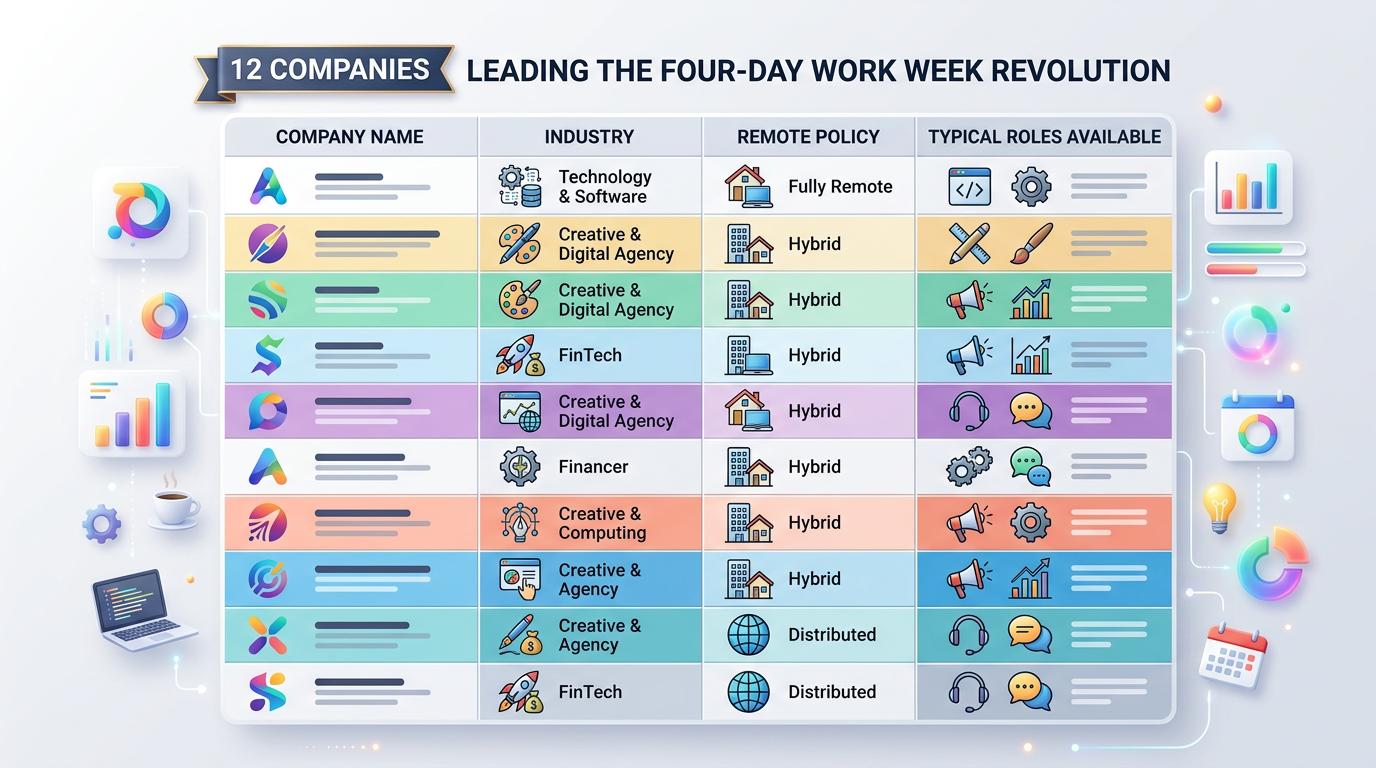
Comparison table showing 12 companies with four-day work weeks, including company name, industry, remote policy, and typical roles available
Comparison of Top 4 Day Work Week Companies
| Company | Industry | Remote Policy | Schedule Type | Typical Roles |
|---|---|---|---|---|
| Bolt | Fintech | Fully Remote | 32-hour week | Engineering, Product, Support |
| Buffer | SaaS/Marketing | Fully Remote | 4-day week | Marketing, Engineering, Customer Success |
| Kickstarter | Tech/Crowdfunding | Hybrid/Remote | 32-hour week | Product, Design, Community |
| Panasonic (divisions) | Technology | Varies by role | 4-day option | Engineering, Sales, Operations |
| ThredUp | E-commerce | Remote-first | 4-day week | Operations, Marketing, Tech |
| Wildbit | SaaS | Fully Remote | 32-hour week | Engineering, Support, Product |
| Elephant Ventures | Venture Capital | Fully Remote | 4-day week | Investment, Operations, Analysis |
| MRL Consulting Group | Consulting | Remote options | 4-day week | Consulting, Project Management |
| Nectafy | Marketing | Fully Remote | 32-hour week | Content, SEO, Strategy |
| GooseChase | EdTech/Events | Fully Remote | 4-day week | Sales, Support, Development |
| Basecamp | SaaS/Productivity | Fully Remote | Summer 4-day | Engineering, Design, Support |
| Atom Bank | Financial Services | Hybrid | 34-hour week | Banking, Tech, Operations |
Understanding the 4 Day Work Week Model
Before diving into specific companies, it's essential to understand what a four-day work week actually means. Not all four-day schedules are created equal, and the implementation varies significantly across organizations.
The 100-80-100 Model
The most common framework is the 100-80-100 principle: 100% of the pay for 80% of the time, with a commitment to 100% productivity. Employees work 32 hours across four days instead of 40 hours across five days. This isn't about cramming 40 hours into four days—it's about eliminating inefficiencies and focusing on output rather than input.
Companies adopting this model typically restructure meetings, reduce interruptions, and implement asynchronous communication practices. The result is more focused work time and better outcomes in fewer hours.
Alternative Schedule Variations
Some companies offer different approaches to the four-day concept:
- Compressed schedules: 40 hours condensed into four 10-hour days
- Seasonal schedules: Four-day weeks during specific periods (often summer months)
- Flexible Fridays: Optional fifth day for meetings or catch-up work
- 9/80 schedules: Nine-day fortnight with alternating Fridays off
For remote workers, the pure 32-hour model tends to be most beneficial, as it provides genuine work-life integration without the fatigue of extended daily hours.
Why Companies Are Making the Switch
The shift to four-day work weeks isn't altruistic—it's strategic. Companies report measurable benefits including reduced turnover (often 30-50% lower), improved recruitment outcomes, maintained or increased revenue, and significantly better employee wellbeing metrics.
Remote companies particularly benefit because the four-day model addresses common remote work challenges: burnout from blurred work-life boundaries, difficulty disconnecting, and the pressure to be always available across time zones.

Infographic showing the 100-80-100 model with visual breakdown of hours, pay, and productivity expectations
1. Bolt
Bolt, the financial technology company, implemented a permanent four-day work week in 2022 after extensive testing. The company operates on a 32-hour schedule with Fridays off, maintaining full salaries and benefits for all employees.
Bolt's approach focuses on eliminating low-value work and maximizing focused time. The company reduced meetings by 50%, implemented no-meeting days, and established clear communication protocols for asynchronous work. With a fully remote workforce across multiple time zones, this structure allows employees to work when they're most productive.
Available remote roles typically include software engineering, product management, customer support, and operations positions. The company maintains a competitive compensation structure, with salaries aligned to major tech hubs regardless of employee location. Benefits include comprehensive health coverage, unlimited PTO (in addition to the four-day schedule), and professional development budgets.
Bolt's hiring process emphasizes self-direction and results orientation. The company looks for candidates who can thrive with autonomy and deliver outcomes without constant supervision. During interviews, they assess how candidates approach productivity and time management.
Pros
- True 32-hour work week with full compensation and benefits
- Fully remote with no geographic restrictions for most roles
- Strong focus on asynchronous communication reduces meeting overload
- Competitive tech salaries with location-independent pay bands
Cons
- Fast-paced fintech environment requires quick adaptation
- High performance expectations with reduced hours
- Limited roles available compared to larger tech companies
2. Buffer
Buffer pioneered remote work transparency and extended this philosophy to their four-day work week implementation. The social media management platform has operated on a four-day schedule since 2020, with the entire company taking Fridays off.
The company publishes detailed insights about their four-day experiment, including productivity metrics, employee satisfaction scores, and operational challenges. This transparency makes Buffer an ideal choice for remote workers who value open communication and data-driven decision making.
Buffer's remote positions span engineering, marketing, customer advocacy, and product roles. The company maintains public salary formulas, so candidates know exactly what they'll earn based on role and experience. All positions are fully remote with flexible hours within reasonable time zone overlaps.
The application process at Buffer emphasizes cultural fit and self-management skills. They use asynchronous work trials for many roles, allowing candidates to demonstrate their abilities in a realistic work environment before making hiring decisions.
Pros
- Transparent salary formulas and public sharing of four-day work week results
- Established remote-first culture with mature asynchronous practices
- Generous benefits including health coverage, retirement matching, and wellness stipends
- Strong emphasis on work-life balance and mental health
Cons
- Smaller company means fewer total job openings
- Salary formulas may be lower than some tech giants
- High visibility culture isn't ideal for those preferring privacy
3. Kickstarter
Kickstarter, the crowdfunding platform, adopted a 32-hour, four-day work week in 2022. The company implemented this change as part of a broader commitment to sustainable work practices and employee wellbeing.
As a B-Corporation, Kickstarter prioritizes social impact alongside business outcomes. Their four-day model reflects this values-driven approach, focusing on long-term sustainability rather than short-term growth at any cost. The company offers hybrid and remote positions depending on role requirements, with many positions available for fully remote work.
Typical remote openings include product design, community management, software engineering, and trust and safety roles. Kickstarter maintains competitive compensation with comprehensive benefits including health insurance, retirement contributions, and parental leave policies that exceed industry standards.
The hiring process emphasizes alignment with company values and mission. Kickstarter looks for candidates passionate about supporting creative projects and comfortable working in a collaborative, consensus-oriented environment.
Pros
- Mission-driven company with strong values alignment
- True 32-hour work week with no expectation of fifth-day work
- Excellent benefits package including generous parental leave
- Collaborative culture with emphasis on work-life integration
Cons
- Some roles require New York presence or specific time zone availability
- Consensus-driven culture can slow decision-making
- Fewer technical roles compared to pure tech companies
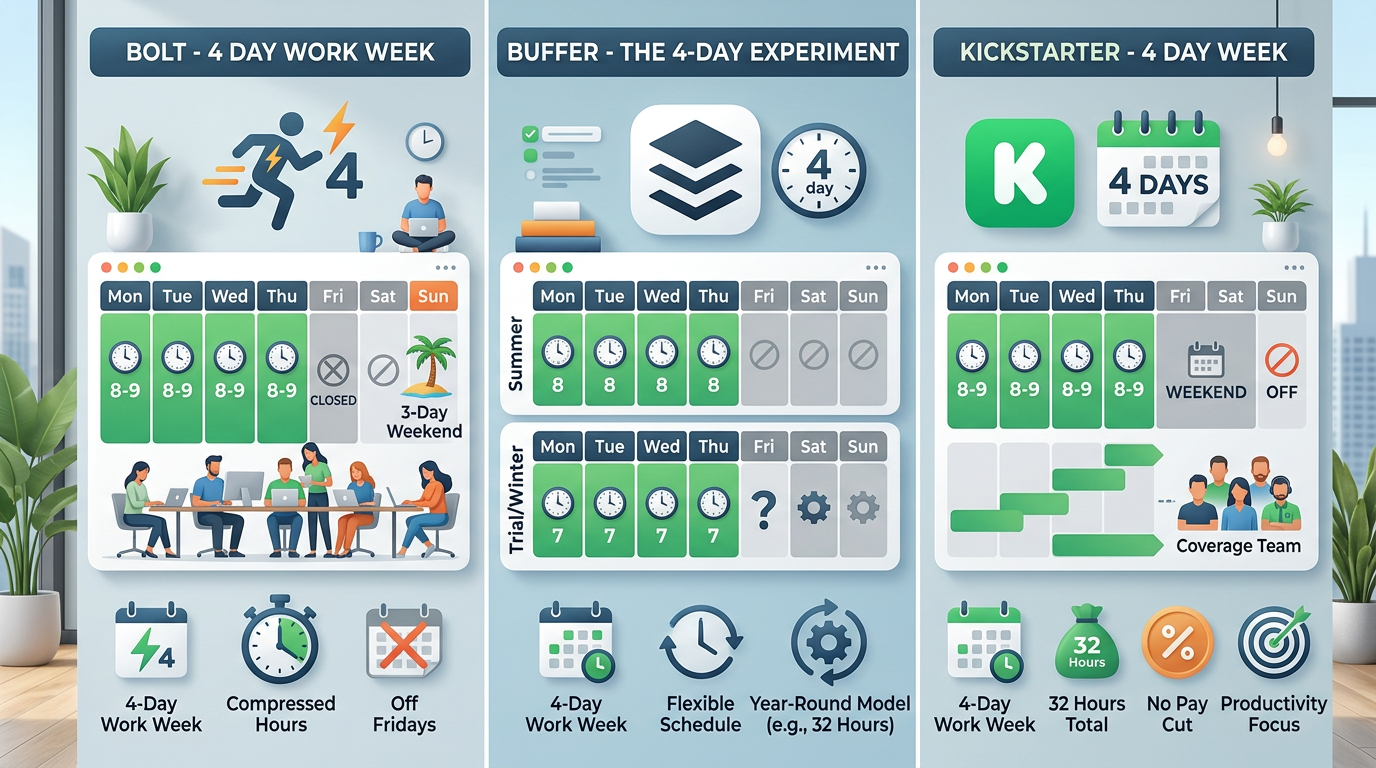
Visual comparison showing the different four-day work week models used by Bolt, Buffer, and Kickstarter with schedule breakdowns
4. Panasonic (Select Divisions)
Panasonic, the multinational electronics corporation, offers four-day work week options in specific divisions and geographic regions. While not company-wide, certain teams—particularly in Japan and select international offices—have adopted flexible four-day schedules.
Panasonic's approach is more flexible than prescriptive, allowing teams and individuals to opt into four-day arrangements based on role requirements and business needs. This makes it ideal for workers who want the option without mandatory participation.
Remote opportunities at Panasonic vary by division but often include engineering roles, sales positions, operations management, and technical support. The company's size means diverse opportunities across consumer electronics, automotive systems, and industrial solutions.
Compensation at Panasonic is competitive for the electronics industry, with benefits varying by region and division. The four-day option typically maintains full-time salary and benefits, though implementation details depend on specific team policies.
Pros
- Large company with diverse role opportunities across multiple sectors
- Established brand with strong financial stability
- Comprehensive benefits and career development programs
- Flexibility in four-day implementation based on team and individual needs
Cons
- Four-day policy not universal across all divisions or regions
- Remote work availability varies significantly by role and location
- Large company bureaucracy can slow processes
- Implementation of four-day schedule requires manager approval
5. ThredUp
ThredUp, the online consignment and thrift store, implemented a four-day work week for corporate employees in 2021. The e-commerce company focuses on sustainability in both business model and work practices.
The company operates on a remote-first model for corporate roles, with warehouse and operations positions following different schedules. ThredUp's four-day approach emphasizes outcome-based work, measuring success by results rather than hours logged.
Remote positions typically include marketing roles, software engineering, data analysis, operations management, and customer experience positions. The company offers competitive e-commerce salaries with equity compensation for many roles.
ThredUp's benefits package includes standard health coverage, 401(k) matching, and employee discounts on the platform. The four-day schedule applies to salaried corporate positions, with the company taking a collective Friday off.
Pros
- Mission-driven sustainability focus appeals to values-aligned candidates
- Remote-first culture for corporate roles with mature distributed practices
- Growing company with expansion opportunities
- Collective day off ensures no pressure to work Fridays
Cons
- Four-day schedule limited to corporate roles, not warehouse positions
- Startup-phase volatility with e-commerce market challenges
- Compensation may be lower than pure tech companies
6. Wildbit
Wildbit, the software company behind products like Postmark and DMARC Digests, has operated on a four-day, 32-hour work week since 2017. This makes them one of the earliest adopters in the tech industry.
Wildbit's extensive experience with the four-day model means they've refined their practices over years of implementation. The company is fully remote with team members across multiple countries, and they've built their entire operational structure around reduced hours.
Available roles typically include software engineering, customer success, product management, and marketing positions. As a bootstrapped company, Wildbit offers competitive but not top-tier salaries, offset by exceptional work-life balance and company culture.
The company emphasizes sustainable growth over rapid scaling, which translates to stable, low-stress work environments. Benefits include comprehensive health coverage, unlimited PTO, professional development budgets, and company retreats for the distributed team.
Pros
- Nearly a decade of four-day experience with proven operational practices
- Fully remote with no geographic restrictions
- Calm, sustainable work environment with low-stress culture
- Strong focus on work-life balance and employee wellbeing
Cons
- Smaller company with limited job openings
- Salaries below top tech company rates
- Slower growth trajectory means fewer rapid advancement opportunities

Timeline infographic showing Wildbit's nine-year journey with the four-day work week, including key milestones and outcomes
7. Elephant Ventures
Elephant Ventures, a venture capital and business development firm, operates on a four-day work week while maintaining fully remote operations. The company focuses on sustainable business practices and applies this philosophy internally.
As a venture firm, Elephant Ventures offers unique opportunities for remote workers interested in investment, business strategy, and startup ecosystem roles. The four-day schedule allows team members to pursue side projects and investments, aligning with the entrepreneurial culture.
Typical positions include investment analysts, operations managers, portfolio support roles, and strategic advisors. The company seeks candidates with startup experience or strong business acumen who can work independently.
Compensation structures often include base salary plus performance bonuses tied to fund performance. Benefits are comprehensive, though the smaller team size means less extensive perks compared to larger firms.
Pros
- Exposure to diverse startups and business models
- Entrepreneurial culture encourages side projects and learning
- Fully remote with flexible scheduling within four-day framework
- Potential for performance-based compensation upside
Cons
- Very limited job openings due to small team size
- Requires significant business experience for most roles
- Variable compensation based on fund performance
- High expectations for independent work and initiative
8. MRL Consulting Group
MRL Consulting Group, a management and leadership consulting firm, offers four-day work week arrangements for consultants and staff. The firm specializes in organizational development and practices what it preaches regarding work-life balance.
The consulting model allows for flexible remote work, with consultants working four-day schedules while maintaining client relationships and project deliverables. This proves that even client-facing roles can succeed with reduced schedules.
Available positions include management consultants, organizational development specialists, project managers, and research analysts. The firm seeks experienced professionals who can work autonomously and manage client relationships effectively.
Compensation is competitive for the consulting industry, with project-based bonuses available for many roles. Benefits include health coverage, retirement plans, and professional development support including coaching certifications and advanced training.
Pros
- Client-facing experience with four-day model proves concept viability
- Remote work with flexibility around client needs
- Professional development emphasis with training support
- Opportunity to work on organizational change projects
Cons
- Client demands may occasionally require fifth-day availability
- Consulting travel may be required for some engagements
- Project-based work can create variable workload intensity
- Requires significant consulting or organizational development experience
9. Nectafy
Nectafy, a content marketing and SEO agency, operates on a 32-hour, four-day work week for all team members. The fully remote agency has built its operations around focused, efficient work practices that maximize output in reduced hours.
The agency specializes in content strategy, SEO, and digital marketing for B2B clients. Nectafy's four-day model demonstrates that creative and strategic work can thrive with reduced hours when processes are optimized and distractions minimized.
Remote positions include content strategists, SEO specialists, writers, account managers, and project coordinators. The agency looks for self-directed professionals who can manage multiple client projects simultaneously.
Compensation is competitive for the digital marketing industry, with most positions offering full-time salaries for the 32-hour work week. Benefits include health insurance, retirement contributions, professional development budgets, and equipment stipends for home offices.
Pros
- Fully remote with no geographic restrictions
- True 32-hour work week with no expectation of Friday availability
- Focus on marketing and content skills in high demand
- Collaborative culture with emphasis on knowledge sharing
Cons
- Agency environment requires managing multiple client demands
- Smaller company with limited advancement paths
- Client deadlines may create occasional workload spikes
- Salaries may be lower than in-house marketing roles at larger companies
10. GooseChase
GooseChase, a platform for interactive scavenger hunts and experiential learning, implemented a four-day work week in 2021. The EdTech company is fully remote with team members across North America.
GooseChase's playful product mission extends to company culture, with the four-day schedule supporting employee wellbeing and creativity. The company takes a collective Friday off, ensuring no one feels pressure to work the fifth day.
Available remote roles typically include sales positions, customer success managers, software developers, and marketing specialists. The company seeks candidates who align with their mission of creating engaging experiences and who can work independently in a remote environment.
Compensation is competitive for the EdTech sector, with equity options available for many positions. Benefits include comprehensive health coverage, RRSP/401(k) matching, professional development budgets, and annual company retreats.
Pros
- Mission-driven company with engaging product and culture
- Fully remote with mature distributed work practices
- Collective Friday off eliminates any fifth-day pressure
- Growing EdTech sector with expansion opportunities
Cons
- Smaller company with fewer total job openings
- EdTech salaries may be lower than pure tech companies
- Seasonal demand fluctuations around events and education calendar

Map visualization showing geographic distribution of four-day work week companies with remote positions, highlighting global opportunities
11. Basecamp
Basecamp, the project management software company, pioneered remote work practices and implements a four-day work week during summer months (May through August). While not year-round, this seasonal approach offers extended periods of reduced schedules.
The company is fully remote with a small, focused team. Basecamp's philosophy of calm, sustainable work practices influences everything from product design to internal operations. The summer four-day schedule complements year-round policies like no overtime expectations and minimal meetings.
Remote positions at Basecamp are rare due to low turnover and small team size. When available, roles typically include software engineering, product design, customer support, and operations positions. The company seeks experienced professionals who can work with minimal supervision.
Compensation is top-tier for remote positions, with Basecamp offering San Francisco-level salaries regardless of location. Benefits include comprehensive health coverage, retirement matching, annual profit sharing, and generous vacation policies.
Pros
- Top-tier compensation with location-independent pay
- Fully remote with extensive experience in distributed work
- Calm work culture with no overtime expectations
- Profit sharing and excellent benefits package
Cons
- Four-day schedule only during summer months (May-August)
- Extremely limited job openings due to small team and low turnover
- High bar for hiring with extensive experience required
- Opinionated company culture may not suit everyone
12. Atom Bank
Atom Bank, a UK-based digital bank, implemented a 34-hour, four-day work week in 2021. While not a pure 32-hour model, the bank's approach demonstrates that financial services—traditionally resistant to flexible schedules—can adopt reduced work weeks.
Atom Bank's implementation maintains five hours of overlap across all team members on working days, ensuring collaboration while providing schedule flexibility. The bank operates with hybrid and remote options depending on role requirements.
Remote positions include software engineering, data analysis, customer service, risk management, and operations roles. The bank seeks candidates with financial services experience or strong technical skills who can work in a regulated environment.
Compensation is competitive for UK financial services, with comprehensive benefits including pension contributions, health coverage, and performance bonuses. The four-day schedule maintains full-time equivalent salaries.
Pros
- Financial services sector experience valuable for career development
- 34-hour model provides more flexibility than pure 32-hour schedules
- Stable, regulated industry with strong job security
- Competitive financial services compensation and benefits
Cons
- UK-based with limited opportunities for non-UK residents
- 34-hour week requires longer daily hours than 32-hour models
- Some roles require hybrid presence rather than full remote
- Regulated environment means less flexibility in some processes
How to Land a Remote Job at 4 Day Work Week Companies
Securing a position at these sought-after employers requires strategic approach and specific preparation. The competition is intense—these companies receive significantly more applications than traditional five-day employers.
Highlight Self-Management Skills
Four-day work week companies prioritize candidates who can deliver results with minimal supervision. Your application materials should demonstrate autonomy, time management, and results-oriented thinking. Use specific examples showing how you've maximized productivity, eliminated inefficiencies, or delivered outcomes ahead of schedule.
In interviews, discuss your personal productivity systems, how you prioritize work, and your approach to managing competing demands. Companies want assurance you'll maintain output in reduced hours.
Demonstrate Asynchronous Communication Skills
Most four-day remote companies rely heavily on asynchronous communication. Showcase your ability to communicate clearly in writing, document decisions, and work independently without constant real-time interaction.
During the application process, respond thoughtfully to written questions, provide detailed context in your communications, and demonstrate that you can move projects forward without immediate feedback.
Research Company Implementation Details
Each company implements four-day schedules differently. Before applying, research:
- Is it a 32-hour week or compressed 40 hours?
- Does the entire company take the same day off or is it flexible?
- Are there any role-specific exceptions?
- How do they handle urgent issues on off days?
- What productivity tools and practices support the model?
Asking informed questions during interviews demonstrates serious interest and helps you assess fit.
Emphasize Outcome-Based Thinking
Four-day companies measure success by results, not hours. Frame your experience in terms of outcomes achieved, problems solved, and value created—not time spent or tasks completed.
Use metrics and specific examples: "Reduced customer response time by 40% while decreasing ticket volume 25%" rather than "Answered customer emails daily."
Verify Current Openings on Job Boards
Many four-day work week companies post positions on specialized remote job boards. Platforms like remoteonly.io verify listings daily against employer ATS systems, ensuring you're applying to real, active positions rather than ghost jobs.
Set up alerts for companies known to offer four-day schedules, and apply quickly when positions open. These roles often receive applications within hours of posting.

Step-by-step visual guide showing the application process for four-day work week remote positions, from research to offer
What to Ask During Interviews
The interview is your opportunity to verify that the four-day policy matches your expectations and to assess whether the company's implementation will work for your situation.
Questions About Schedule Implementation
- Is this a 32-hour or 40-hour compressed schedule?
- Does everyone take the same day off or is it flexible?
- Are there any times of year when the five-day schedule returns?
- How do you handle urgent issues on the off day?
- What's the expectation for response time on the off day?
- How long has the company been on this schedule?
- Are there any role-specific exceptions to the four-day policy?
Questions About Productivity and Culture
- How do you measure productivity in a four-day model?
- What practices support efficiency in reduced hours?
- How many meetings does the typical team member attend weekly?
- What percentage of communication is asynchronous vs. synchronous?
- How do you prevent scope creep or workload compression?
- What happens if someone consistently needs more than 32 hours?
Questions About Compensation and Benefits
- Is compensation equivalent to five-day full-time roles?
- Are benefits the same as they would be for 40-hour positions?
- How does PTO work in addition to the four-day schedule?
- Are there any compensation adjustments related to the schedule?
These questions demonstrate thorough consideration and help you avoid surprises after accepting an offer.
The Reality of 4 Day Work Week Remote Jobs
While four-day work week positions offer significant benefits, it's important to understand the realities and potential challenges of these roles.
Higher Performance Expectations
Reduced hours don't mean reduced expectations. Most four-day companies maintain the same output goals as five-day organizations. This requires exceptional focus, efficiency, and time management.
Employees report needing to be more disciplined about eliminating distractions, declining low-value meetings, and protecting focused work time. The trade-off—an extra day off—is worth it for many, but the work days themselves can be more intense.
Not Suitable for All Roles
Some positions don't translate well to four-day schedules. Customer-facing roles requiring specific coverage, positions with external deadlines that don't align with internal schedules, and jobs with unpredictable urgent demands may struggle with reduced availability.
Before pursuing these opportunities, honestly assess whether your work style and role type fit the model. Some people thrive with compressed, focused work periods; others prefer spreading work across more days with lower daily intensity.
Company Culture Fit Is Critical
The four-day schedule is often part of a broader company culture emphasizing autonomy, results-orientation, and work-life balance. If you prefer more structure, frequent check-ins, or collaborative work environments, these companies may not be ideal despite the schedule appeal.
Research company culture thoroughly through employee reviews, social media presence, and interview conversations to ensure alignment beyond just the schedule.
Geographic and Time Zone Considerations
While many four-day companies are fully remote, some require specific time zone availability for collaboration. If the entire company takes Friday off, you need flexibility to work Monday-Thursday in company-specified hours.
International candidates should verify whether companies hire in their location and whether time zone differences create challenges for the four-day model.
Industries Leading the 4 Day Work Week Trend
Certain sectors have embraced four-day schedules more readily than others, creating more opportunities for remote workers in these fields.
Technology and Software
Tech companies lead in four-day adoption due to outcome-based work, digital-first operations, and competitive talent markets. Software engineering, product management, and technical roles are most commonly available with four-day schedules.
The tech sector's comfort with remote work and asynchronous communication makes the four-day transition smoother than in traditional industries.
Marketing and Creative Services
Marketing agencies, content companies, and creative services firms have successfully implemented four-day models. These roles often involve project-based work with clear deliverables, making outcome measurement straightforward.
Positions in content strategy, SEO, social media management, and digital marketing frequently appear in four-day company job listings.
Professional Services and Consulting
Some consulting firms and professional services companies offer four-day options, though implementation varies. These roles require strong client management skills and the ability to maintain relationships with reduced availability.
Financial Services (Emerging)
While still rare, some digital-first financial companies are experimenting with four-day schedules. These opportunities typically require specific financial services experience and comfort working in regulated environments.
Which Is Best For You?
Choosing the right four-day work week company depends on your priorities, experience level, and work style preferences.
For Maximum Stability: Panasonic or Atom Bank
If you prioritize job security and established companies, the larger organizations offer more stability. These companies have proven business models and financial strength, though four-day implementation may be less comprehensive.
For True Remote Flexibility: Bolt, Buffer, or Wildbit
If location independence and mature remote practices matter most, the fully remote tech companies provide the most flexibility. These organizations have built their operations around distributed work with no geographic restrictions.
For Mission-Driven Work: Kickstarter, ThredUp, or GooseChase
If you want work that aligns with personal values, the mission-driven companies offer purpose beyond paychecks. These organizations prioritize social impact, sustainability, or education alongside business outcomes.
For Creative and Marketing Roles: Nectafy or Buffer
If you're in marketing, content, or creative fields, the agencies and marketing-focused companies provide the most relevant opportunities. These roles offer skill development in high-demand areas.
For Entrepreneurial Experience: Elephant Ventures or Wildbit
If you want exposure to startups and business strategy, the venture-focused or bootstrapped companies provide entrepreneurial environments. These roles suit those interested in business building beyond their specific function.
For Highest Compensation: Basecamp or Bolt
If maximizing salary is the priority, the companies offering location-independent top-tier compensation provide the best financial outcomes. Competition for these positions is intense, requiring significant experience.
Ultimately, the best choice depends on your unique situation. Consider not just the four-day schedule, but the entire package: company culture, growth opportunities, compensation, role type, and long-term career implications.
Frequently Asked Questions
Is the US considering 4 day work weeks?
The US has no federal legislation mandating four-day work weeks, but individual companies are adopting them voluntarily. Several pilot programs across American companies show positive results, and some states are exploring supportive policies. The trend is employer-driven rather than government-mandated, with over 200 US companies now offering reduced schedules.
What jobs do you work 4 days a week?
Software engineering, marketing, customer success, product management, and consulting roles commonly offer four-day schedules at progressive companies. Remote positions in tech, creative services, and professional services sectors have the highest availability. Many roles require outcome-based work rather than time-based coverage, making them suitable for compressed schedules.
Do 4 day work week companies pay full-time salaries?
Most four-day work week companies maintain full-time salaries and benefits for 32-hour schedules. The 100-80-100 model provides 100% of pay for 80% of time with 100% productivity expectations. Some compressed schedules work 40 hours across four days, while others reduce total hours with maintained compensation.
How do I find remote jobs with 4 day work weeks?
Use specialized remote job boards like remoteonly.io that verify listings daily and allow filtering by work schedule. Research companies known for four-day policies and set up alerts for their openings. Join remote work communities where members share four-day opportunities, and directly check career pages of companies listed in four-day work week directories.
What is the best paying lazy job?
Four-day work week positions aren't lazy jobs—they require high productivity in reduced hours. However, remote roles with flexible schedules and outcome-based measurement include software engineering, technical writing, and data analysis. These positions offer strong compensation with autonomy over when and how work gets done, provided results are delivered.
Are 4 day work weeks becoming more common?
Four-day work weeks are growing but remain a small percentage of total jobs. Over 200 companies globally have adopted permanent four-day schedules as of 2026, with pilots expanding across multiple countries. Remote-first companies lead adoption, and successful trials are encouraging more organizations to experiment with reduced schedules.
What are the downsides of 4 day work weeks?
Four-day schedules require intense focus and discipline during work days, with higher productivity expectations than traditional schedules. Some roles don't translate well to reduced availability, and workload compression can increase daily stress. Limited availability for urgent issues and potential misalignment with five-day clients or partners create additional challenges.

Decision tree flowchart helping readers choose which four-day work week company best matches their priorities, experience level, and work style
Conclusion
4 day work week companies represent a significant shift in how we approach work, particularly in remote environments. The 12 companies detailed here demonstrate that reduced schedules can succeed across industries, from tech startups to established financial institutions. With over 200 organizations now offering permanent four-day arrangements, remote job seekers have growing opportunities to find positions that prioritize both productivity and wellbeing.
Success in these roles requires self-management, outcome-focused thinking, and comfort with asynchronous communication. The trade-off—an extra day each week for personal priorities while maintaining full-time compensation—appeals to professionals willing to work with exceptional focus during their four work days. As more companies experiment with reduced schedules and report positive results, the availability of these positions will likely continue expanding.
Check verified remote job boards daily for new four-day work week openings, as these positions attract significant competition and fill quickly.